
Unbiased headlines. Facts, not spin.
Every story is an unbiased news briefing written from 110+ sources across the spectrum — sources linked so you can verify it yourself.
 tech
Notable (5/10)
June 16, 2026 at 11:34 AM
tech
Notable (5/10)
June 16, 2026 at 11:34 AM
Global Trust in News Falls to 37 Percent, Lowest Since Reuters Institute Tracking Began in 2015
The Numbers
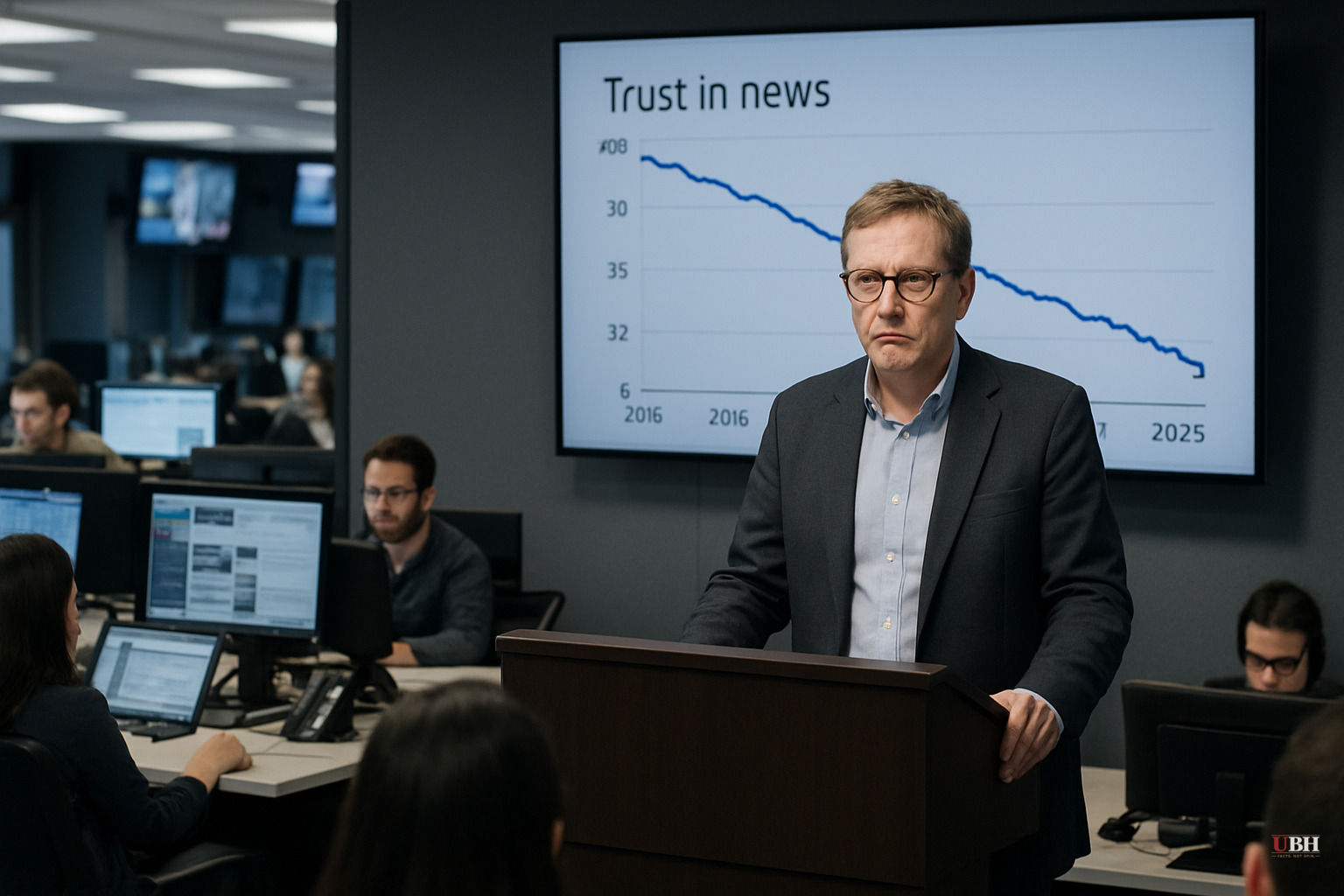
The Reuters Institute for the Study of Journalism at Oxford published its Digital News Report 2026 on Tuesday, June 16. The headline finding: global trust in news is at 37%, down three points from 2025 and the lowest in the report's history, which dates to 2015.
The U.S. is worse than the global average. According to the Reuters Institute, only 25% of Americans say they trust the news most of the time. One in four. The decline is significant.
The UK dropped five points to 30%, which is 20 points below where it stood a decade ago. A straight-line decline over ten years.
Where People Are Getting News Instead
For the first time since the Reuters Institute began tracking, platforms—social media, video networks, and similar third-party services—are more popular globally as news sources than TV or news websites and apps combined. The Reuters Institute flagged that shift specifically in the report.
BBC News reported that more than half of respondents now get news primarily from third-party platforms. Traditional sources remain more popular in the UK specifically, but the global trend is unmistakable.
Confidence in social media as a news source sits at 22%, five points below already-low overall trust in news. People are migrating toward a source they trust even less.
AI Chatbots: Growing Use, Low Confidence
The report also tracked AI chatbots as a news source. Faith in AI chatbot answers sits at 20% globally. Weekly use of AI for news grew from 7% to 10% year-over-year, and among people under 35, that figure reaches 16%, according to the Reuters Institute.
South Korea stands out as an outlier: the report notes it has a relatively higher proportion of users who say they always or often click through to the original source when an AI chatbot provides a news answer—8% do that consistently. Everywhere else, most people appear to accept AI-generated summaries without tracing them back.
Influencers and independent creators are part of the conversation, but they haven't taken over. Only 10% of respondents said most of their news needs were met by creators and influencers, per the BBC's reporting on the study. They're supplementing traditional media, not replacing it.
Why Trust Is Falling
The Reuters Institute didn't dance around the explanation. The report states directly that audiences show "anxiety, disengagement, and cynicism," driven in part by dissatisfaction with how publishers are covering long-running stories including immigration, inflation, and international conflict.
That's a significant admission from a research institution that leans toward defending professional journalism. The problem isn't just misinformation from rogue sources. Audiences are actively rejecting how established outlets are framing the biggest stories of the decade.
The strongest counter-argument from the industry's defenders deserves a fair hearing: professional journalism, whatever its flaws, maintains editorial standards, employs fact-checkers, and operates under legal and reputational accountability that social media creators and AI systems simply don't face. A 37% trust rating in journalism is still higher than the 22% trust rating in social media news, and the Reuters Institute notes that "support for impartial news remains high" despite the broader decline. Audiences haven't stopped wanting good journalism; they've stopped believing they're getting it.
Demand exists. The supply problem is real, but it's not irreversible.
What's Missing From the Coverage
BBC News's write-up of the report was accurate on the numbers but framed the AI and influencer findings largely as curiosities rather than structural threats to the news business model. The Reuters Institute's own executive summary is harder-edged: platforms now structurally outrank legacy outlets as news delivery mechanisms, which has direct implications for advertising revenue, audience reach, and the long-term viability of newsrooms that depend on both.
The report covers 48 markets. Countries with the highest online news video consumption—Thailand, Indonesia, Peru, and South Africa, all over 80%—are markets where platform-first consumption is already the norm, not an emerging trend. The Western media industry is watching a future that's already arrived elsewhere.
The Open Question
The Reuters Institute report notes openness to "new sources and formats" as a potential positive signal. What it doesn't answer is whether any existing news organization, or any new one, has found a format that actually rebuilds trust at scale, rather than just capturing a smaller, more loyal slice of a shrinking audience. That's the question the 2027 report will need to address.
Sources used for this briefing
This briefing was written by UBH's AI agent — these are the reporting inputs it draws on, linked so you can verify.


