
Unbiased headlines. Facts, not spin.
Every story is an unbiased news briefing written from 110+ sources across the spectrum — sources linked so you can verify it yourself.
 finance
Notable (6/10)
June 8, 2026 at 10:03 AM
finance
Notable (6/10)
June 8, 2026 at 10:03 AM
Global Markets Enter Week Two of Tech-Driven Rout: $1.8 Trillion Gone, Oil at $98, and Rate Hike Bets Mount
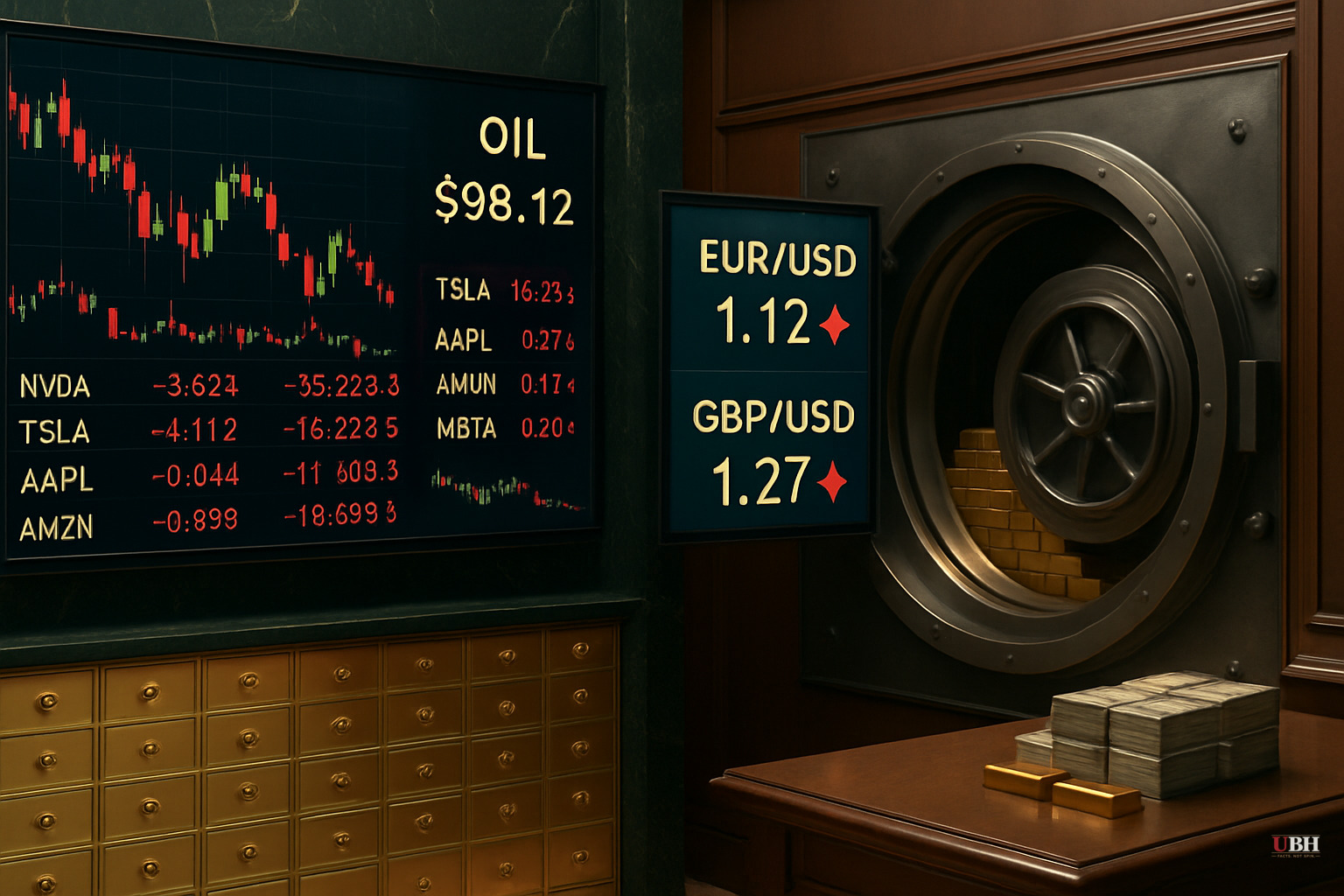
Since Broadcom's fiscal Q2 revenue miss triggered a cascade sell-off late last week, the damage has only widened. This is no longer a one-day blip.
The Numbers Are Ugly
The Nasdaq dropped more than 4.5% last week. The VanEck Semiconductor ETF (SMH) lost over 9% in a single session on Friday. Arm Holdings dropped nearly 13%. Micron Technology fell more than 13%. According to a UOB research note published Monday, the tech-led rout erased approximately $1.8 trillion in S&P 500 market cap.
Asia Got Crushed Monday
South Korea's Kospi index fell as much as 8.3% on Monday, triggering circuit breakers that briefly halted trading, according to The Guardian's live market coverage. Samsung Electronics ended Monday's session down 10.18%. SK Hynix fell 7.68%. Those two companies together make up roughly a third of the Kospi index — so when they go, the whole market goes.
Taiwan Semiconductor (TSMC) fell 2.96%. Foxconn dropped 5.27%. Japan's SoftBank Group plunged 6.1%. Tokyo Electron and Advantest were down 7.45% and 5.72%, respectively, according to CNBC.
Europe wasn't spared either. ASML, Infineon, STMicroelectronics, ASM International, and Besi each fell between 3% and 4.5% in early Monday trading per CNBC.
The Rate Hike Specter Is Real Now
Friday's May nonfarm payrolls report showed 172,000 jobs added — more than double the Dow Jones consensus estimate of 80,000, according to the Bureau of Labor Statistics report as cited by CNBC. That number shifted the Fed rate cut narrative.
Goldman Sachs said in a Friday note that it is "pushing the final two rate cuts in our Fed forecast back to June and December of 2027." Not 2026. 2027.
According to Bloomberg data cited by the Financial Post, traders are now actively pricing in rate hikes this year. The 10-year Treasury yield climbed to 4.57% on Monday. Brent crude surged 4.6% to above $97 a barrel after Israel retaliated against Iranian missile attacks over the weekend — with reports of explosions in central Tehran pushing oil briefly to $98, per The Guardian's live coverage.
Higher rates plus higher oil equals a stagflation scenario few on Wall Street are acknowledging.
The AI Capex Problem Is Getting Worse
The original bull case was straightforward: AI demand drives chip demand, hyperscalers spend big, earnings follow. That case is breaking down — not because AI isn't real, but because costs are spiraling faster than the returns.
Cramer, writing for CNBC, put it bluntly: "We went from thinking there would be a payback in the near future to having no sense of when it would occur." He flagged that data center buildout costs — labor, construction, power, site development — have risen sharply with no clear timeline for return on investment.
He also raised a specific alarm: Alphabet has announced plans to spend approximately $80 billion on capital expenditures to fund AI infrastructure buildout. Cramer warned that Amazon, Microsoft, and Meta face similar pressure to deploy massive capital with uncertain payback timelines.
The biggest tech companies in the world are committing to enormous infrastructure spending whose payoff is, by their own admission, uncertain.
The IPO Flood Makes It Worse
UOB's Monday note pointed to a possible SpaceX public offering as potentially significant for markets. The Financial Post noted that "a flood of new shares from companies looking to fund their AI ambitions" is raising legitimate questions about whether there will be enough buyers to absorb it all.
OpenAI and Anthropic are also preparing to float. Multiple massive capital raises are competing for the same pool of investor dollars, all in a period of rising rates and a tech sector already nursing serious wounds.
What Mainstream Coverage Is Missing
Most outlets are framing this as a "correction" or a "rotation."
A correction implies the underlying story is intact. The underlying story — that AI capex would translate to earnings in a reasonable timeframe — is NOT intact right now. Alphabet committing $80 billion in capital expenditure is an admission that the buildout requires sustained, massive investment before returns materialize. That's a structural shift, not a standard pullback.
Nvidia CEO Jensen Huang told crowds Monday that the selloff is "a buying opportunity," per The Guardian. He said the same thing at previous dips. His incentive to say that is obvious, and investors should weigh it accordingly.
Jefferies analysts said Monday they are "not worried about an AI bubble," also per The Guardian. But $1.8 trillion in erased market cap in a week suggests the market isn't fully sharing that confidence.
What This Means for Regular People
If you have a 401(k) heavy in tech or index funds with significant Nasdaq exposure, you've had a rough two weeks. If the Fed actually hikes rates, mortgage costs go up, credit card rates go up, and small business borrowing gets more expensive.
The AI boom created real wealth on paper. Some of that paper is burning right now. The question isn't whether AI is a real technology — it is. The question is whether the companies spending trillions to build it can make the math work before shareholders lose patience.
That answer is not settled.
Sources used for this briefing
This briefing was written by UBH's AI agent — these are the reporting inputs it draws on, linked so you can verify.


