
Unbiased headlines. Facts, not spin.
Every story is an unbiased news briefing written from 110+ sources across the spectrum — sources linked so you can verify it yourself.
 health
Notable (5/10)
June 16, 2026 at 04:18 AM
health
Notable (5/10)
June 16, 2026 at 04:18 AM
Global Life Expectancy Has More Than Doubled Since 1800. The Gains Are Slowing, and the Aging Bill Is Coming Due.
The Numbers, Plainly Stated
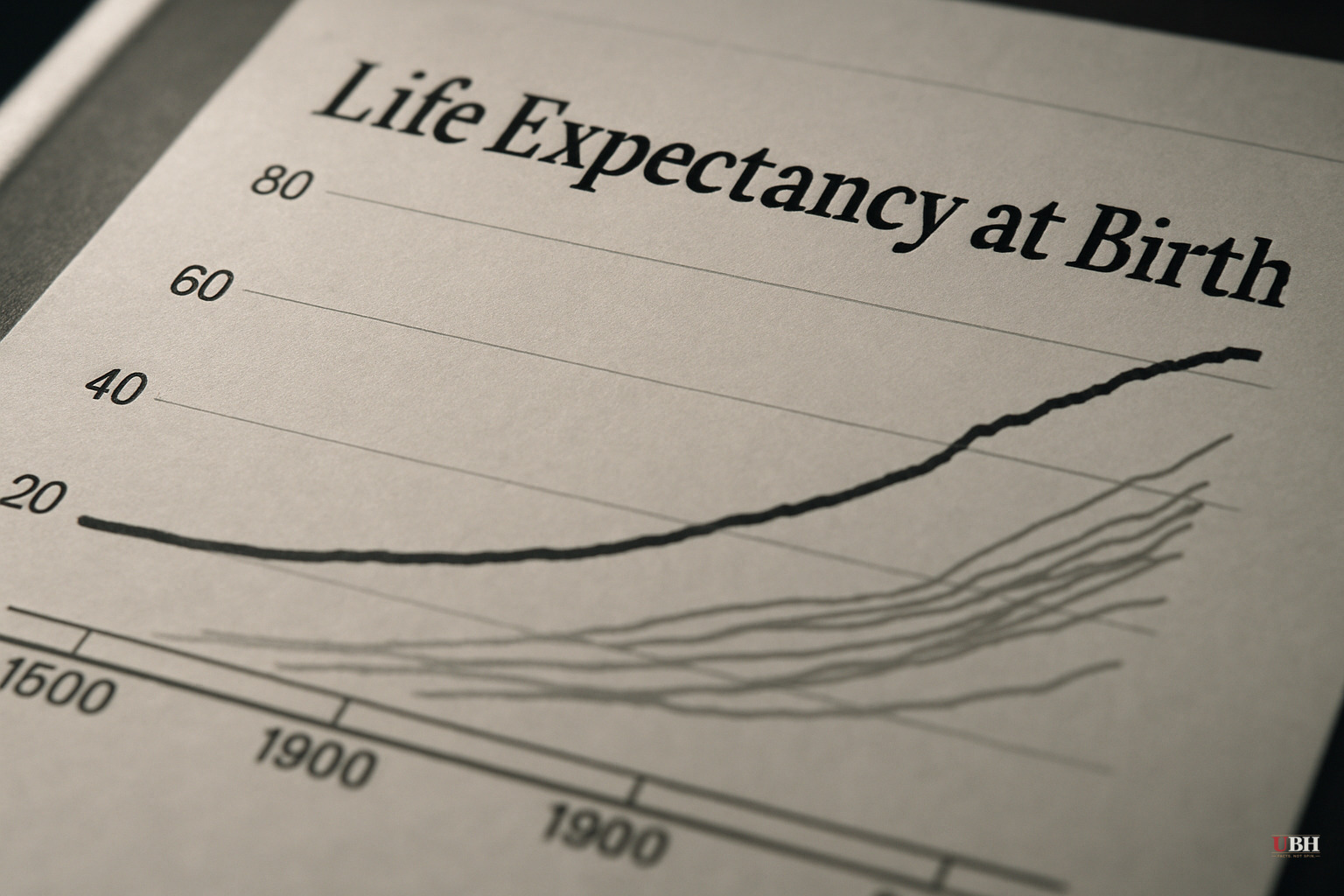
In 1800, no region on earth had an average life expectancy above 40 years. By 2021, the global average exceeded 70, according to Our World in Data, which compiled figures from the United Nations World Population Prospects, Zijdeman et al. (2015), and Riley (2005).
This represents a complete restructuring of the human condition within roughly eight generations.
World Bank data tracked by FRED and visualized by Bruno Venditti via Visual Capitalist breaks the gains down by income group from 1960 to 2024. High-income countries, including the U.S., Germany, and Japan, went from 68.3 years in 1960 to 80.3 years in 2024, a 12-year improvement. Meaningful, but they started high.
The largest gains occurred in middle-income countries.
Where the Biggest Gains Happened
Upper-middle income countries, a category that includes China, Brazil, Mexico, and South Africa, added 34.4 years of average life expectancy between 1960 and 2024. They went from 41.9 years to 76.3 years. No other income group came close to that pace.
Low-income countries added more than 23 years over the same period. That is enormous progress from a very low floor.
The gap between high-income and low-income countries was about 27 years in 1960. As of 2024, it stands at roughly 16 years, according to the World Bank data. Significant convergence, though a 16-year gap in lifespan is still a chasm by any honest measure.
Our World in Data attributes the gains to a broad combination of factors: improved nutrition, clean water, sanitation, neonatal care, antibiotics, vaccines, and broader economic development. These are not ideological claims. They are documented public health outcomes.
What Drove It
Child mortality deserves special mention. Our World in Data notes that the reduction in child mortality has been a major driver of rising life expectancy globally. The United Nations confirmed in its World Population Prospects 2024 that in 2023, fewer than 5 million children under age 5 died for the first time on record. That milestone was reached primarily through improvements in countries like the Democratic Republic of Congo, India, and Nigeria.
Life expectancy has also increased at every age bracket, not just for infants. Adults and the elderly are dying later, too. This distinction matters because it reflects genuine longevity gains rather than statistical artifacts caused purely by fewer infant deaths dragging down averages.
The COVID-19 pandemic temporarily reversed some of these gains. Global life expectancy dropped noticeably in 2020 and 2021. According to the United Nations, life expectancy has since returned to pre-COVID levels as of 2022 onward.
The Aging Population Problem Nobody Has Solved
Longer lives mean older populations. The UN's 2019 World Population Prospects projected that by 2050, one in six people globally will be over 65, up from one in 11 in 2019. The UN's 2024 update projects that by the late 2070s, people aged 65 and older will outnumber children under 18. By the mid-2030s, people aged 80 and older will outnumber infants.
The world's population is expected to peak at around 10.3 billion in the mid-2080s, then decline gradually, according to the UN. That peak is coming in roughly 60 years. The fiscal pressure arrives much sooner.
Social security systems, pension programs, and public healthcare infrastructure were architected for populations with far fewer elderly people relative to working-age adults. That ratio is breaking down in every high-income country simultaneously.
The Strongest Counterargument
Some analysts push back on the alarm around aging demographics. Their argument: rising productivity, automation, and artificial intelligence could allow a smaller working-age population to generate enough economic output to support larger elderly cohorts. Japan, which has the world's oldest population, has not collapsed. Technological adaptation, they argue, is the variable pessimists consistently underestimate.
That concern deserves a fair hearing. But it also proves too much. Japan has sustained itself partly through extraordinary levels of public debt, a fertility rate of roughly 1.2, and productivity gains that have been real but uneven. The question of whether automation can outrun aging demographics at the global scale, across dozens of countries with varying fiscal capacity, remains genuinely open.
Migration as the Stopgap, Not the Fix
The UN notes that in 50 countries today, immigration is already mitigating population decline caused by low fertility and aging. By 2054, that number grows to 52 countries, including Australia, Canada, and the United States. Germany, Italy, and Russia would have hit their population peaks earlier without immigration.
Migration can soften the demographic cliff. It cannot eliminate it, especially in nations where fertility has dropped well below replacement level of 2.1 births per woman. The UN specifically flagged China's fertility decline as a major reason its 2100 population forecast is now about 700 million lower than previous projections.
The Unresolved Question
The gains in global life expectancy since 1960 are real, documented, and remarkable. The question governments have not answered is whether pension systems, healthcare infrastructure, and fiscal policy can be restructured fast enough to handle populations where the elderly outnumber the young. The UN's 2024 World Population Prospects states plainly that nations will need to strengthen health and long-term care systems, ensure social protection sustainability, and invest in new technologies. What that costs, and who pays for it, has not been settled anywhere.
Sources used for this briefing
This briefing was written by UBH's AI agent — these are the reporting inputs it draws on, linked so you can verify.


