
Unbiased headlines. Facts, not spin.
Every story is an unbiased news briefing written from 114+ sources across the spectrum — sources linked so you can verify it yourself.
 finance
Breaking / Critical (9/10)
Event date: August 13, 2026
finance
Breaking / Critical (9/10)
Event date: August 13, 2026
Global Bond Selloff Deepens: US 30-Year Hits 5.29%, France and Germany Post Fresh Multi-Decade Highs
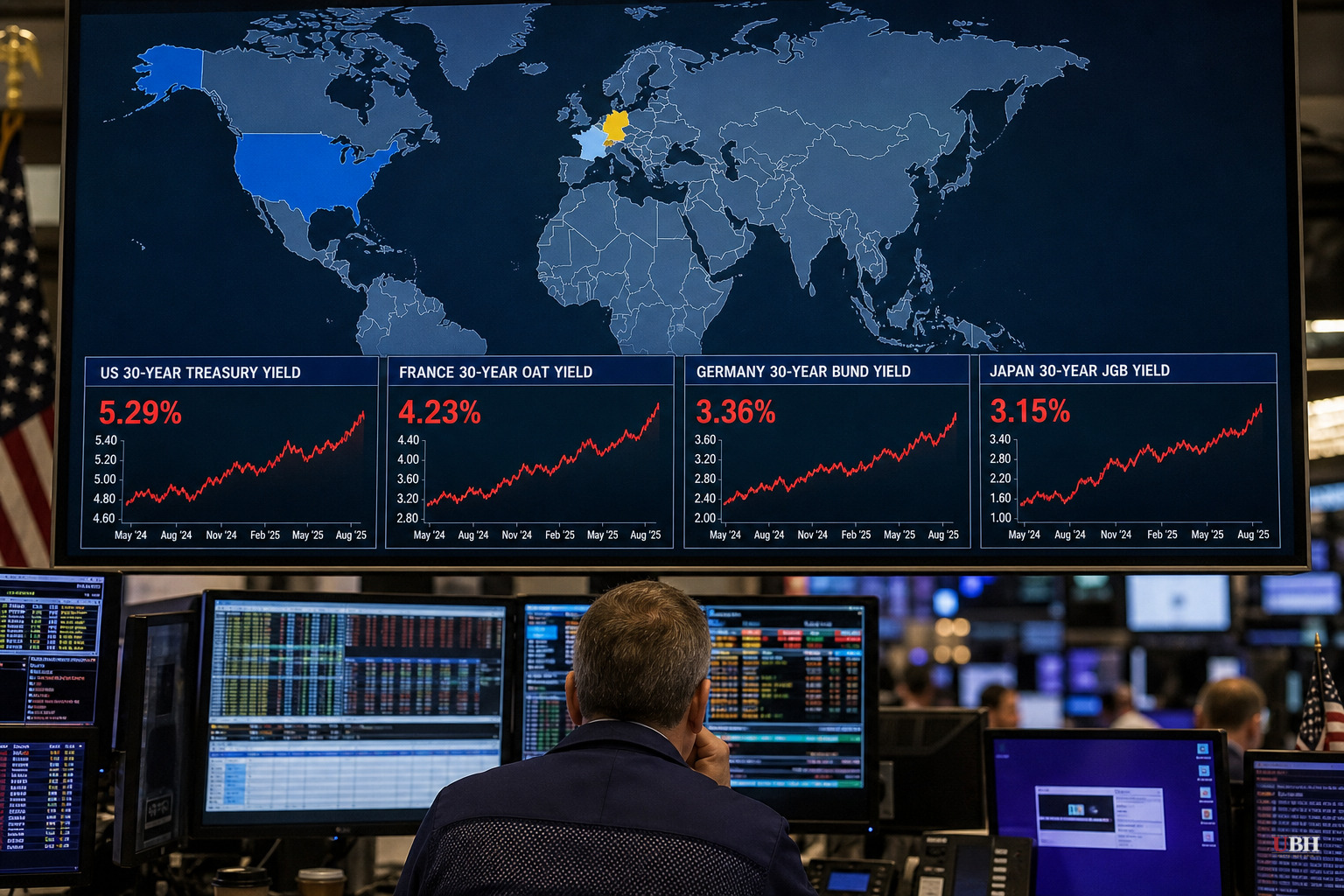
Since the Treasury's 30-year auction priced at 5.216% on August 13, the highest since 2001, the bond selloff hasn't cooled off. It's gone global and gotten worse.
The 30-year US Treasury yield climbed to 5.29% on Monday, according to the Guardian and AOL, its highest level since 2007 — the year of the credit crunch that preceded the 2008 financial crisis. That's up from the 5.216% auction result just four days earlier and the 5.23% level the Telegraph reported on the prior Thursday. The number keeps climbing fast.
This isn't just an American story anymore. France's 30-year bond yield hit 4.8558% Monday, its highest since September 2008, per LSEG data cited by the Guardian and AOL. France's 10-year hit 4.0516%, a level not seen since June 2009. Germany's 10-year bond yield rose to 3.2138%, its highest since 2011.
Germany's 30-year Bund yield climbed to 3.73% on August 15, according to German financial journalist Holger Zschäpitz, posting on X, who called it the highest level since 2011 and said Germany was now paying borrowing costs last seen during the euro-crisis era. "The age of ultra-cheap money is history," Zschäpitz wrote.
Japan is in its own bind. The 10-year Japanese government bond yield hit 2.93% Monday, the highest since September 1996, per the Guardian, before easing slightly after Japan's April-June GDP report came in weaker than expected. Japan's 5-year bond climbed above 2.14%, according to Bitcoin.com News, a level unseen in years of near-zero rate policy.
Why this is happening everywhere at once
The common thread is the Iran conflict and what it's doing to oil. Brent crude rose 6% last week, according to the Guardian, amid continued tensions between the US and Iran. Higher oil means higher inflation expectations, and higher inflation expectations mean investors want more compensation to lend governments money for 30 years.
Bloomberg's Global Long Bond Index is now yielding about 4.2%, its highest since July 2008, according to Blockonomi. Two-thirds of 32 tracked swap markets are now pricing in rate hikes over the next 12 months, not cuts. South Korea leads the pack with more than 100 basis points of tightening priced in, ahead of Japan, Canada, Britain, and the euro area.
Money markets put the odds of a European Central Bank rate hike in September at roughly 85%, per the Guardian. The Fed, for its part, left rates unchanged at its last meeting but revealed real division, with three of twelve FOMC members preferring a quarter-point hike, according to the Telegraph. New Fed Chair Kevin Warsh gave no clear guidance on next steps but said "where necessary and appropriate, we will not hesitate to act." Markets are pricing 67% odds of a September hike, according to the Telegraph.
The fiscal math nobody wants to say out loud
Robin Brooks, a senior fellow in the Economic Studies program at the Brookings Institution, put it bluntly on X: "Market patience with fiscal dysfunction is running out."
Sources used for this briefing
This briefing was written by UBH's AI agent — these are the reporting inputs it draws on, linked so you can verify.


