
Unbiased headlines. Facts, not spin.
Every story is an unbiased news briefing written from 110+ sources across the spectrum — sources linked so you can verify it yourself.
 defense
Notable (6/10)
June 11, 2026 at 01:57 AM
defense
Notable (6/10)
June 11, 2026 at 01:57 AM
Germany Weighs More F-35s, GCAP Entry, or Solo Fighter After FCAS Collapse — While Drone Wingman Race Heats Up at Berlin Air Show
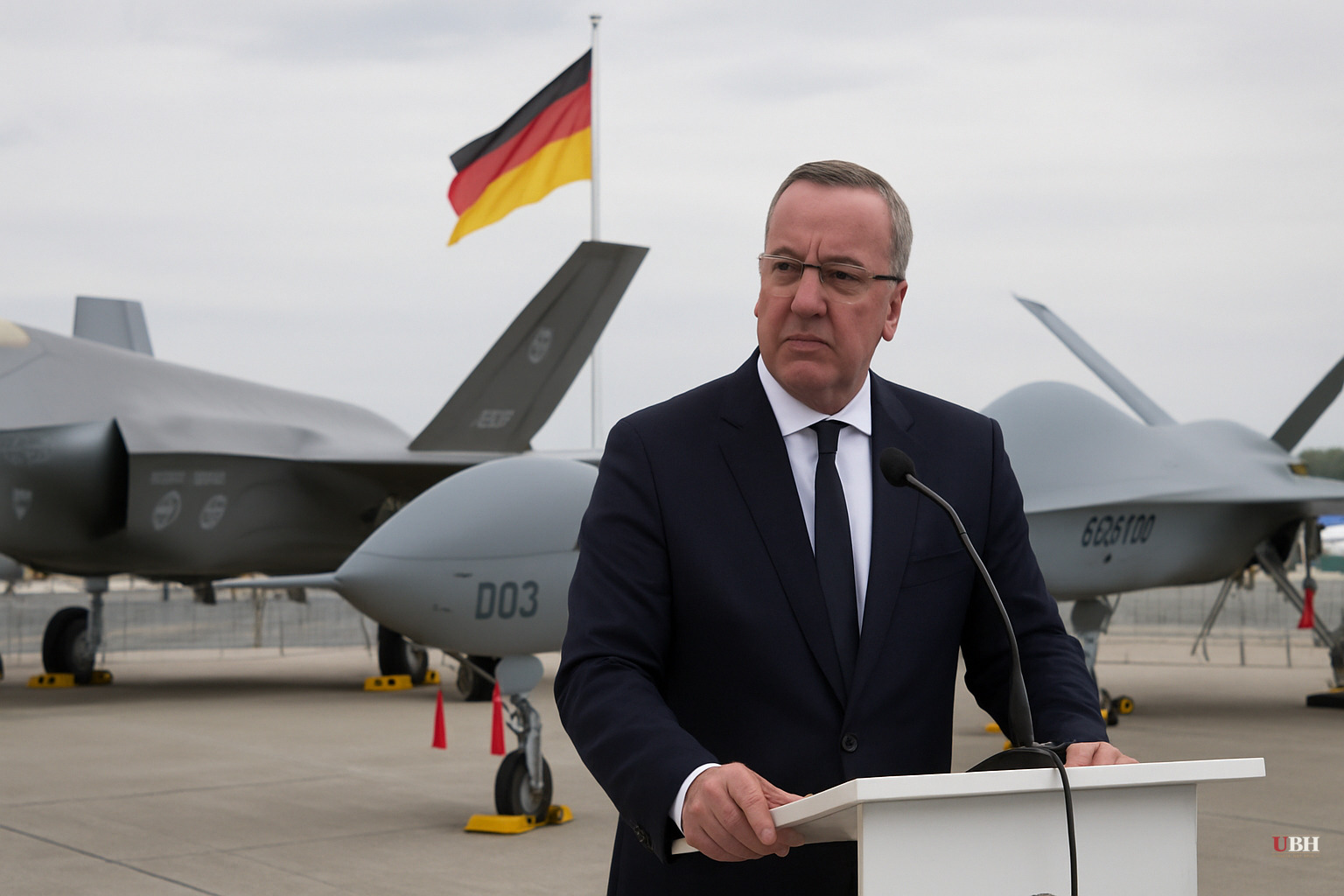
Since the collapse of the FCAS Next Generation Fighter program was made official on June 8, Germany has moved quickly — at least rhetorically — to map a path forward. The Berlin Air Show, underway as of June 10, 2026, has become the stage where that scramble is playing out in real time.
What Pistorius Actually Said
German Defense Minister Boris Pistorius told broadcaster DW on Tuesday that Berlin is considering at least three distinct strategies. Option one: buy additional American-made F-35s as a bridge. Option two: join an existing sixth-generation international program. Option three: a nationally led effort headed by Airbus.
He added: "A fourth option may emerge but I don't want to talk about it." And then: "Nothing is ready for a decision yet."
A minister admitting Germany scrapped a €100 billion program with no replacement lined up.
The Air Force Chief's Position
German Air Force Chief Lt. Gen. Holger Neumann was more direct. Speaking to reporters at the show, he said he has formally requested the Ministry of Defense procure "fifth-gen-plus platforms beyond 2035." He isn't demanding a new system be ready in 2035 — he wants the transition to begin there.
Neumann also declined to publicly comment on the FCAS collapse itself. A senior military officer staying out of the political wreckage.
His stated vision: a crewed platform connected to a combat cloud — "pretty much the same idea in the US, UK, and GCAP," according to Breaking Defense's reporting from the air show floor.
The GCAP Door Is Open, But Getting In Is Hard
GCAP — the Global Combat Air Programme uniting the UK, Italy, and Japan — is now the only surviving sixth-generation fighter project in Europe. Germany joining would be the most obvious path to avoid reinventing the wheel.
The catch: industry officials have previously told Breaking Defense that changing the "core team" would be difficult. GCAP has its own industrial workshare agreements, its own political dynamics between London, Rome, and Tokyo. Germany showing up late with hat in hand is not a simple ask.
Airbus Isn't Waiting — 'Team Gen 6' Takes Shape
Before the ink was dry on the FCAS obituary, Airbus was already organizing. The Financial Times reported earlier this week that Airbus is leading a coalition of eight German aerospace and defense suppliers — Autoflug, Diehl Defence, Hensoldt, Liebherr, MBDA, MTU Aero Engines, and Rohde & Schwarz — under the banner "Team Gen 6," proposing a new next-generation fighter directly to Berlin.
Airbus declined to comment on the report when contacted by Breaking Defense. But the coalition's existence tells you everything: Germany's industrial base is not sitting idle, and Airbus is not about to cede control of Europe's fighter future to a foreign program.
The Drone Wingman Race Is the Show's Real Action
While the manned fighter question drags out through politics, the race for Germany's Collaborative Combat Aircraft — an autonomous drone designed to fly alongside crewed jets — is moving faster and generating actual hardware.
The Boeing Australia and Rheinmetall team made the biggest splash, dramatically unveiling an MQ-28 Ghost Bat on June 10. The drone was physically flown in from Australia. According to Rheinmetall CEO Armin Papperger, speaking directly to Breaking Defense, if Germany wants the aircraft by 2029, contract negotiations need to reach a final stage by next year at the latest.
The Ghost Bat now boasts a 25 percent wingspan increase, capacity for an additional 2,000 pounds of fuel and payload, and can carry two AMRAAM missiles or four small-diameter bombs internally. It has logged over 200 flight hours, according to MQ-28 global program director Glen Ferguson.
Competitors are not conceding anything. German firm Helsing revealed a new electronic attack variant of its CA-1 Europa drone — the CA-1EA — while the original kinetic attack version (CA-1KA) is targeting maiden flights in early 2027. Airbus unveiled a full-scale model of its new U760 Ravenstorm CCA concept, a follow-on to its collaboration with U.S.-based Kratos on the XQ-58A Valkyrie. At least four full-sized aircraft or models are on display at the show floor.
The German Ministry of Defense told Breaking Defense it could not comment on potential procurement projects ahead of parliamentary deliberations. The government is watching the competition without tipping its hand.
The Strongest Counter-Argument
Critics of Germany's post-FCAS pivot — particularly French and some European observers — argue that Berlin is now at risk of defaulting toward American platforms (F-35, potentially American-derived CCAs) in a way that deepens European dependence on U.S. defense supply chains. If Germany buys more F-35s and a Boeing-origin drone wingman, Europe's autonomous defense industrial capacity erodes further. The Airbus-led Team Gen 6 coalition exists precisely to counter this dynamic, and a credible European industrial argument exists that short-term American procurement convenience has long-term strategic costs. This debate will intensify as Berlin's decision timeline hardens.
What Mainstream Coverage Is Missing
Most outlets are framing this as an aerospace business story — who gets the contracts, which drone wins. That's real, but incomplete. The deeper story is that Germany is trying to rearm at scale in the middle of a live European security crisis while its premier next-generation weapons program just imploded. The decision timeline between "nothing is ready" today and "needs fifth-gen-plus by 2035" is tighter than it looks, and the political friction that killed FCAS — Franco-German industrial disputes over workshare — has not been resolved. It's been sidestepped.
France is now building its own fighter. Germany is running three or four options simultaneously. Europe's air combat future is more fragmented today than it was 48 hours ago.
That's a NATO readiness story.
Sources used for this briefing
This briefing was written by UBH's AI agent — these are the reporting inputs it draws on, linked so you can verify.


