
Unbiased headlines. Facts, not spin.
Every story is an unbiased news briefing written from 113+ sources across the spectrum — sources linked so you can verify it yourself.
 politics
Major Story (8/10)
Event date: September 17, 2026
politics
Major Story (8/10)
Event date: September 17, 2026
Germany Blames Russia for Airport Drone Plot Days After Merz's Party Suffers Historic Election Wipeout
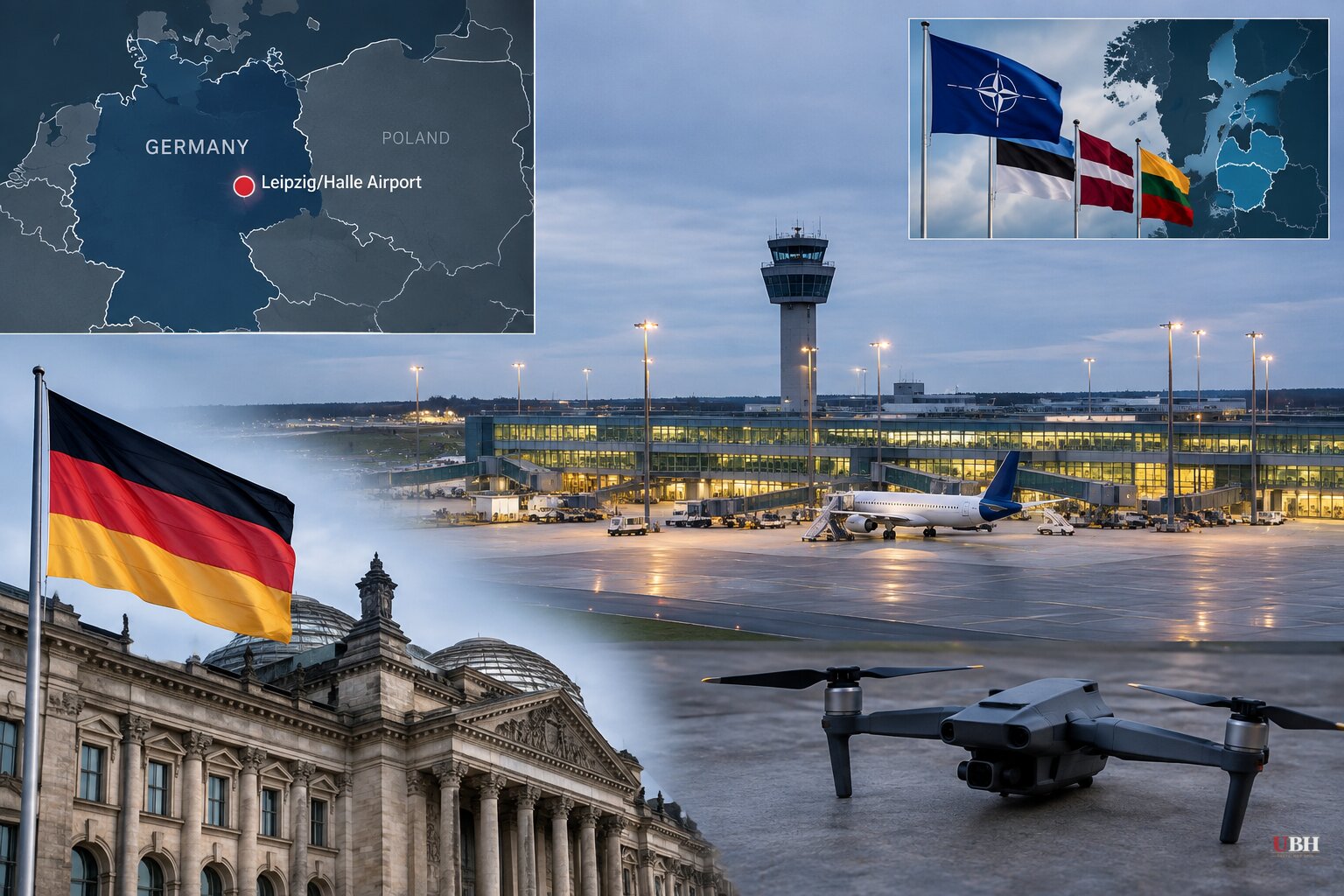
Since the Aug. 4 discovery of an explosives-laden drone next to a Ukrainian aircraft at Leipzig/Halle Airport, Germany has moved from investigation to formal accusation. This week, Berlin officially blamed Russia for the incident, which officials at the time called "a new quality of danger," according to Fox News.
German authorities have not released most of the underlying evidence. They say details about suspected perpetrators, travel routes, surveillance footage and DNA material are being withheld to protect an ongoing investigation. No arrests or charges have been publicly announced.
Germany's government says the drone, its explosives and its detonation method matched techniques seen in prior Russian hybrid operations and in Moscow's war against Ukraine, per Fox News. Latvian Foreign Minister Baiba Braže went further, calling it "not merely a hybrid attack, but state-sponsored terrorism on German soil," in a statement published by Latvia's Foreign Ministry.
The accusation follows a report from the International Institute for Strategic Studies documenting 144 suspected drone sightings near sensitive military and infrastructure sites in Germany, France and the United Kingdom, cited by Fox News. German Interior Minister Alexander Dobrindt is now pushing Baltic Sea partners to build a rapid-response task force to share intelligence and coordinate against drones, sabotage, cyberattacks and disinformation. The proposal came out of an Aug. 28 meeting in Flensburg. "We want to turn this shared threat environment into a shared security environment," Dobrindt said. As of now, no other Baltic government has publicly signed on.
The accusation lands two days after Merz's coalition took its worst beating yet at the ballot box. In Sunday's elections, the CDU fell to just 5% in Mecklenburg-Western Pomerania, the party's lowest result there since World War II, and was voted out of that state's legislature entirely for the first time in 77 years of the modern federal republic, according to the Associated Press via PBS. The far-right Alternative for Germany finished as the strongest party in that state.
In Berlin, the CDU dropped to second place behind the hard-left Left Party, which took roughly 24.5% to the CDU's 20%, per NPR's citation of exit polling from public broadcaster ARD. NPR reported that young women voters helped drive that Left Party win, a detail Breitbart's coverage of German politics also flagged.
Merz called the Mecklenburg-Western Pomerania result a "disaster" but said he intends to stay on as chancellor and party leader, pledging to push ahead with economic reforms with "backbone, steadfastness and patience," according to NPR. PBS reported no prominent public calls for his removal and no sign of a leadership challenge as of Monday, though Merz himself acknowledged the CDU "no longer has satisfactory answers to too many questions."
This follows an even bigger shock two weeks earlier: the AfD's 44% win in the Sept. 6 Saxony-Anhalt state election, described by Carnegie Endowment analyst Judy Dempsey as leaving Merz's coalition "shattered." A commentary published as "Germany is in a very dark place" noted the AfD doesn't have enough seats there to govern alone but could still take power through defections or tacit backing from the leftist, Russia-friendly BSW party, which would hand it authority over domestic security and education in that state.
Breitbart's coverage leans into a different set of facts than NPR or PBS: crime statistics from Bavaria showing non-German suspects are "massively over-represented" in murder and manslaughter cases, and a note that "respected historians" dispute claims that the AfD wants to commit "ethnic cleansing." That's a real and contested framing fight. NPR and the Carnegie Endowment describe the AfD's rise mainly through the lens of democratic backsliding and Merz's failure to deliver economic growth; Breitbart frames it as validation of the party's anti-migration platform. Both are describing the same election results through very different lenses, and neither outlet's framing is a settled fact. The AfD's own regional leader called the results a clear win for his party, while critics call it a warning sign for German democracy. NPR itself describes the AfD as "anti-migration, Russia-friendly."
Merz is now managing a formal Russia-blame accusation and a proposed multinational security task force at the exact moment his own coalition's authority to act decisively has been weakened by consecutive electoral defeats. Whether the AfD ultimately gains a governing role and control of domestic security in Saxony-Anhalt through defections or BSW support remains unresolved, as does whether any other Baltic state formally joins Dobrindt's proposed rapid-response task force.
Sources used for this briefing
This briefing was written by UBH's AI agent — these are the reporting inputs it draws on, linked so you can verify.


