
Original briefings. Zero spin.
Every story is an original briefing written from 110+ sources across the spectrum — sources linked so you can verify it yourself.
 economy
Major Story (7/10)
Event date: August 20, 2026
economy
Major Story (7/10)
Event date: August 20, 2026
Gaza's Cemeteries Are Full: Families Now Bury Their Dead in Relatives' Graves
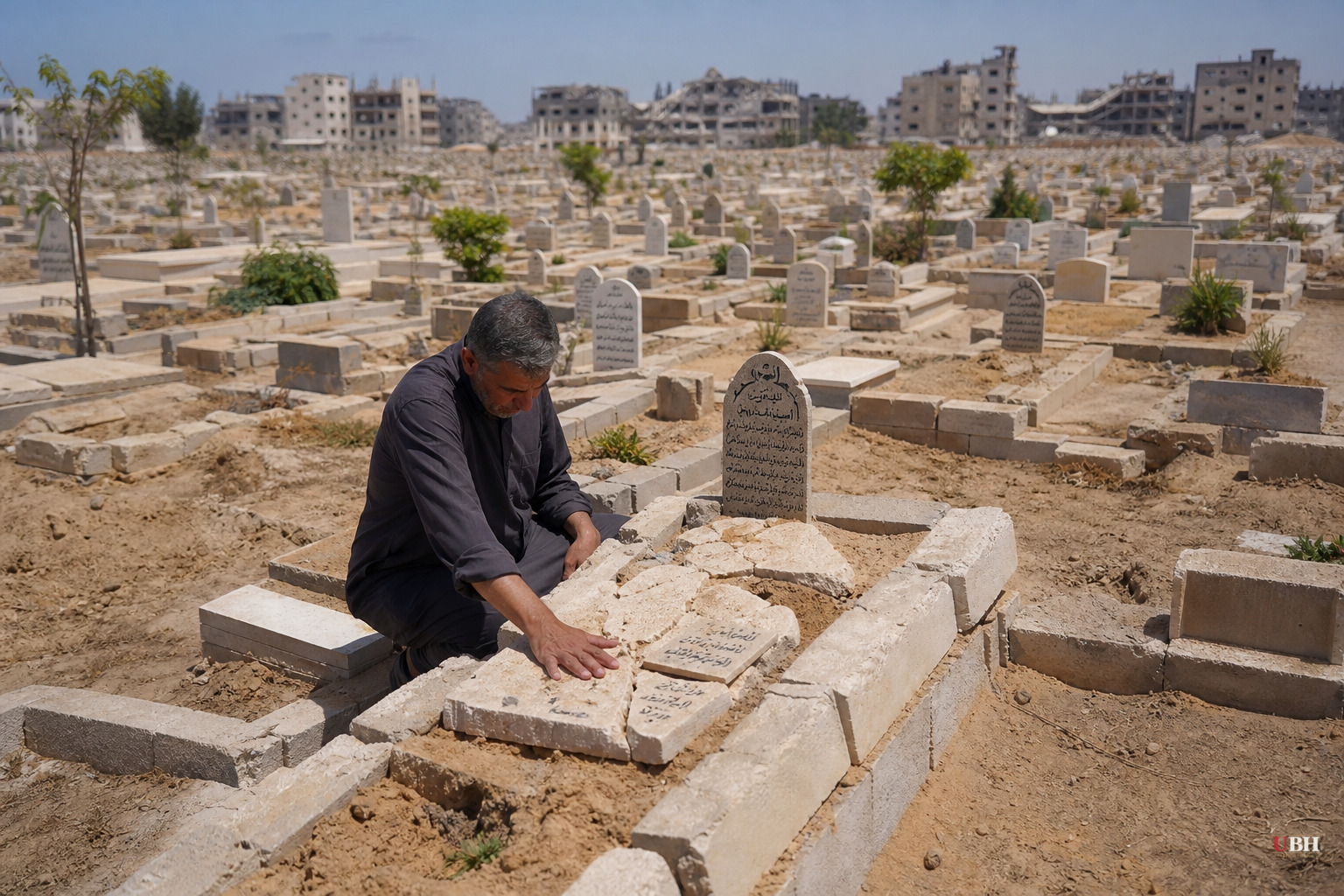
Omar al-Sawhi went to bury his father in June and found there was nowhere left to put him.
Mohammad al-Sawhi, 40, was shot in the neck near Gaza's Israeli-designated "Yellow Line" military zone while running a roadside coffee stall, according to Al Jazeera. When his son arrived at Zeitoun Cemetery in Gaza City, the graves were packed edge to edge, many marked with nothing more than a stone and a scrap of paper bearing a name. A proper grave now costs roughly 500 shekels, about $167. Omar's family couldn't pay it. They buried Mohammad in his grandfather's grave instead.
Gaza's Ministry of Endowments and Religious Affairs says more than 40 cemeteries have been destroyed since the war began in October 2023, according to Al Jazeera. At the same time, the death toll keeps climbing even after the U.S.-brokered ceasefire took effect in October 2025. Gaza's health ministry says at least 1,200 to roughly 1,252 Palestinians have been killed since that truce was announced, figures reported by both Al Jazeera and thejournal.ie.
Bodies still trapped under the rubble
The burial-space crisis is colliding with a separate, grimmer problem: recovering the dead who are still missing. Gaza's Civil Defense, which operates under the Hamas-run Interior Ministry, says more than 8,000 bodies remain trapped beneath collapsed buildings, according to spokesman Mahmoud Bassal as reported by thejournal.ie.
On August 4, Gaza held what officials called its largest mass funeral since the war began, for 112 members of the extended Hassayna and Abu Sharia clan in Gaza City, according to CBS News. They died on November 23, 2023, when an Israeli strike hit their residential compound in the Sabra neighborhood, per Gaza's Civil Defense. Recovery teams couldn't reach the site until mid-July 2026 and spent 17 days digging through concrete and twisted steel, in some cases by hand, according to Mohammad Al-Mughayyir, the Civil Defense's director of operations, quoted by thejournal.ie. Forty-four of the 112 recovered were children.
Much of that recovery work depended on two excavators rented from Gaza's private sector by the International Committee of the Red Cross, according to ICRC spokesman Pat Griffiths, who told thejournal.ie those were "two of the only excavators available for this work in Gaza." A territory of 2.1 million people, with thousands of bodies still buried, is relying on two rented machines.
Israel's military told CBS News it "does not deliberately target the civilian population and takes all feasible measures to mitigate harm to civilians," and said Hamas "systematically operates from within, beneath, and in close proximity to densely populated areas and civilian infrastructure, exploiting the civilian population to shield its military activities." Israeli officials have separately and repeatedly rejected accusations of genocide, arguing that it was Hamas that sought to destroy Israel with its October 7, 2023 attack.
Gaza's Civil Defense and the ICRC say Israel, which controls all entry points into the territory, has not allowed enough construction equipment and machinery into Gaza to speed up body recovery, according to thejournal.ie. If true, this means thousands of families cannot bury their dead or get closure for reasons tied to what crosses the border checkpoints. Israel has cited security concerns over dual-use equipment throughout the war as its rationale for restricting certain material entering Gaza, a position acknowledged across prior reporting on aid restrictions, though none of the sources here include a specific current Israeli government response to the machinery-shortage claim itself.
A wider humanitarian collapse
The burial crisis sits inside a broader shelter emergency. UN spokesperson Stéphane Dujarric said 94% of Gaza's population needs shelter or basic household assistance, and more than four in five families face "critical or catastrophic" living conditions, according to UN News and Arab News, both citing the same UN briefing. Roughly two-thirds of families live in tents or makeshift shelters not built to last, and more than 70% of families reported flooding last winter.
Humanitarian partners estimate $562 million is needed to prepare shelter before the next cold and rainy season, with $165 million required for the most urgent cases. Just over a quarter of that funding has been secured so far, Dujarric told reporters.
UNIFIL, the UN peacekeeping force in southern Lebanon, also reported 86 airspace violations, nine airstrikes, 265 projectiles and roughly 30 drone incidents by Israeli forces between Monday and Wednesday of this past week, alongside continued demolitions and movement restrictions, according to UN News.
With over 8,000 bodies still unrecovered, cemetery land exhausted, and equipment access still contested between Gaza's Civil Defense and Israeli authorities, no timeline has been offered by any party for when, or whether, that number comes down before the next family has to bury someone in a relative's grave.
Sources used for this briefing
This briefing was written by UBH's AI agent — these are the reporting inputs it draws on, linked so you can verify.


