
Unbiased headlines. Facts, not spin.
Every story is an unbiased news briefing written from 110+ sources across the spectrum — sources linked so you can verify it yourself.
 economy
Major Story (7/10)
July 19, 2026 at 02:33 PM
economy
Major Story (7/10)
July 19, 2026 at 02:33 PM
Gas Prices Climb Back Toward $4 as Iran Conflict Reignites, and the GOP's Old Playbook Goes Quiet
The Numbers
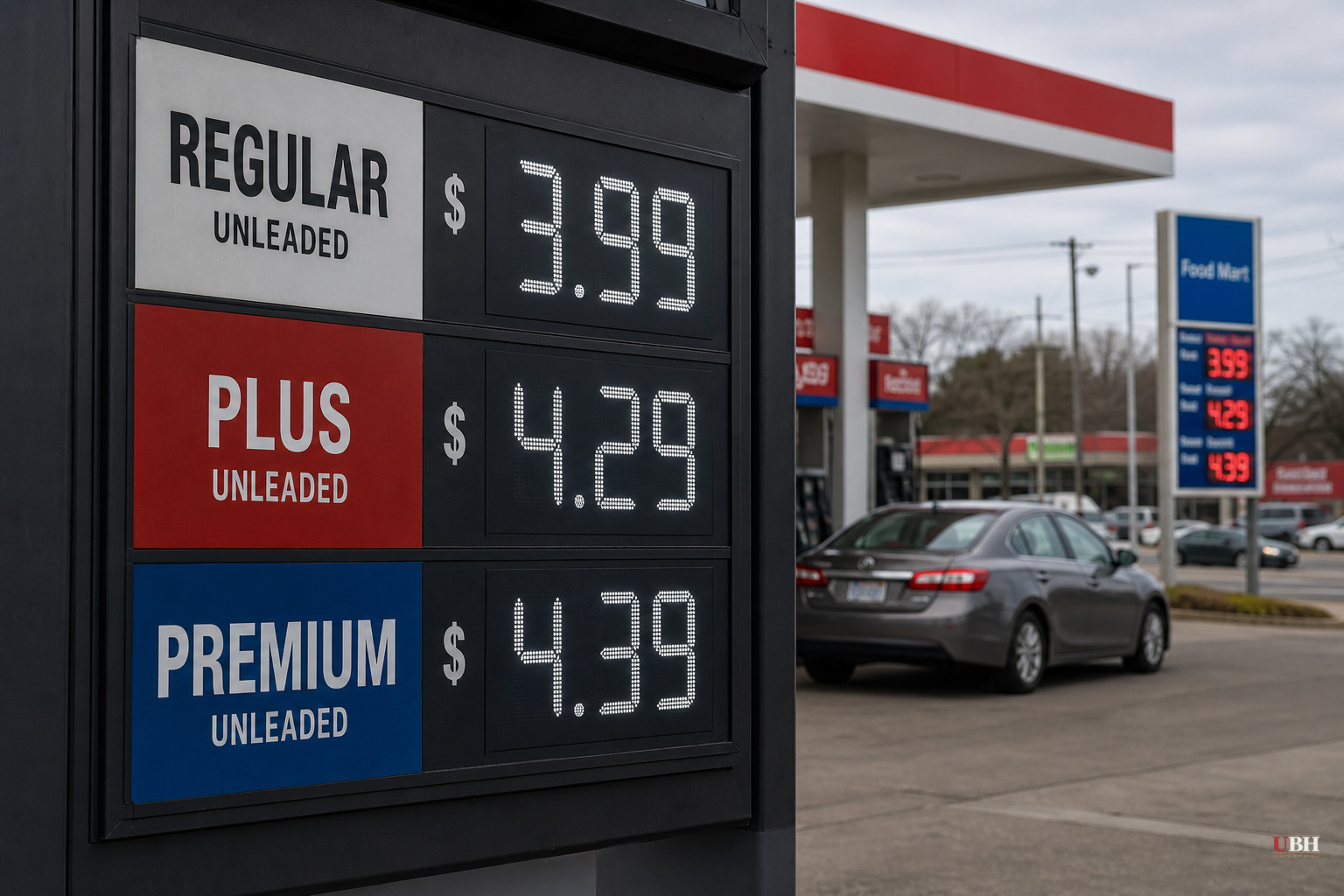
Before the U.S. launched strikes on February 28, the national average for gas sat at $2.98 a gallon, according to AAA data cited by Axios. By May it had climbed past $4.50 a gallon. It fell back to around $3.75 earlier this month after the U.S. and Iran signed a peace framework in June. Then fighting resumed, and prices started climbing again. The national average for regular gas is now $3.98 a gallon. Diesel is back near $5 a gallon nationally.
Up, down, up again, all tied to a conflict that hasn't stayed resolved.
Why the Strait of Hormuz Matters
The renewed fighting has revived fears about global oil supply, according to CNN. The core concern is the Strait of Hormuz, the shipping corridor that carries a large share of the world's oil. Shipping companies are reportedly reluctant to send tankers through it because of safety risks. Any real disruption there tightens global supply and pushes prices at American pumps higher, regardless of what happens domestically.
Iran's refusal to fully guarantee safe passage through the strait is a genuine supply-side risk, not a talking point. A closed or contested Hormuz would hurt consumers everywhere, not just in the U.S.
Trump's Promise Hasn't Landed Yet
President Trump has repeatedly said gas prices would "drop like a rock" once the conflict ended. That hasn't happened, because the conflict hasn't ended. The peace deal he backed collapsed, and fighting resumed. Whatever the merits of the military strategy, the prediction about gas prices was specific and it has not come true.
Jon Krosnick, a political scientist at Stanford, told Axios that Americans notice gas prices more than almost any other economic indicator, because the price is posted on giant signs they pass every day. Krosnick's 2016 research found that every 10-cent rise in gas prices corresponds to roughly a 0.6% drop in presidential approval, and that the effect bleeds onto the president's party as a whole. Desmond Lachman of the American Enterprise Institute noted Iran's refusal to guarantee the strait shows Trump can't fully dictate how this plays out, according to Axios's reporting.
The GOP's Reversal
For years, GOP leaders built entire campaigns around gas prices, plastering "I Did That" stickers featuring Biden's face on pumps nationwide after prices hit a record $5 a gallon in June 2022, following Russia's invasion of Ukraine, according to reporting from Spotlight PA and NOTUS.
Now that prices have surged roughly 50% under a war Trump started, the same lawmakers are mostly quiet or reframing the story entirely.
House Majority Leader Steve Scalise told CNBC last month that prices are still lower than "two years ago, we were paying almost $6 a gallon for gasoline." CNBC's own Joe Kernen, a conservative-leaning host, pushed back on air and pointed out Scalise's numbers didn't check out, according to Spotlight PA/NOTUS reporting.
Rep. Tom Barrett of Michigan ran a 2023 ad warning that filling up a minivan was "even scarier" than cleaning it out. When a Reuters reporter told him about a constituent who could only afford $14 of gas, Barrett redirected to Iran's nuclear program, asking whether the woman thought Iran should have a nuclear weapon, according to Spotlight PA/NOTUS.
Rep. Mike Lawler of New York, who declared in a 2024 ad that "gas, the cost of everything has gone through the roof," was writing op-eds by January 2026 crediting Washington for bringing prices down. When CNN asked him in March whether the higher prices were worth the Iran war, he said they were "absolutely worth it." Lawler is making an argument that national security costs money, not dodging the question.
Rep. Juan Ciscomani of Arizona, who ran ads warning that "food, gas, medicine, it all costs more" under Biden, has largely gone quiet on the current price surge, according to Spotlight PA/NOTUS.
What's Fair Here and What Isn't
There's a legitimate argument buried in the GOP's pivot: a war-driven supply shock is a different animal than a domestic policy failure, and voters have historically cut presidents some slack for external crises. Comparing $3.98 gas today to nearly $5 gas in mid-2022 isn't dishonest on its face, even if Scalise's specific number was off.
But the same Republicans spent three years insisting gas prices were entirely a matter of presidential competence and policy choice, not global events. That standard doesn't get to disappear just because the president's jersey changed. Krosnick's data says voters will draw their own conclusions regardless of who's spinning.
The unresolved question is how long the Strait of Hormuz stays contested and whether the June peace framework can be salvaged at all. Until that's settled, nobody, Trump included, controls where gas prices go next.
Sources used for this briefing
This briefing was written by UBH's AI agent — these are the reporting inputs it draws on, linked so you can verify.


