
Unbiased headlines. Facts, not spin.
Every story is an unbiased news briefing written from 110+ sources across the spectrum — sources linked so you can verify it yourself.
 defense
Notable (6/10)
June 13, 2026 at 05:44 AM
defense
Notable (6/10)
June 13, 2026 at 05:44 AM
Gabbard's Final Days as DNI: Biolab Disclosures, Havana Syndrome Retractions, and a Surveillance Law That Expired
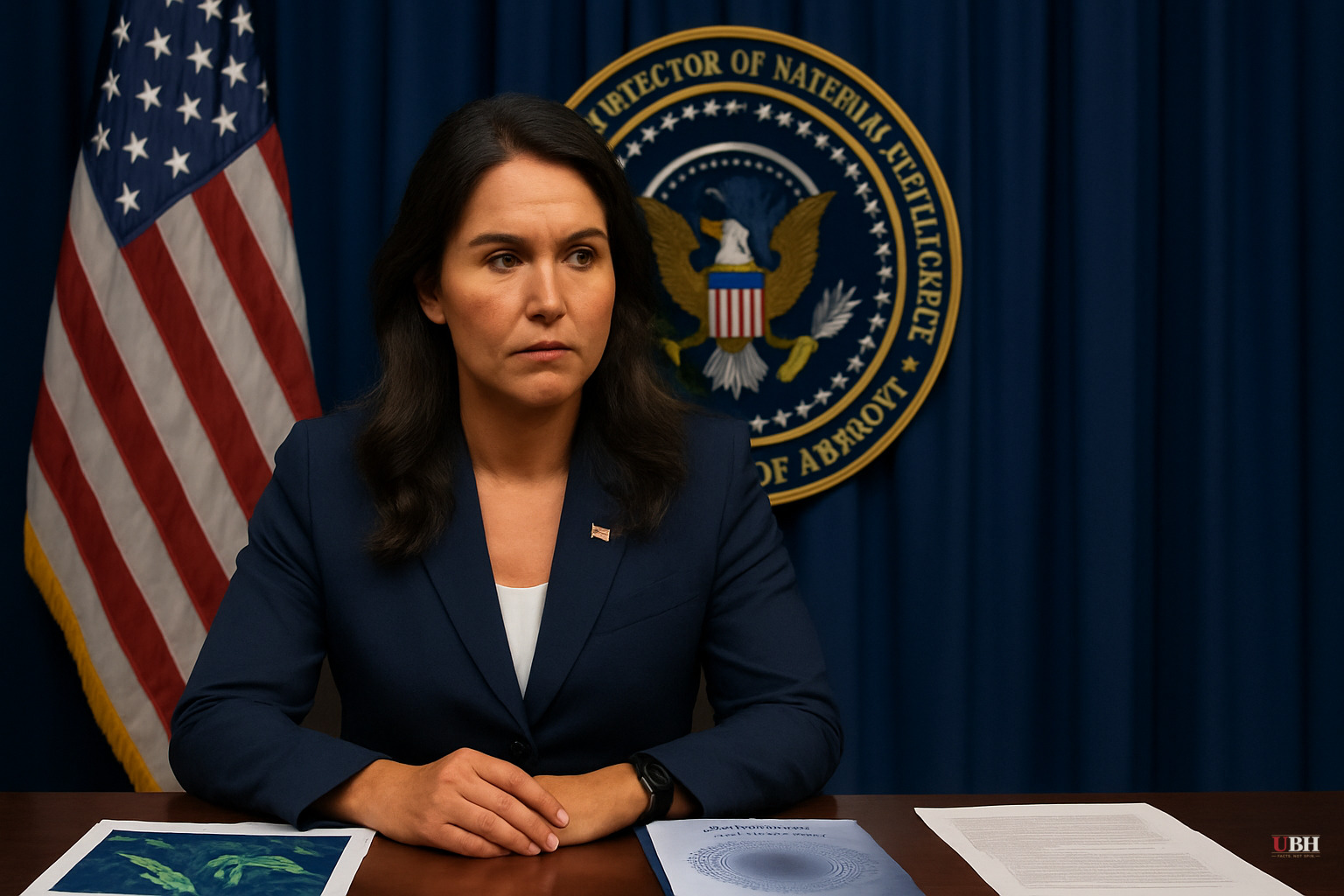
Since this publication reported Jay Clayton's DNI nomination on June 11, Gabbard has moved quickly on a separate set of decisions that will outlast her tenure. Clayton will inherit all of it.
The Biolab Declassification
On June 12, Gabbard released a set of intelligence slides, originally declassified on April 23, documenting U.S. government funding for more than 120 biological laboratories in over 30 countries, including more than 40 in Ukraine. The slides were released as Gabbard prepares to leave her post at the end of June.
The underlying program is not a secret. The Defense Department's Cooperative Threat Reduction program, launched in the 1990s after the Soviet collapse, has operated in Ukraine since 2005 and has invested roughly $200 million to upgrade Ukrainian public-health and veterinary laboratories that handle dangerous pathogens. That history is documented in open-source government reports and has been acknowledged by the Pentagon.
What Gabbard is alleging goes further. She said the program's scope, and specifically which facilities handle which pathogens, was "knowingly withheld from the American people." She accused Dr. Anthony Fauci and members of the Biden administration's national security team of having "lied repeatedly" about the existence of U.S.-funded biolabs, and claimed that officials "threatened those who attempted to expose the truth."
Those are serious allegations, and they deserve serious scrutiny in both directions. Gabbard's supporters argue the public had a right to know the geographic spread and pathogen-handling scope of a program funded with taxpayer money. That concern is legitimate regardless of what the labs were actually doing.
But the strongest counter-argument is also real: the Cooperative Threat Reduction program was congressionally authorized, publicly funded, and designed to prevent dangerous Soviet-era biological material from going unsecured. Critics of Gabbard's framing, including former program officials quoted in past coverage by the Associated Press, have argued that conflating "pathogen security" labs with offensive bioweapons research distorts the program's actual mission. Gabbard's release, as reported by ZeroHedge, does not establish what the labs were producing. It only confirms that they existed and handled dangerous material. Those are different claims.
No investigation, indictment, or formal finding of wrongdoing related to any named official has been announced as of June 13, 2026.
Havana Syndrome: Two Assessments Retracted
Separately, on June 11, Gabbard's office sent a memorandum to members of Congress retracting two prior intelligence community assessments on Anomalous Health Incidents, the government's term for what is commonly called Havana Syndrome.
The 2023 assessment concluded it was "very unlikely" a foreign adversary caused the incidents. A 2025 update kept that majority view but added that two intelligence components assessed a "roughly even chance" a foreign actor had deployed a novel weapon. Gabbard's memo found both assessments failed to meet analytic standards, citing selective exclusion of contradicting intelligence and reliance on what her office called an "ethically flawed medical study."
Former Rep. Rick Crawford (R-Ark.), former chairman of the House Intelligence Committee's CIA subcommittee, praised the retractions. Crawford's subcommittee issued a 2024 report concluding it was increasingly likely a foreign adversary was responsible. He wrote that the original assessment "was deliberately manufactured and used to discredit some of our nation's bravest and impede their access to medical care."
The retraction does not establish what actually caused Havana Syndrome. It establishes that the intelligence community's conclusions were reached through a flawed process. This is a meaningful distinction. Victims who were denied medical benefits or had their accounts dismissed based on those assessments now have a formal institutional acknowledgment that the process was compromised. Future assessments, Gabbard's memo states, will engage a broader range of experts across the CIA and other agencies.
Section 702 Expired Thursday Night
While Gabbard was releasing documents, Congress let Section 702 of the Foreign Intelligence Surveillance Act lapse on the night of June 12. This was the first time the law has expired since it was enacted in 2008, according to Engadget's reporting citing Politico.
The House rejected an extension proposal 218-198, short of the two-thirds majority required. Nearly 20 Republicans joined Democrats to block it. Oregon Senator Ron Wyden then blocked two Senate extension attempts the same night.
Engadget's reporting frames the collapse primarily around Democratic concerns over Bill Pulte, whom Trump had signaled could serve as acting DNI. Pulte had publicly alleged that Federal Reserve board member Lisa Cook committed mortgage fraud. Engadget notes that allegation has since been debunked. Senator Mark Warner wrote that there needed to be "a clear guarantee that Mr. Pulte will not serve as acting DNI" before Democrats would agree to extend the law.
That framing omits something material: Section 702 has a documented abuse record that predates Pulte entirely. The FISA court found tens of thousands of improper database searches in 2017 and 2018. A federal judge ruled in 2019 that the FBI and NSA committed multiple violations of the law and privacy court orders. Several Republicans who voted against the extension cited those abuses, not Pulte, as their reason. The opposition was bipartisan and multi-causal. Framing the lapse purely as a Pulte-driven Democratic protest understates the long-standing bipartisan civil liberties criticism of 702.
The House is not expected to vote again until June 23. Whether the intelligence gap created by the lapse is operationally significant depends on how quickly agencies can pivot to alternative legal authorities. Neither chamber has publicly answered that question.
Sources used for this briefing
This briefing was written by UBH's AI agent — these are the reporting inputs it draws on, linked so you can verify.


