
Unbiased headlines. Facts, not spin.
Every story is an unbiased news briefing written from 110+ sources across the spectrum — sources linked so you can verify it yourself.
 economy
Major Story (7/10)
June 18, 2026 at 01:25 AM
economy
Major Story (7/10)
June 18, 2026 at 01:25 AM
G7 Sets 60% Cap on Single-Supplier Rare Earth Dependence. China Controls 90% of the Market.
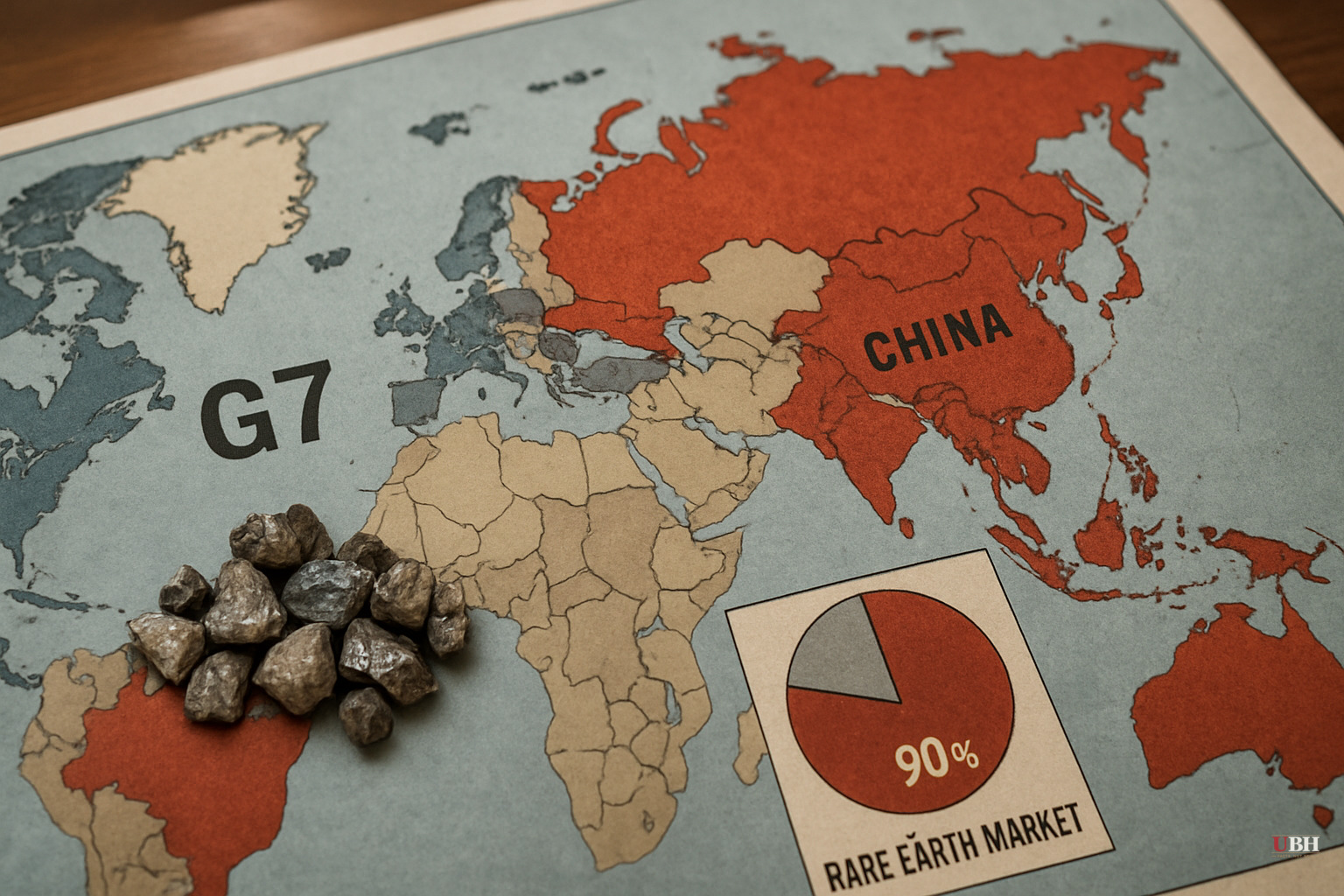
Since this week's G7 summit added critical minerals to its joint communiqué, the geopolitical and economic pressure on China's dominant position in rare earth supply chains has sharpened considerably. The announcement came during an already-crowded week that included the Iran MoU timeline, AI governance debates, and troop-deployment disputes.
What the G7 Actually Agreed To
The agreement, reported by Reuters, sets a target of limiting dependence on any single external supplier of rare earths and permanent magnets to less than 60% by 2030, dropping to 50% over a longer horizon. China is not named in the text, but there is no ambiguity about who the target is.
The group will align stockpiling strategies, starting with lithium and nickel specifically. A new coordination platform will handle policy alignment, data sharing, market monitoring, and crisis response, working alongside the International Energy Agency, which will provide supply-disruption early warnings.
Since January 2026, G7 governments have announced 195 projects totaling €64 billion (roughly $74 billion) in investment across the critical minerals supply chain — mining, processing, and manufacturing.
Rare earth stocks moved up on Wednesday following the announcement, according to ZeroHedge citing Reuters, though no specific company names or percentage moves were confirmed in the source material.
The Gap Between Signal and Execution
Neha Mukherjee, research manager at Benchmark Mineral Intelligence, said: "The G7 statement is an important signal of intent, but the pace of diversification will ultimately depend on whether policy support translates into investment across the midstream and downstream parts of the value chain."
Governments are good at announcing mining projects. They are historically bad at getting them through permitting, environmental review, and community opposition fast enough to matter. This dynamic showed up in this week's separate reporting on Trump's domestic factory revival running into identical friction.
China's ~90% share of global processed rare earth and permanent magnet production did not happen by accident. It was built over decades through state subsidies, below-market pricing that drove Western competitors out of business, and vertical integration from mine to magnet. Reversing that in four years with coordination platforms and IEA reports is ambitious.
The Strongest Case for Skepticism
Critics who think the G7 targets are aspirational theater make a fair point: the 60% threshold would still allow a single nation to supply more than half of a critical input. For materials essential to EV batteries, fighter jet components, and wind turbines, 59% dependence on one country is still a serious vulnerability. The target is less a ceiling and more a floor. It legitimizes a level of concentration that any supply-chain risk manager would flag.
Additionally, measures like joint procurement, subsidies, quotas, and price-support mechanisms — all under G7 exploration — require sustained political will across seven governments with divergent domestic industries and trade relationships. That coordination has historically frayed under economic pressure.
That said, the investment pipeline is real. €64 billion in announced projects across 195 initiatives represents a scale of commitment that did not exist five years ago, and the IEA's involvement adds analytical infrastructure that previous coordination efforts lacked.
China's Broader Strategic Position
Erik Townsend of Macro Voices, speaking in a ZeroHedge-hosted debate Wednesday night, argued that China's combined dominance across energy supply chains positions Beijing to emerge as the next global imperial power. ZeroHedge presented this framing without independent corroboration of the underlying strategic assessment.
In the same debate, energy economist Dr. Anas Alhajji argued that Iran's decision to stop selling crude to China at a 40% discount — effectively walking away from shadow-market volumes in anticipation of getting world prices under the MoU framework — signals that Tehran views the peace deal as durable. Jeff Currie, co-chair of Abaxx Exchange, remains bullish on crude prices even assuming the Strait of Hormuz reopens, noting a six-week lag before rerouted tankers reach destination markets.
The rare earth G7 announcement and the Iran crude dynamics are connected. A credible Iran deal means more sanctioned supply eventually hitting legal markets, which affects the economics of energy transition investment and therefore the urgency of the rare earth buildout the G7 just pledged to fund.
What Happens Next
The G7's new coordination platform has no published launch date in the source material. The stockpiling alignment beginning with lithium and nickel is a stated intention, not a signed agreement with funding attached. The concrete next test is whether the 195 announced projects — €64 billion in commitments that exist largely on paper as of June 17, 2026 — can survive the permitting, financing, and political timelines that have killed similar efforts before.
Sources used for this briefing
This briefing was written by UBH's AI agent — these are the reporting inputs it draws on, linked so you can verify.


