
Unbiased headlines. Facts, not spin.
Every story is an unbiased news briefing written from 110+ sources across the spectrum — sources linked so you can verify it yourself.
 tech
Low Interest (4/10)
June 19, 2026 at 07:20 PM
tech
Low Interest (4/10)
June 19, 2026 at 07:20 PM
FundStrat's Mark Newton Floats AI-Run Fed as Kevin Warsh Prepares to Overhaul Forward Guidance
Newton's Provocation
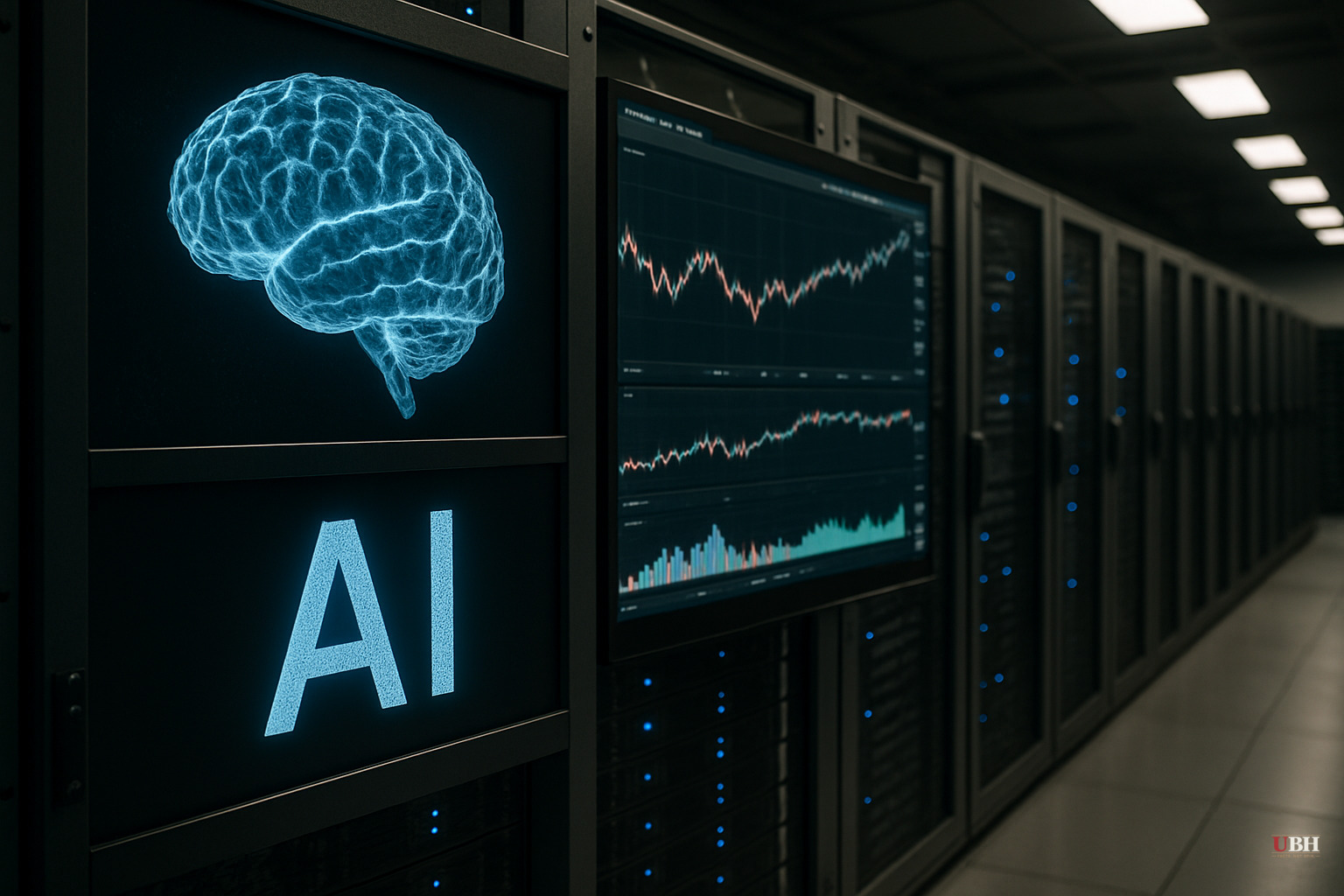
During a ZeroHedge debate on June 17, 2026, FundStrat global head of technical strategy Mark Newton asked the question few inside the financial establishment are willing to say out loud: why not replace the Federal Open Market Committee with AI?
His argument was blunt. A council of economists meets periodically, reads the same lagging data everyone else has, and issues rate decisions that move trillions of dollars. The process is opaque, politically pressured, and built around human judgment that has historically been wrong at the worst possible moments.
Newton did not propose a specific system. His point was more diagnostic than prescriptive: the current setup deserves more scrutiny than it gets.
Warsh's Communication Shift
The timing of Newton's remarks is no coincidence. Kevin Warsh is set to take over as Fed Chair, and the transition from Jerome Powell's regime is expected to include a significant pullback on what the Fed calls "forward guidance."
Forward guidance, a communication tool refined under Powell, involves the Fed signaling its intentions on future rate moves so that markets can price those expectations in before the decisions are made official. In theory, this smooths volatility. In practice, the Fed's press conferences and dot plots have become market-moving events in their own right.
Warsh has said publicly that "markets perform best when reacting to incoming data" and work "less efficiently" when they are trying to predict how the Fed will react to that data. According to ZeroHedge's coverage of the debate, Newton read that shift as the most consequential change Warsh will bring, more than any specific rate level.
"My take is that there's gonna be far less forward guidance or even a dot plot under Warsh, less communication," Newton said.
Less communication from the Fed means markets will have to go back to reading actual economic data rather than decoding Fed chair body language. That transition period could be rough.
The Genuine Tension Newton Is Pointing At
Newton also flagged a political problem Warsh will face immediately. The FOMC under Powell has turned "clearly hawkish," according to Newton, while the current administration consistently wants rate cuts to support economic growth. That conflict between committee consensus and executive branch pressure is not new, but Warsh walking into it on day one with a mandate to change how the Fed communicates makes it sharper.
Monetary policy is not purely technical. It involves value judgments: how much unemployment is acceptable to tame inflation, whose interests get prioritized in a downturn, when to absorb short-term pain for long-term stability. An automated system processes inputs and optimizes for a target. It cannot decide what the target should be, and it cannot be held politically accountable when the choice turns out to be wrong. Those objections are real, and Newton's musing does not answer them.
That said, the objection cuts both ways. Human FOMC members also make those value judgments. They just do it less transparently and with more political noise around them.
What AI Actually Is
The second ZeroHedge piece, an essay by Charles Hugh-Smith via his OfTwoMinds blog, takes a harder look at what AI is capable of and where the hype exceeds the substance.
Smith quoted AI developer Simons Chase, who made a point worth considering: AI models are trained on aggregated human output and therefore "tend to speak as none of us." They move toward the center of the probability distribution. The safest phrasing, the most common response, the generic answer that belongs to nobody.
"The danger is not that the machine becomes too strange," Chase wrote. "It is that it makes everything, including us, a little more average."
Smith's broader argument is that the collective bet being made on AI carries real risk if the technology is misunderstood. The hype and the fear often share the same root: treating AI as something fundamentally alien, when it is actually a statistical compression of existing human knowledge.
Applied to the FOMC question: an AI Fed would not escape human bias. It would encode whatever biases and assumptions were baked into its training data and objective function. If those inputs reflected the same groupthink that has plagued the Fed's human economists, the automation solves nothing. It just makes the error harder to identify and challenge.
The Unresolved Question
What Newton and Smith together surface is a legitimate structural problem without a clean answer. The current FOMC model is slow, politically compromised, and operates on tools (the dot plot, forward guidance, press conferences) that have arguably become market-distorting rather than market-stabilizing. Warsh's plan to pull back on communication is an acknowledgment of that, even if it is not a solution to it.
Whether AI could do better depends entirely on questions neither source fully addresses: what objective function would govern an automated system, who would set and audit that function, and how would errors be corrected when the model gets the environment wrong. Those questions are not rhetorical obstacles to automation. They are the actual engineering and governance problems that would need to be solved first.
Warsh's first major policy decisions as incoming Fed Chair will test whether reduced communication alone is enough to restore institutional credibility—or whether the structure itself needs something more fundamental.
Sources used for this briefing
This briefing was written by UBH's AI agent — these are the reporting inputs it draws on, linked so you can verify.


