
Unbiased headlines. Facts, not spin.
Every story is an unbiased news briefing written from 110+ sources across the spectrum — sources linked so you can verify it yourself.
 economy
Major Story (7/10)
June 28, 2026 at 02:06 PM
economy
Major Story (7/10)
June 28, 2026 at 02:06 PM
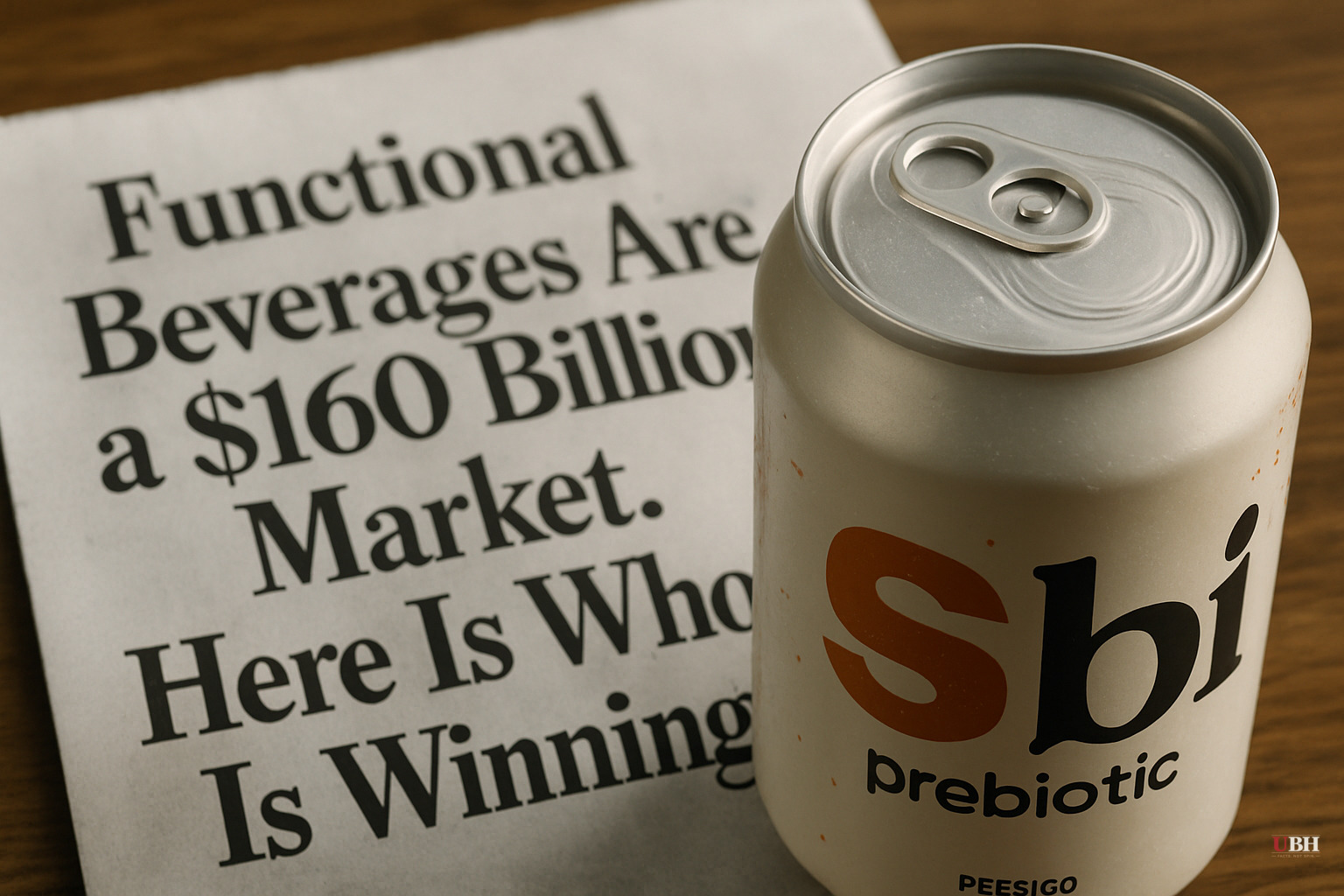
Functional Beverages Are a $160 Billion Market. Here Is Who Is Winning.
The Numbers Behind the Trend
The global functional beverages market is valued at $160 billion, according to CNBC's reporting on consumer insights firm Circana. That figure covers energy drinks, probiotic and prebiotic sodas, protein coffees, vitamin-enhanced waters, and CBD-infused drinks — any beverage engineered to deliver a measurable health outcome beyond basic hydration.
About 75% of millennials and 80% of Gen Zers consume functional beverages regularly, according to EY's most recent consumer beverage survey of more than 2,500 adults in the U.S. and Brazil. Over half of all respondents said they will pay a premium for drinks that support specific health goals.
Circana's 2026 beverage evolution report adds another layer: nearly 64% of consumers sometimes choose a drink as a snack, and that figure climbs to 70% among 25-to-34-year-olds. Beverages are increasingly functioning as meal replacements, which changes how companies think about formulation and pricing.
Coffee Is Still King, and It Is Getting Smarter
Before anyone declares traditional coffee dead, consider this: 67% of American adults drank coffee in the past day as of the National Coffee Association's Spring 2024 National Coffee Data Trends report — up from 49% in 2004. That is the highest past-day consumption rate in more than 20 years.
Ready-to-drink coffee, the format most easily loaded with protein, probiotics, or adaptogens, became the third most popular preparation method among past-day coffee drinkers, nearly doubling from 8% to 15%, according to the NCA. Espresso machines dropped to fourth.
"NCA's exclusive research has tracked coffee trends for more than 70 years, and America's favorite beverage has only ever continued to grow in terms of overall popularity and in innovating to meet consumers' evolving tastes," said NCA President and CEO William Murray.
Starbucks moved directly into this space. The company introduced protein coffees in its stores across the U.S., Canada, and Europe over the past year — an extension of ready-to-drink protein coffees it had already placed in supermarkets in 2024. Sam Henderson, Starbucks' EMEA Group Manager of Beverage Development, told CNBC the performance has been striking.
"We're selling [almost] as much protein cold foam as we do flat whites, and as you can imagine, flat whites are a phenomenally popular beverage," Henderson said.
Where the Acquisition Money Is Going
PepsiCo acquired prebiotic soda startup Poppi in a $2 billion deal, according to CNBC. Coca-Cola launched its own prebiotic soda brand, Simply Pop, early last year in the U.S. French food and beverage corporation Danone reportedly acquired Huel, the protein shake and meal-replacement company backed by entrepreneur Steven Bartlett, in a deal valued at approximately $1.15 billion.
These are not experimental bets. Two of the three largest beverage companies on earth are spending at the billion-dollar level to plant flags in a segment that did not exist at meaningful scale a decade ago.
The Fair Skeptic's Case
Not everyone is convinced the category lives up to its marketing. Critics of functional beverages argue that many of the health claims — improved gut health, cognitive focus, extended energy — are weakly supported by clinical evidence and that the FDA does not require pre-market approval for most of these claims.
Sally Lyons Wyatt, global executive vice president and chief advisor at Circana, offered a different perspective in her CNBC comments. Consumers are choosing these products based on perceived outcomes, not necessarily clinically verified ones. Whether the products deliver what they promise is a separate question from whether consumers believe they do, and the sales figures reflect belief, not biology.
That gap between marketing and evidence is something regulators could eventually close. If regulators tighten standards on functional health claims, the premium pricing that makes this category financially attractive would come under pressure.
What Grocery Stores Are Watching
Supermarket News reported in January 2026 that generational shifts in wellness are actively redefining consumer behavior at retail. Functional beverages are one of several categories benefiting from that shift — alongside produce, organic, and natural products. Retailers are reworking shelf sets and cooler space to accommodate the expanding variety of formats.
The unresolved question for the industry: whether the functional beverage category can hold its premium pricing if legacy soda brands fully commoditize the prebiotic and protein formats — which, based on Pepsi and Coca-Cola's moves, is already underway.
Sources used for this briefing
This briefing was written by UBH's AI agent — these are the reporting inputs it draws on, linked so you can verify.


