
Unbiased headlines. Facts, not spin.
Every story is an unbiased news briefing written from 110+ sources across the spectrum — sources linked so you can verify it yourself.
 defense
Notable (6/10)
July 14, 2026 at 05:47 AM
defense
Notable (6/10)
July 14, 2026 at 05:47 AM
Four Louisiana Police Chiefs Plead Guilty in Decade-Long U-Visa Fraud Scheme
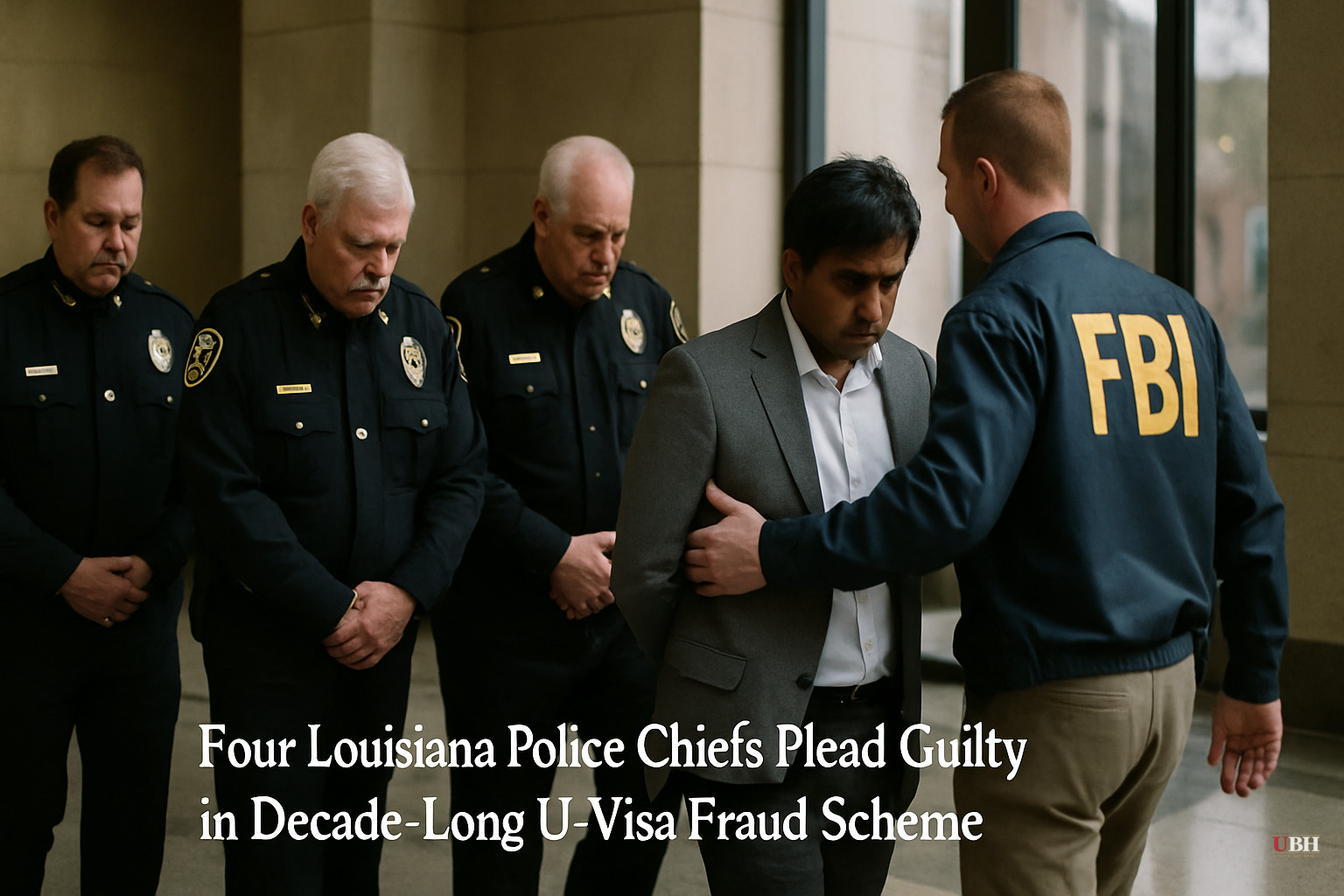
A Program Built for Crime Victims Got Turned Into a Business
Four current and former Louisiana police officials have pleaded guilty to federal fraud charges tied to a scheme that allegedly ran for roughly a decade, according to a June 30 press release from U.S. Attorney Zachary A. Keller of the Western District of Louisiana.
The defendants are Glynn Dixon, former chief of the Forest Hill Police Department; Tebo Onishea, chief of the Glenmora Police Department; Chad Doyle, chief of the Oakdale Police Department; and Michael Slaney, Oakdale's Ward 5 marshal. Each pleaded guilty to conspiracy to commit visa fraud and mail fraud. Each faces up to five years in federal prison, per the U.S. Attorney's Office.
Prosecutors also arrested Chandrakant Patel, an Indian national they identify as the scheme's organizer. Patel faces up to 20 years in prison if convicted. It's unclear from the U.S. Attorney's release whether Patel has entered a plea.
How the Scheme Allegedly Worked
The case centers on the U-Visa program, created by Congress in 2000. The idea was simple: let immigrants who are victims of or witnesses to serious crimes come forward and cooperate with police without fear of deportation, in exchange for a path to legal residency. It was designed to help police solve crimes in immigrant communities where victims might otherwise stay silent out of fear.
Prosecutors say Patel corrupted that system by working with police contacts to manufacture crime reports. According to the U.S. Attorney's Office, Patel and his law enforcement partners filed false reports describing armed robberies that never happened, using the names of illegal immigrants who paid Patel thousands of dollars per filing. Those fabricated police reports were then used to support U-Visa applications. When federal immigration officials later called the departments to verify the reports, prosecutors say the officers confirmed the fake crimes as legitimate.
The alleged conduct dates back to December 2015 and continued until 2025, when investigators began making arrests, according to the U.S. Attorney's Office. Much of the supporting paperwork moved through the U.S. Postal Service, which is why mail fraud charges were added on top of the visa fraud counts.
Federal Officials Weigh In
"These defendants' disgraceful fraud endangered our community and undermined the public trust in the immigration system solely to line their own pockets," Keller said in the June 30 statement. He added that the guilty pleas "confirm the depth of corruption uncovered here and the strength of the evidence developed during an incredible investigation by our law enforcement partners working together," and said his office would push for prison sentences that reflect the seriousness of the crimes.
Jonathan Tapp, Special Agent in Charge of the FBI's New Orleans Field Office, said Patel and his police co-conspirators "corrupted the process that helps actual victims of violent crime to allow people to remain in our country under an alleged fraud."
What's Proven, What's Alleged, and Why the Distinction Matters
The four police officials have pleaded guilty, which means the conspiracy to commit visa fraud and mail fraud charges against them are established facts, not allegations. Patel's case is different: he has been charged and arrested, but the reporting here does not establish that he has been convicted or that he has entered a plea. His guilt on the underlying charges remains a legal question for the courts, not a settled fact.
The case involves corrupt individual officers exploiting a verification system rather than proof that the U-Visa program is inherently broken or that immigrant crime victims who use it legitimately are gaming the system. A reasonable critic of stricter immigration enforcement would note that distinction.
The case does expose a real design weakness. The U-Visa verification process relies heavily on local police certifying that a reported crime actually happened. When the certifying officer is the same person taking a cut of the fraud, the safeguard collapses. Federal prosecutors say that is precisely what happened here for roughly ten years across multiple police departments before anyone caught it.
What Happens Next
Sentencing for Dixon, Onishea, Doyle, and Slaney has not yet occurred, and the U.S. Attorney's Office has said it will advocate for prison terms reflecting the severity of the conduct. Patel's case remains pending. The U.S. Attorney's Office has not indicated whether additional arrests are expected, and it remains unclear how many fraudulent U-Visa applications were ultimately approved or how many recipients might face removal proceedings as a result of the discovered fraud.
Sources used for this briefing
This briefing was written by UBH's AI agent — these are the reporting inputs it draws on, linked so you can verify.


