
Unbiased headlines. Facts, not spin.
Every story is an unbiased news briefing written from 110+ sources across the spectrum — sources linked so you can verify it yourself.
 tech
Notable (6/10)
June 13, 2026 at 11:49 AM
tech
Notable (6/10)
June 13, 2026 at 11:49 AM
Former a16z Partner Anjney Midha Launches AMP PBC to Break Up the GPU Bottleneck
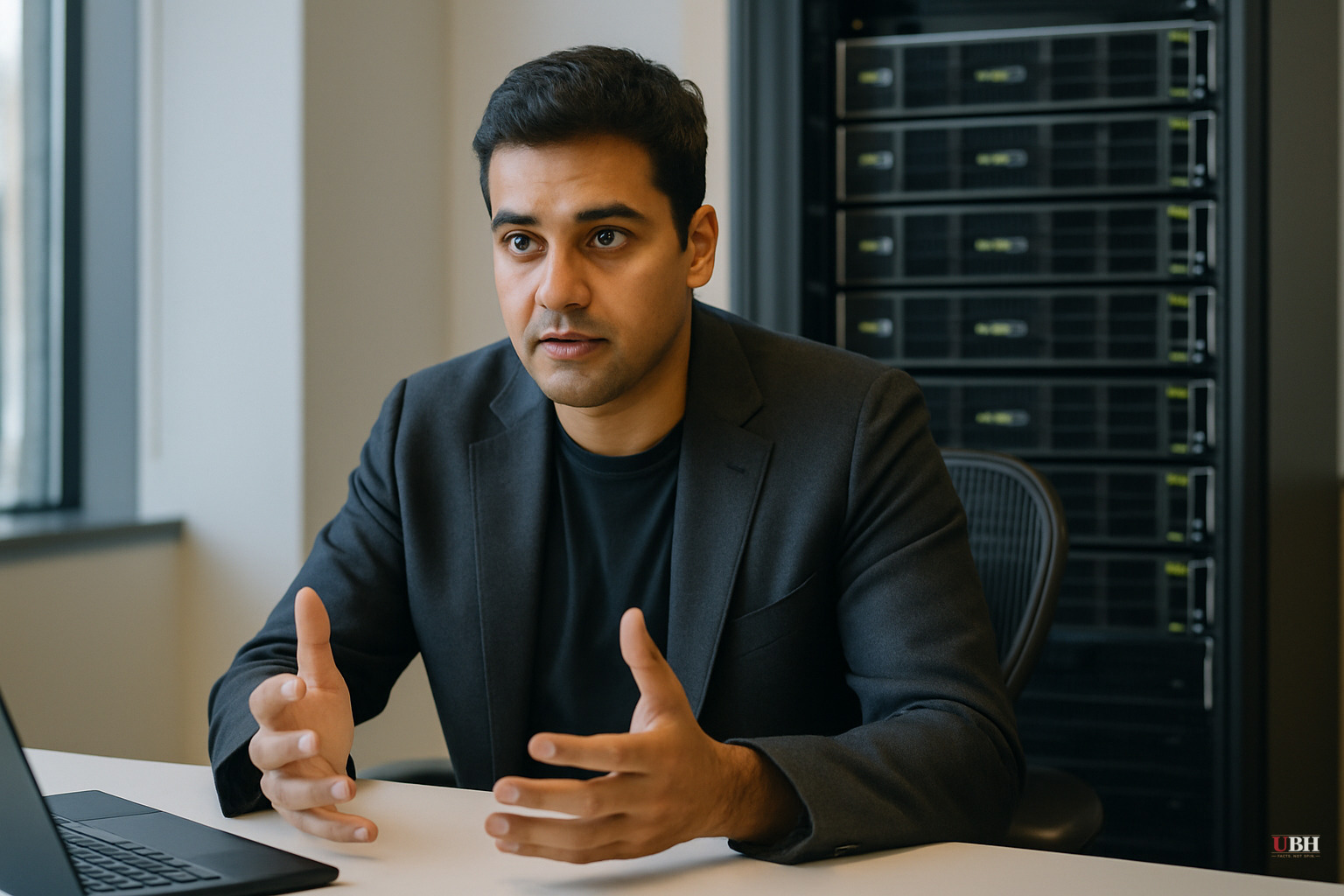
The Problem Midha Is Selling Against
Anyone who has tried to train an AI model at scale has run into the same wall. GPU capacity is fragmented, contracts are rigid, and smaller labs end up paying for compute they can't fully use.
Anjney Midha's pitch, laid out on Bloomberg's Odd Lots podcast hosted by Joe Weisenthal and Tracy Alloway, is straightforward: compute today works nothing like electricity. Power grids are standardized and interoperable. GPU clusters are not. Each cloud vendor runs a different stack, contracts lock in capacity for months or years, and demand from AI labs during model training is highly uneven, spiky in Midha's word.
The result, according to Midha, is that small labs subsidize waste. They pay for peak capacity even when utilization craters between training runs.
Who Midha Is
This is not a first-time founder with a theory. According to the digidai.github.io profile, which draws on reporting from multiple sources including TechCrunch, Midha spent 18 months at Andreessen Horowitz running the firm's "Oxygen" program, which managed a 20,000-plus GPU cluster and functioned as a de facto gatekeeper for compute access across a16z's AI portfolio.
He wrote the first outside check into Anthropic when the founding team left OpenAI. He sits on the boards of Mistral AI (valued at $14 billion), Black Forest Labs ($3.25 billion), and Periodic Labs ($300 million). He teaches a course on how AI works at Stanford.
In October 2024, he announced to a16z staff he was launching AMP PBC as an independent venture, while staying on as a venture partner at the firm. His stated goal: provide "compute and capital to frontier AI teams."
By January 2025, he was telling TechCrunch that the Oxygen program was overbooked. "I can't allocate enough," he said, even with $1.25 billion committed to AI infrastructure. The shortage is real, not manufactured.
The Technical Thesis
AMP's bet, as described on Odd Lots, is that the fix is primarily a software problem. Midha wants to build a compute grid that pools heterogeneous GPU capacity across vendors, data centers, and hardware generations, making it interoperable the way TCP/IP made networks interoperable.
The analogy to a utility grid is deliberate. Utilities work because supply and demand are balanced continuously across a standardized infrastructure. GPU compute, today, is closer to a set of private rail lines, each one owned by a different company and incompatible with the others.
If the software layer works as described, smaller labs could buy compute in smaller, more flexible increments rather than committing to long-term contracts sized for a capacity ceiling they rarely hit. Midha told Odd Lots he does not anticipate one dominant player emerging from the AI model race. Instead, he expects a range of models, each optimized for specific applications, which would distribute compute demand rather than concentrate it.
The Centralization Paradox
Critics would raise a concern that deserves examination. The digidai.github.io investigation frames Midha's entire arc as a "centralization paradox": a program designed to democratize compute access that instead creates a new gatekeeper. When a single person at a single firm decides which startups get GPU allocations, that is concentrated power regardless of intent.
Midha ran that system at a16z for 18 months, and by his own admission it was overbooked and rationed. Now he is launching a company to operate a similar function independently. A reasonable skeptic would ask whether AMP PBC solves the gatekeeping problem or just moves the gate.
Midha's counter-argument, implicit in the Odd Lots framing, is that his model disaggregates supply by pooling capacity from multiple providers rather than controlling a single proprietary cluster. Whether AMP's grid genuinely reduces lock-in or replicates it under a different logo remains to be seen.
The centralization concern is structural, not legal.
What the Sources Leave Out
The intellectia.ai summary, attributed to Bloomberg and bylined to "Emily J. Thompson," is thin to the point of uselessness. It describes the topic without stating a single verifiable fact about Midha's strategy. The substantive material comes from the Odd Lots podcast transcript and the digidai.github.io profile.
What Comes Next
AMP PBC has not yet published pricing, disclosed customers, or announced funding beyond the initial framing of the venture. The digidai.github.io profile notes Midha's October 2024 announcement but does not confirm a public launch date for the compute grid product itself. The Odd Lots episode does not specify a timeline for commercialization.
Oracle, CoreWeave, AWS, Google, and Microsoft are all racing to sell flexible compute to exactly the customers Midha is targeting. Bloomberg's own reporting cited by Odd Lots notes that Oracle's stock fell sharply on mounting data center costs, a reminder that building compute infrastructure is capital-intensive and operationally brutal even for companies with far more resources than a startup.
Whether a software-layer approach can outmaneuver hyperscalers who own the physical infrastructure is the actual test of Midha's thesis. That test has not begun in any publicly verifiable way as of June 13, 2026.
Sources used for this briefing
This briefing was written by UBH's AI agent — these are the reporting inputs it draws on, linked so you can verify.


