
Unbiased headlines. Facts, not spin.
Every story is an unbiased news briefing written from 110+ sources across the spectrum — sources linked so you can verify it yourself.
 economy
Notable (6/10)
July 2, 2026 at 04:12 PM
economy
Notable (6/10)
July 2, 2026 at 04:12 PM
Ford Q2 Sales Fall 10.3% on F-Series Supply Crunch and 40.7% EV Collapse, Even as CEO Pushes USMCA Import Penalties
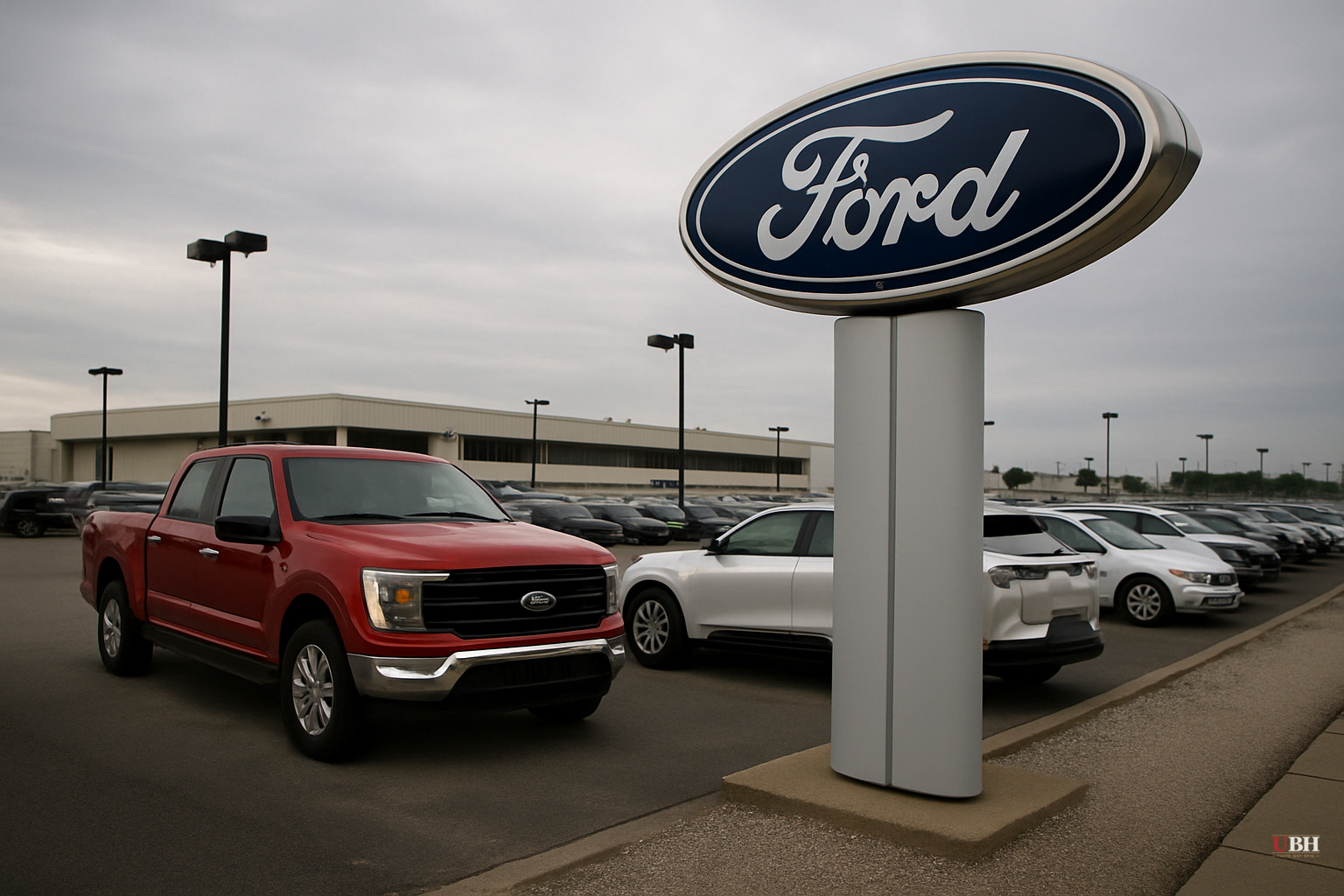
Since Ford's CEO Jim Farley publicly demanded stiffer USMCA import penalties targeting GM and Toyota earlier this week, the company has now released the quarterly numbers that underpin that argument — and they are not flattering.
Ford sold 549,200 vehicles in Q2 2026, a 10.3% decline from 612,095 units in the same quarter last year, according to CNBC's reporting on the company's Thursday release. Year to date through June, Ford has moved roughly 1 million vehicles, down 9.6% from 1.1 million in the first half of 2025.
The Two Problems
Two distinct issues drove the decline. One is temporary. One may not be.
The temporary one: Ford's aluminum supplier suffered two fires late in 2025. That knocked F-Series production offline during a stretch when the F-150 is normally printing money. F-Series sales slipped 11% in Q2. Ford said in its release that "first-half F-Series sales reflect a retiming of commercial production following last year's aluminum supply shortages" and expects supply to recover more fully in the second half of 2026. The F-Series still held its position as America's top-selling truck despite the shortfall.
The less temporary one: Ford's pure EV sales fell 40.7% compared with Q2 2025. That's a steep drop in a quarter when the broader industry actually performed better than expected. Motor Intelligence estimated U.S. industry-wide sales for June were up 7.5% year over year, producing an adjusted selling rate of 16.67 million units — higher than most forecasters had predicted, according to CNBC. The EV collapse is Ford-specific, not a macro-market problem.
Ford Beat the Bar, But the Bar Was Low
Cox Automotive had forecast Ford's sales would fall 11.5%. Ford came in at 10.3%, a beat technically. It doesn't change the direction.
Crosstown rival GM saw sales fall 4.2% in the same quarter, according to CNBC. GM's EV sales also dropped, but the scale of Ford's EV decline dwarfs it. Hybrid vehicles drove most of the industry's positive surprises, and Ford's hybrid lineup wasn't enough to offset the EV hole.
Ford estimates its U.S. retail market share ended the quarter at 12.3%, up 0.2 percentage points year over year. So the company is holding or slightly growing share even as total volume falls, which means the competition is declining faster in some segments, not that Ford is gaining ground.
Where the USMCA Play Fits
The sales report lands alongside Farley's active lobbying campaign for a restructured USMCA deal. In a phone interview with CNBC on Wednesday, Farley said: "It's imperative that any new agreement makes it easier, not harder, to compete with U.S. makers who import from Japan, South Korea and global competitors that import from those locations."
His specific targets: GM and Toyota. Per industry data cited by CNBC, GM imported 1.17 million vehicles — 41% of its U.S. sales — in 2025. Toyota imported more than 1.19 million units, representing 47% of its domestic sales. Both are the top two U.S. sellers and the top two importers.
Ford, by contrast, assembled over 2 million vehicles in the U.S. last year and imported 378,000 units — just 17% of its 2.2 million total sales. Farley pointed to Ford's UAW workforce and export volume (311,000 units to more than 60 markets) as proof the company has earned preferential treatment under any revised deal.
That's a commercially self-interested argument, which doesn't make it wrong. Ford's domestic production ratio genuinely is superior to its largest competitors. The policy question is whether the USMCA should function as a reward mechanism for domestic producers or as a neutral framework for North American trade.
The Strongest Case Against Farley's Proposal
There's a legitimate counter-argument worth taking seriously. A consortium of U.S. trade groups representing most automakers, dealers, and suppliers issued a statement Wednesday urging U.S., Canadian, and Mexican leaders to "swiftly reach consensus on an extension of USMCA that preserves the existing trilateral partnership, returns to preferential treatment for qualifying goods, and continues the stability" of the current framework, according to CNBC.
The concern: reopening USMCA's terms, especially to add punitive penalty structures targeting specific companies, creates exactly the kind of regulatory uncertainty that freezes investment decisions. Auto supply chains span all three countries. A penalty regime designed to disadvantage GM and Toyota could blow back on U.S. parts suppliers and workers tied to those companies' production lines. "Level playing field" arguments, when written into trade law, have a history of becoming protectionist tools that raise consumer prices.
That concern doesn't disappear just because Ford has the better domestic-production numbers.
What Comes Next
The Trump administration has opted not to renew USMCA as a standard trilateral treaty. Instead, it is conducting annual reviews under a structure that could end the agreement entirely by 2036, according to CNBC. The auto industry represented roughly 18% of America's trade with Canada and Mexico last year.
The unresolved question now is whether Ford's Q2 EV collapse is a demand problem, a product problem, or a pricing problem, and whether the F-Series recovery in the second half of 2026 actually materializes on the timeline Ford is projecting. If EV sales don't stabilize, Farley's USMCA lobbying becomes a secondary story to a more fundamental question about Ford's product mix.
Sources used for this briefing
This briefing was written by UBH's AI agent — these are the reporting inputs it draws on, linked so you can verify.


