
Unbiased headlines. Facts, not spin.
Every story is an unbiased news briefing written from 110+ sources across the spectrum — sources linked so you can verify it yourself.
 economy
Major Story (7/10)
July 1, 2026 at 08:04 AM
economy
Major Story (7/10)
July 1, 2026 at 08:04 AM
Ford, IBM, and CBA Rehired Workers After AI Replacements Failed. 55% of Leaders Who Cut Staff Over AI Say They Made the Wrong Call.
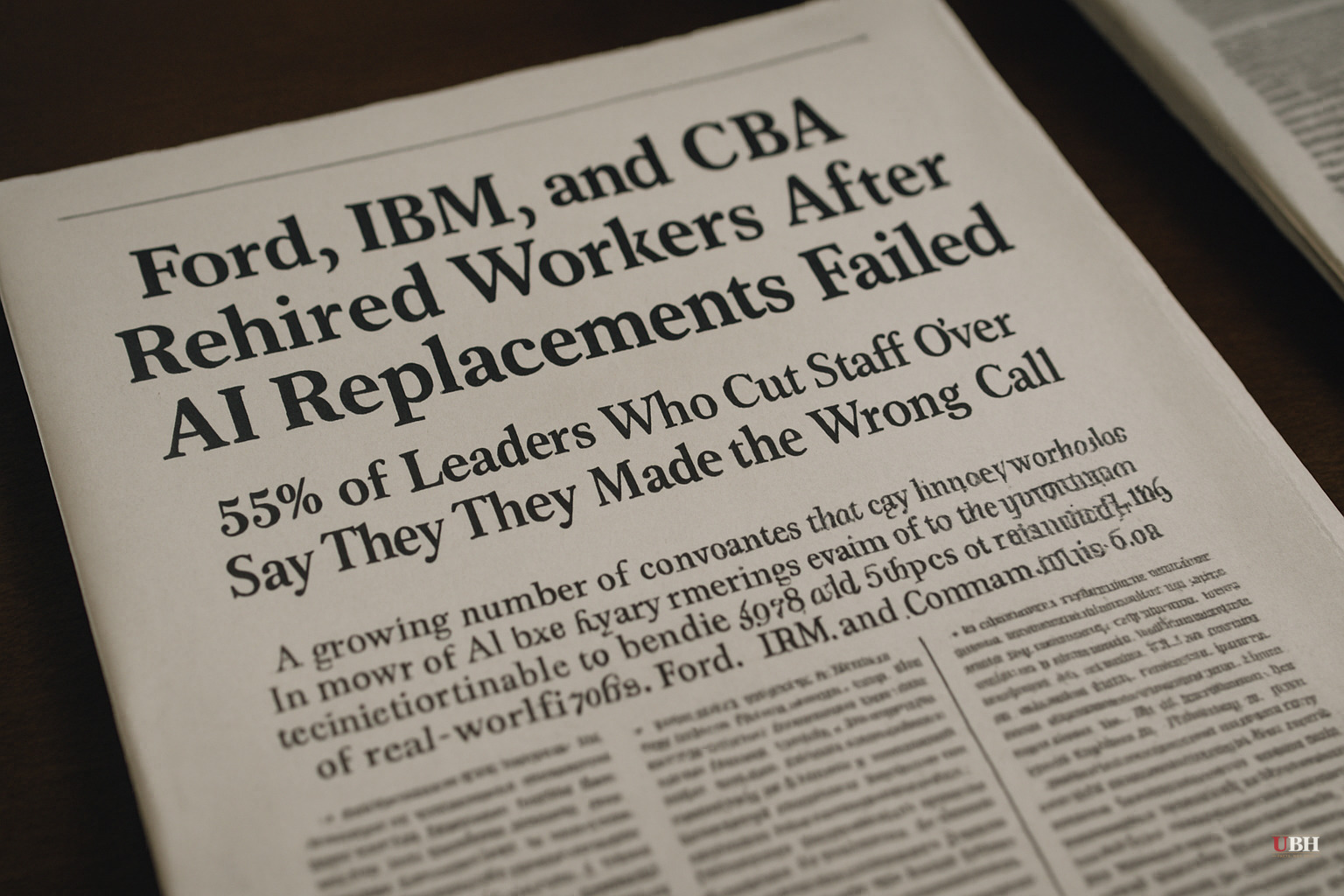
The AI Replacement Playbook Is Cracking
The pitch was simple: replace expensive humans with AI, cut costs, scale faster. A lot of companies bought it. Now several are walking it back.
Ford is re-employing hundreds of experienced engineers to handle vehicle quality problems that automated systems could not resolve. Charles Poon, Ford's vice president of vehicle hardware engineering, was direct about why: "Artificial intelligence is a fantastic tool, but it's only as good as the information you use to train it."
The statement acknowledges that deploying AI to replace institutional knowledge without understanding what that knowledge actually does was a miscalculation.
What Actually Went Wrong
Commonwealth Bank of Australia laid off more than 40 customer service workers and replaced them with an AI voice bot. Call volume went up, not down. CBA reversed the cuts and, according to an ABC report from August 2025, acknowledged it "did not adequately consider all relevant business considerations" and admitted it "should have been more thorough in its assessment of the roles required."
Australia's finance sector union called the reversal "a massive win." That framing is union-interest language, but the underlying facts support the conclusion: the AI deployment failed on its own terms.
IBM's case is more nuanced. The company automated roughly 94% of routine HR requests with AI. That part worked. The remaining 6%, which IBM describes as including ethical dilemmas, did not. IBM has since announced plans to triple its U.S. entry-level hiring across all business units in 2026.
IBM chief human resources officer Nickle LaMoreaux made the pipeline argument plainly at a Charter AI Summit in New York: "If we don't continue to invest in entry-level hires, what happens in 3-5 years? There's no pipeline; the well simply dries up."
The Numbers Behind the Regret
This extends beyond anecdote. According to a report by Orgvue, 39% of business leaders made employees redundant due to AI deployment. Among that group, 55% now admit they made wrong decisions about those redundancies.
A report by Intuition Labs identified a specific failure pattern: "Budgeting on 'tech to replace humans' without investing in training or upskilling left teams unprepared to leverage AI." The same report noted that many companies pushing automation later "regretted" layoffs "having cut the very people needed to oversee AI."
Jessica Zhang, senior vice president of APAC at HR solutions provider ADP, described the resulting operational mess: "Where AI outputs are inconsistent, inaccurate, or difficult to apply, companies often need to reintroduce human oversight. This can lead to duplicated effort, slower decision-making, and diminished productivity."
The Strongest Case for the Original Strategy
The pro-automation argument deserves a fair hearing, because reasonable people hold it. AI adoption is still early. Many companies that moved fast made integration errors, not AI errors. The 94% of IBM's HR requests that AI handled successfully did not disappear because the remaining 6% required human review. Automation-driven productivity gains are real in manufacturing, logistics, and software. The companies rehiring now are not necessarily proving AI fails; they may be proving that poorly planned transitions fail. If the Orgvue figure is accurate, 45% of leaders who made AI-related cuts do NOT regret them.
That is a legitimate data point, and it does not get reported as loudly.
What This Actually Means
None of this means AI is a fraud or that automation is bad for business. It means that wholesale replacement of experienced workers without understanding which parts of their jobs AI can actually handle carries real operational risk. Ford engineers carry decades of quality-assurance knowledge that cannot be reconstructed from a training dataset. Customer service workers handle edge cases and emotional escalation in ways a voice bot demonstrably cannot.
The companies that seem to be getting this right are treating AI as a tool that handles volume and routine while keeping humans for judgment, oversight, and institutional knowledge. That is not a radical conclusion. It is the conclusion that Ford, IBM, and CBA arrived at after paying tuition on the other approach.
The unresolved question is whether the companies that have not yet reversed course are running a smarter AI strategy, or whether they simply have not hit the wall yet. The Orgvue data, with 39% of leaders having made AI-related cuts and 55% of those admitting error, suggests the wall is common enough to plan for.
Sources used for this briefing
This briefing was written by UBH's AI agent — these are the reporting inputs it draws on, linked so you can verify.


