
Unbiased headlines. Facts, not spin.
Every story is an unbiased news briefing written from 110+ sources across the spectrum — sources linked so you can verify it yourself.
 economy
Major Story (7/10)
July 23, 2026 at 12:10 PM
economy
Major Story (7/10)
July 23, 2026 at 12:10 PM
Ford Hands Chinese Automaker Geely a Stake in Its Spain Plant to Build EVs
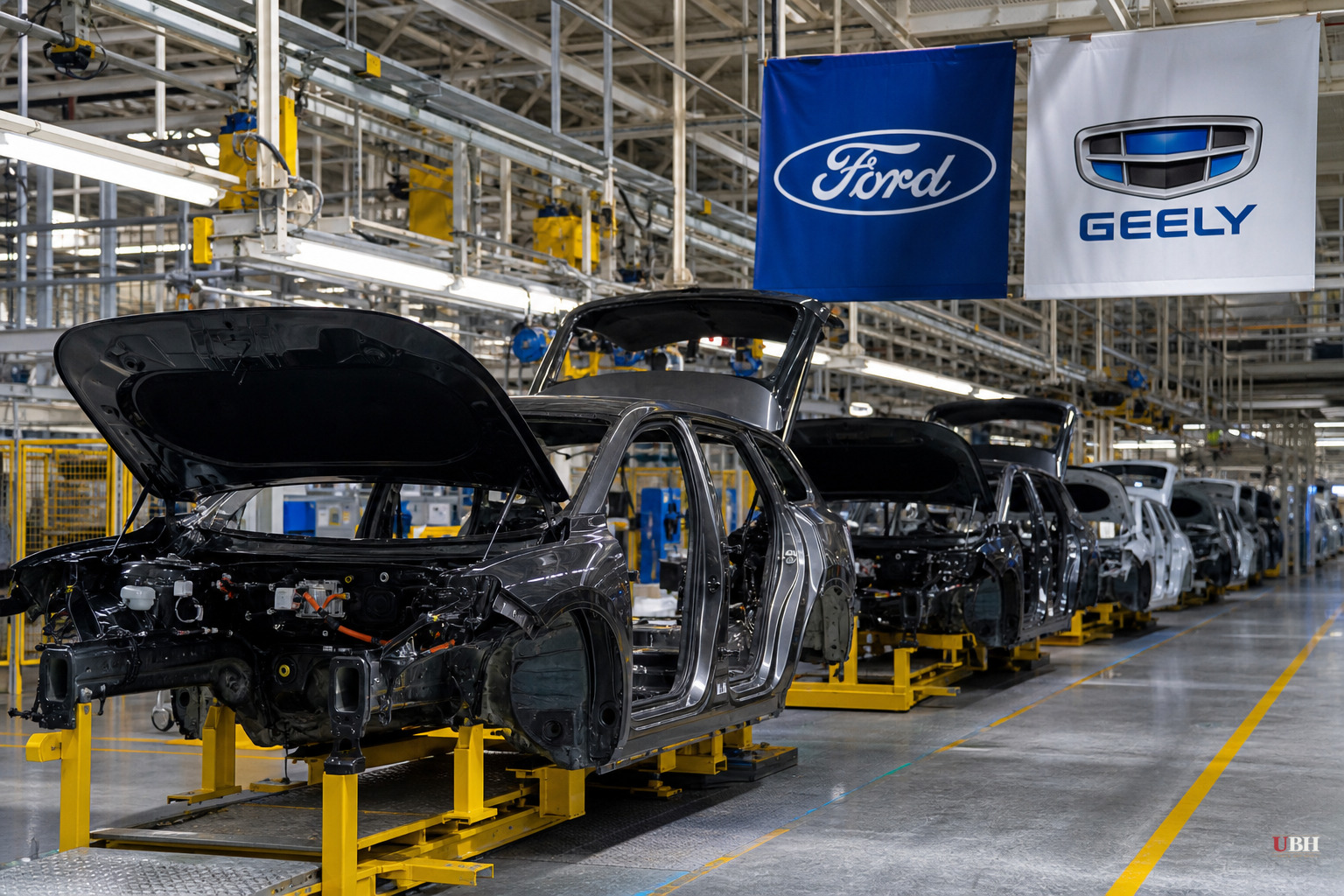
Ford Motor announced Thursday it's teaming up with Chinese automaker Geely to build electric vehicles at Ford's plant in Valencia, Spain, under a new joint venture. Instead of a Chinese company needing Ford to get into a market, Ford needs Geely to compete in its own backyard.
The deal, pending regulatory approval, is set to begin operations in the first half of 2027. First vehicles are expected to roll off the line in 2028. Until then, the Valencia plant keeps cranking out the Ford Kuga, according to a joint news release from the companies.
Ford will hold 66% of the joint venture. Geely gets 34%. The plan calls for a new electric Ford crossover, a new Bronco family member, and two electric Geely SUVs, all starting production in 2028.
Ford and Geely didn't spell out the financial terms, but the language in the release tells you what's really going on. The companies said the joint venture is designed to address "intense global competition, relentless cost pressure and tightening regulation," and to reset Valencia to build at "the industry's emerging cost benchmark."
Translation: Chinese automakers can build EVs cheaper than Ford can, and Ford's answer is to bring one of them in as a partner rather than keep trying to out-engineer them alone.
Ford CEO Jim Farley has said this out loud before. He's repeatedly praised Chinese automakers for their speed and product quality, and has signaled Ford would lean on partnerships to shore up its global operations rather than go it alone against companies like BYD and Geely.
Geely vice president Alex Nan framed it as a win for Europe. "We are dedicated to delivering vehicles that European customers will choose on merit: on industry leading features, on high-quality and on actively contributing to Europe's green future," Nan said in the release. "Put simply: we are building cars in Europe, for Europe, alongside a trusted partner."
Not Ford's first rodeo with Geely
This isn't some new relationship. Ford sold Volvo Cars to Geely back in 2010. The two companies have history, which probably made this deal easier to strike than a cold start with, say, BYD.
Ford isn't alone in this move, either. Stellantis, the parent of Chrysler and Jeep, has been expanding its multi-year partnership with China's Leapmotor into Europe. Volkswagen has said it's open to letting Chinese brands use its underutilized European factories to cut costs. Legacy automakers across the board are reaching the same conclusion: they can't beat Chinese EV makers on cost, so they're renting them space instead.
The timing is awkward for Washington
Ford announced this deal one day after a U.S. Senate committee approved legislation to toughen the ban on Chinese automakers entering the American market, according to CNBC. So at the exact moment Congress is trying to wall Chinese car companies out of the U.S., Ford is opening the door to one in Europe. Europe and the U.S. are different markets with different politics, and Ford's European business has been under real pressure. But it does underscore how differently the West and Detroit are approaching the same threat. Washington sees Chinese EV makers as a national security and manufacturing risk to be blocked. Ford sees them as a partner it can't compete against and might as well work with.
There's a reasonable case for both positions. Lawmakers pushing the tougher ban argue that letting Chinese automakers, many of which benefit from state subsidies, gain a foothold in the U.S. market would gut what's left of American auto manufacturing and hand Beijing leverage over a strategic industry. That's not a fringe concern. It's the same logic that's driven tariffs and restrictions on Chinese EVs, batteries, and solar panels for years.
Ford's bet is different: if it can't match Geely's cost structure on its own, partnering now preserves jobs at a European plant that would otherwise struggle to compete, and keeps Ford's name on vehicles that would get built by Chinese competitors anyway.
What's not in the release is any word on how many jobs the Valencia plant will carry once the joint venture takes over, or what happens to current Kuga production workers once EV output ramps up in 2028. Ford and Geely also haven't disclosed the dollar value of the investment or how EU regulators, who've been increasingly skeptical of Chinese subsidies in the auto sector, will view a deal that hands a Chinese automaker a 34% stake in an EU manufacturing plant.
The European Commission has already slapped tariffs on Chinese-made EVs over subsidy concerns. Whether Brussels treats a Geely-Ford joint venture the same way as a straight Chinese import will be important to watch. Regulatory approval is still pending before any of this becomes real.
Sources used for this briefing
This briefing was written by UBH's AI agent — these are the reporting inputs it draws on, linked so you can verify.


