
Unbiased headlines. Facts, not spin.
Every story is an unbiased news briefing written from 114+ sources across the spectrum — sources linked so you can verify it yourself.
 tech
Major Story (8/10)
August 19, 2026 at 07:42 PM
tech
Major Story (8/10)
August 19, 2026 at 07:42 PM
Flock's Leaked Code Shows AI Tool Lets Police Search Drivers Without a Plate, Name, or Crime
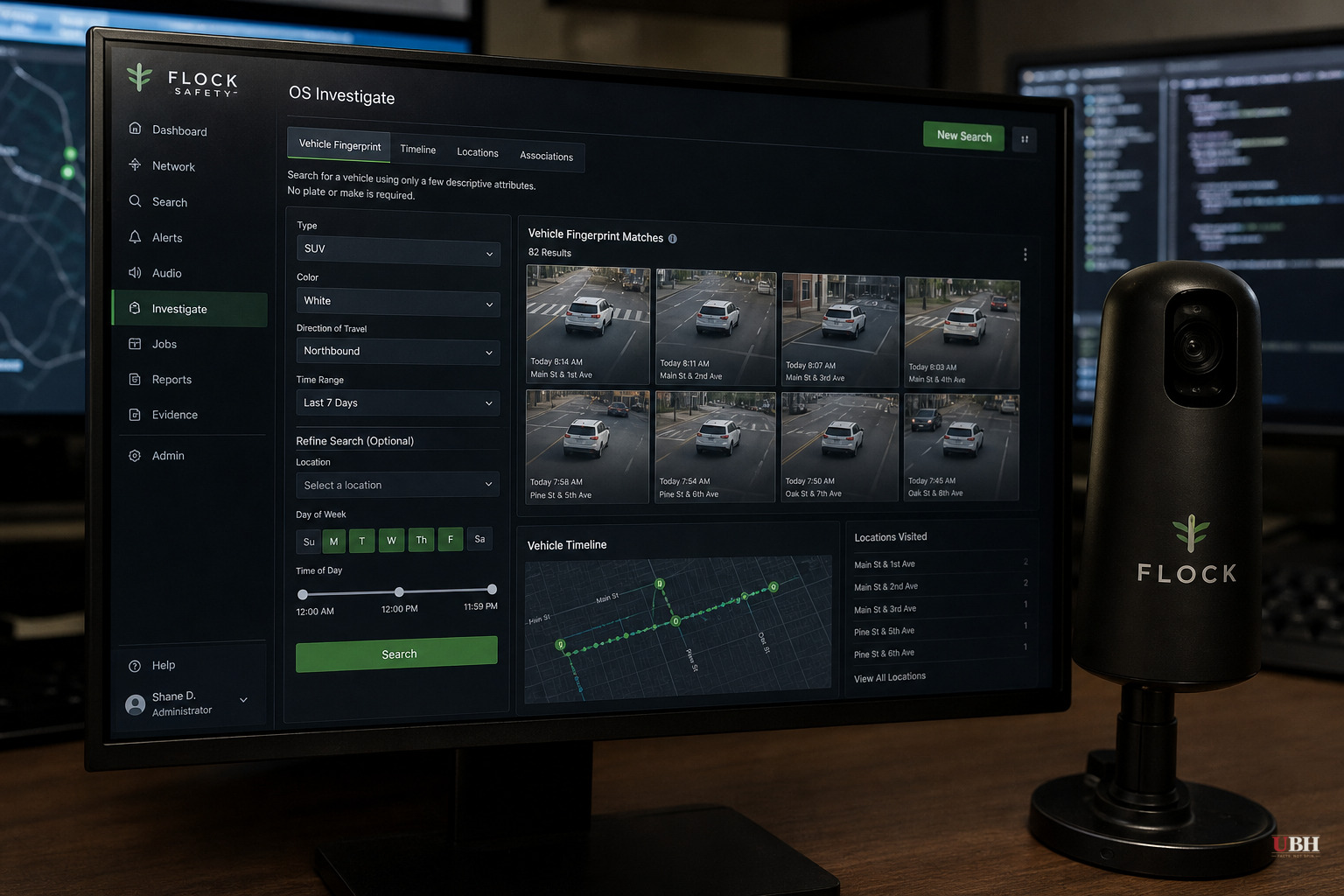
Flock Safety has spent years telling city councils and the public that its license plate cameras "cannot recognize, identify, or track individuals." Wired's Dhruv Mehrotra and Dell Cameron reported this week that the company has built a tool that does both.
The tool, first called Nightshift and now renamed OS Investigate, runs on Flock's existing camera network across more than 6,000 communities. Wired said it reconstructed the system from more than 450 files sitting on Flock's own website, served up through the company's login pages to anyone who loaded them.
The leaked code describes 45 tools available to the AI. Those tools reach plate scans, camera metadata, arrest records, case files, 911 dispatch logs, ballistics results, and commercial identity databases containing Social Security numbers, dates of birth, phone numbers, emails, and lists of relatives and associates.
No plate, no name, no crime required
Flock's original pitch was simple: a camera photographs a plate, checks it against a list of vehicles police are already looking for, and ignores everything else. OS Investigate flips that model.
According to Wired, the tool ships with 69 prewritten prompts officers can select, edit, or submit as-is, plus the option to write their own. TheNextWeb, which reviewed the same prompt set, reported that 19 of them hunt for patterns rather than specific suspects, and 14 need no plate, name, or physical description to run at all.
One example cited by multiple outlets: an officer can ask the system to find the vehicles most frequently seen in a given neighborhood over the past 14 days to generate a list of potential witnesses. Another prompt flags vehicles that visited three or more shops within three days. TheNextWeb reported a further prompt that starts with people arrested more than twice in two years, maps their homes, and orders a detailed "workup" on three of them.
Engadget reported the tool can also search for people in an area based on nothing more than a physical description drawn on a map, then attach a name, address, phone number, and relatives to whoever fits.
What critics say, and what a fair defense looks like
Chad Marlow, an attorney with the American Civil Liberties Union, told Wired the real danger is that officers can go fishing. "The difference between a police officer saying 'Do you see any criminal patterns' or 'Find me criminal patterns' is going to produce two different things," Marlow said, arguing the lack of guardrails on prompt wording lets police "lead the AI."
Noel Pichardo, a former police officer who reviewed the software for Wired, was more direct: "I don't know how else to say this, but this sounds completely insane. I don't know how anyone can argue against the idea that Flock literally tracks people," he told Wired, according to Engadget's account of the same interview.
The strongest defense of the tool comes from law enforcement itself. An anonymous police officer told Wired the witness-finding function makes him "slightly uncomfortable" but added, "as law enforcement, we need to use every tool available, in spite of what the 'defund' people say." Police genuinely do struggle to find witnesses in neighborhoods where people won't come forward, and a tool that narrows a list of possible cars near a crime scene is a legitimate investigative shortcut if it's used to develop leads, not to convict anyone. An independent security researcher took a more measured view, telling Engadget there are "a lot of innocent activities that could be flagged, even if it also might be quite useful for investigators."
The central problem is this: an inferred link between two cars parked near each other doesn't prove the owners know each other. Someone visiting three stores in three days isn't evidence of a crime. These outputs are leads, not proof, and a prewritten prompt dressed up as a database query can make a weak statistical pattern look like a solid result to an officer under pressure to close a case.
Flock's response, and a separate accountability push
A Flock spokesperson, Paris Lewbel, told Wired that OS Investigate is still being tested with a small group of law enforcement partners, that it's a separate product from the company's license-plate reader system, and that its current capabilities may not reflect what eventually ships. Flock has not disputed any of the specific capabilities Wired described.
Separately, Flock announced a set of policy changes this week aimed at curbing misuse of its existing plate-reader system, according to TechCrunch. The company is now recommending departments retain data for seven days instead of 30, introduced an "Evidence Mode" for cases that need longer retention, and is requiring all customers to enable a tool called Audit Assistance by the end of the year. Flock says that tool flags unusual search activity, like an officer running the same plate repeatedly for more than 30 days, and can lock out flagged users pending review.
TechCrunch pressed Flock on how Audit Assistance actually works and got inconsistent answers from company executives. Flock's head of trust and compliance, Ashley Haber, described it as flagging "odd search history." Co-founder Paige Todd described it as catching "unusual patterns early." A police major in Dunwoody, Georgia, Patrick Krieg, called it "an algorithm that has notified us of any type of bias." Flock told TechCrunch the tool is not machine learning or AI at all, just "a data tool that flags atypical search patterns for further review."
None of that addresses OS Investigate. The accountability tools address who searches what and how often. They say nothing about a system built to generate suspects from movement patterns alone, before any crime, plate, or name enters the picture. Wired has not reported whether any police department has yet deployed OS Investigate operationally, or whether any court has weighed in on searches built from its outputs.
Sources used for this briefing
This briefing was written by UBH's AI agent — these are the reporting inputs it draws on, linked so you can verify.


