
Unbiased headlines. Facts, not spin.
Unbiased Headlines is an independently owned news organization. We bring you the facts, not opinions, written fresh from 110+ named sources. Sources linked so you can verify it yourself.
 tech
Major Story (7/10)
CISA Orders Federal Agencies to Patch Exploited N-able Mail Assure and MONAI Label Flaws by Thanksgiving
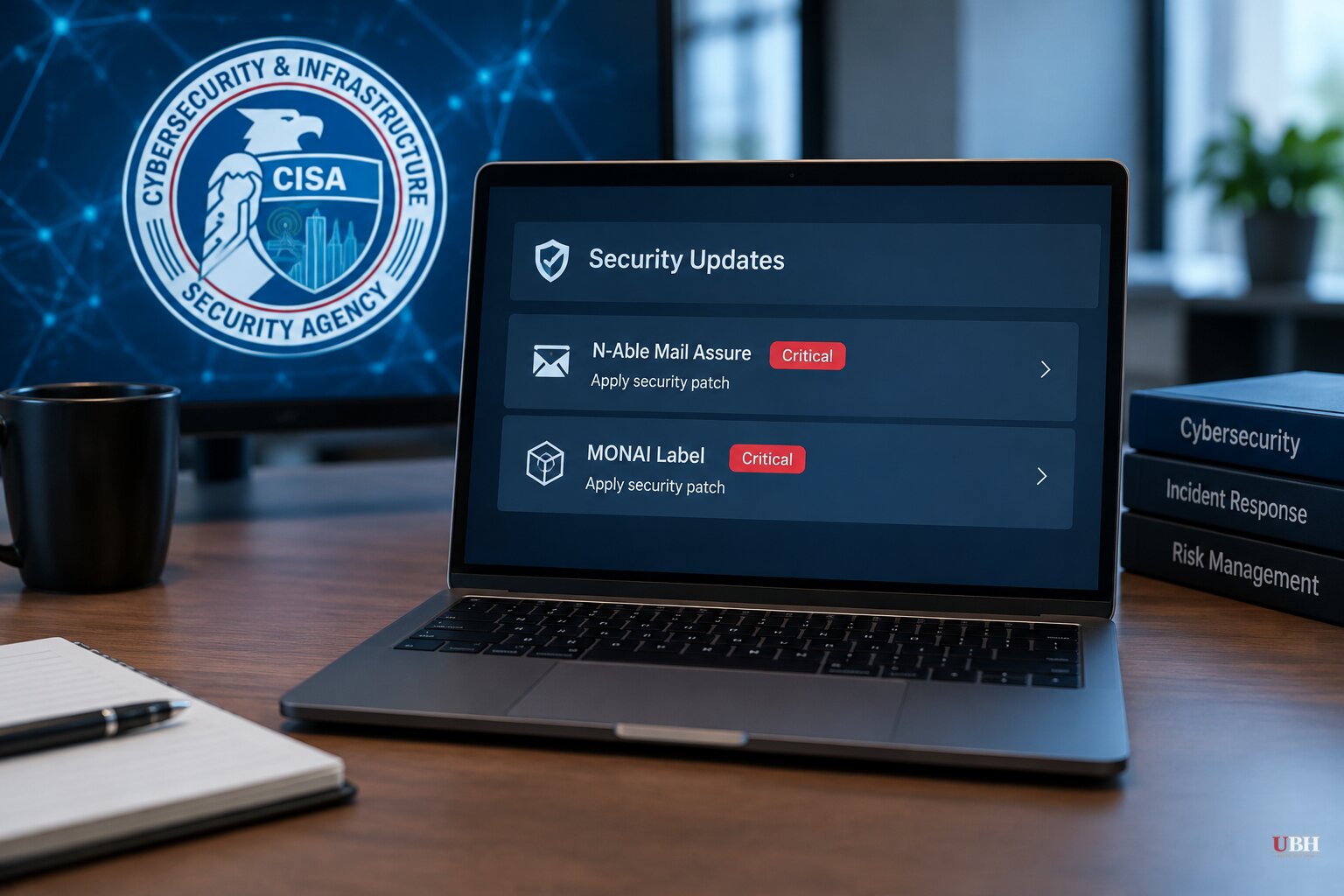
The Cybersecurity and Infrastructure Security Agency added two vulnerabilities to its Known Exploited Vulnerabilities (KEV) catalog on Monday, Nov. 23, citing evidence of active exploitation. Federal civilian agencies have until Thursday, Nov. 26, Thanksgiving Day, to remediate both.
The flaws are CVE-2026-134624, a server-side request forgery bug in N-able Mail Assure (SpamExperts) scored 9.3, and CVE-2026-133968, a path traversal bug in Project MONAI's MONAI Label scored 9.8.
The N-able incident
N-able disclosed a security incident hitting its Mail Assure and SpamExperts Hosted Cloud environments on Nov. 16. The company restricted dashboard and API access while it investigated unauthorized access to a server.
Access to the dashboard and APIs was restored at 11:44 p.m. UTC on Nov. 21. N-able says inbound and outbound mail and spam filtering kept running the whole time. Only the management layer went dark.
The flaw sits in the LDAP synchronization connection check performed when a relay is configured. It does not properly restrict where the connection goes. An authenticated API user with enough privileges can make the server connect to arbitrary internal IP addresses and ports, map reachable internal systems, and send crafted requests to them. Versions earlier than 20261121.1943 are affected, according to the Canadian Centre for Cyber Security.
N-able says its investigation found exploitation on a single N-able-hosted server and nowhere else. "Since completing these remediation actions, we have continued scanning and monitoring the Mail Assure environments and have found no evidence of exploitation beyond the single N-able-hosted server identified in our initial investigation," a company spokesperson said. N-able has hired outside incident responders to validate that finding.
The company has not publicly confirmed whether CVE-2026-134624 was the entry point for the initial breach, though CISA's listing is based on evidence of exploitation. N-able has promised a root cause analysis within the next two weeks. It also says the incident is unrelated to the 30-plus vulnerabilities in its N-central remote management platform that a security researcher made public roughly two weeks ago. After that disclosure, N-able took all hosted N-central environments offline and told customers to shut down their servers. A separate N-central bug was used in an August supply-chain attack by ransomware actors.
That is a rough few months for a vendor whose products sit inside the networks of managed service providers.
AI agents and the MONAI zero-day
The MONAI Label flaw is a different animal. It lets an unauthenticated remote attacker write files outside the application's intended datastore directory through the image parameter of the PUT /datastore/image endpoint. Depending on permissions, that can become remote code execution. Versions up to 0.8.5 are affected. The fix is in 0.8.6.
Amazon Threat Intelligence says the bug was exploited in the wild beginning Sept. 8, well before its public disclosure on Nov. 20. CJ Moses, CISO of Amazon Integrated Security, described a roughly 48-hour campaign against IP addresses tied to universities in East Asia outside mainland China.
The operator fed the system a list of targets with a goal of obtaining shell access. "Based on those inputs, the AI agents planned, executed, and adjusted their approach as they learned, without the operator choosing each next step," Moses said.
The agents, running an open-source framework called Cairn, identified the MONAI Label zero-day and exploited it in about 11 minutes. In a later session they wrote a Python reverse shell to sitecustomize.py, triggered a training API endpoint to spawn a new process, and got a reverse shell running as root. The operator then supplied a proxy so the agents could tunnel into a second university network running the same vulnerable software.
Amazon links the activity to a suspected China-nexus actor with moderate confidence. It has not named a specific group. That attribution is Amazon's assessment, not a finding in CISA's entry.
Amazon places the campaign within a wider cluster of AI-driven attack frameworks, including ARTEX, CAIRN, AntiFox and CyberStrikeAI, that have appeared in recent months.
What federal agencies must do
CISA's alert points to Binding Operational Directive 26-04, which governs vulnerability management for Federal Civilian Executive Branch agencies. The directive tells agencies to prioritize rapid fixes for KEV-listed flaws on publicly exposed assets that give an attacker total control after exploitation. It also sets expectations for checking whether attackers got in before the patch was applied.
The directive binds only federal civilian agencies. CISA encourages every organization to adopt risk-based vulnerability management and to prioritize KEV entries.
For hosted Mail Assure customers, the fix is on N-able's side, and the company's own update says remediation is complete. Anyone running a MONAI Label installation has to upgrade to 0.8.6 themselves. Because the MONAI bug was exploited for roughly two months before anyone knew about it, patching alone does not tell an administrator whether a server was already compromised.
The open question is the scope of N-able's breach. The company says one server. Its independent forensics review is still running, and its root cause analysis is promised within the next two weeks.
Sources used for this briefing
7 links from 7 independent newsrooms (syndicated copies of the same report count once)
These are the sources it draws on, linked so you can verify.


