
Unbiased headlines. Facts, not spin.
Every story is an unbiased news briefing written from 110+ sources across the spectrum — sources linked so you can verify it yourself.
 economy
Notable (5/10)
July 25, 2026 at 06:55 PM
economy
Notable (5/10)
July 25, 2026 at 06:55 PM
Finland Posts 10.8% Unemployment, Worst in the OECD, While Japan Sits at 2.5%
The Numbers
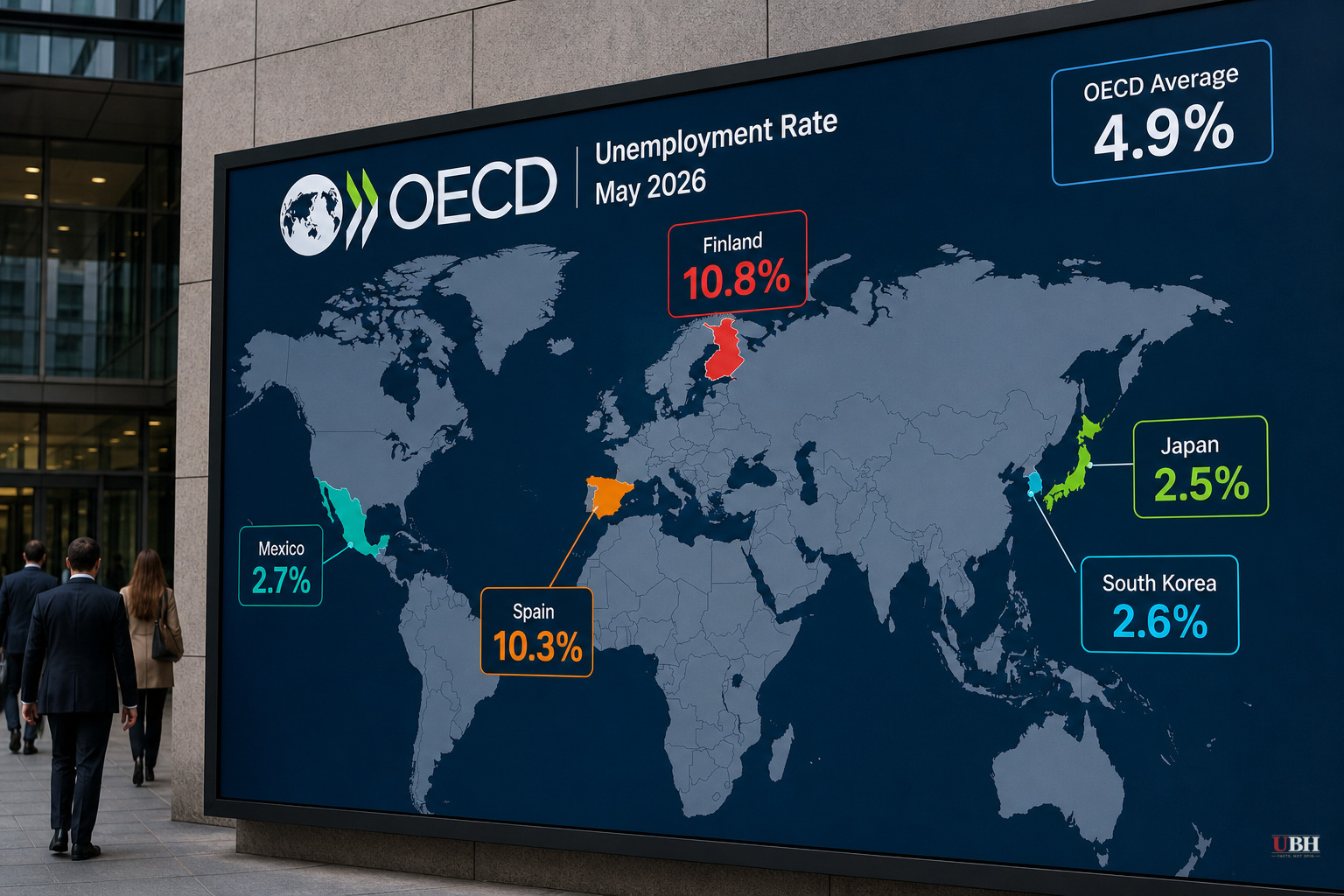
The OECD's May 2026 unemployment data puts the 38-member bloc's average at 4.9%. Finland sits at the top of the list with a 10.8% unemployment rate, according to OECD data cited by both ZeroHedge and BusinessToday. Spain is right behind at 10.3%. Chile comes in third at 9.2%, and Sweden rounds out the top four at 8.8%.
France and Türkiye are tied at 8.2%. Greece, Lithuania, Denmark, Luxembourg and the Baltic states also posted rates above the OECD average, per ZeroHedge's breakdown of the same Visual Capitalist data set BusinessToday cited.
On the other end, Japan posted the lowest unemployment rate in the entire OECD at 2.5%. Mexico came in at 2.7%, South Korea and Israel tied at 2.8%, and Czechia at 2.9%.
Where the U.S. and Canada Land
The United States posted a 4.2% unemployment rate, below the OECD average. Canada came in at 6.6%, well above it and well above its southern neighbor.
That gap between the U.S. and Canada—2.4 percentage points—stands out. Two countries with similar economic structure and trade exposure show a significant joblessness gap. Neither source explored why, but it warrants more than a passing mention in future coverage.
Finland's Youth Problem
The most alarming number in the whole data set isn't the headline 10.8%. It's what's happening to young Finns.
Unemployment among Finns under 25 hit 23%, according to the OECD data reported by both ZeroHedge and BusinessToday. Nearly one in four young workers in Finland can't find a job.
BusinessToday's writeup attributes Finland's overall numbers to "weaker economic growth and softer labour demand," language pulled from Visual Capitalist. That explanation is accurate but incomplete. Finland has been dealing with a manufacturing slowdown and reduced trade with Russia since the war in Ukraine cut off a major economic relationship. That structural detail is missing from both source reports.
Spain's Decades-Long Problem
Spain's 10.3% rate isn't new or surprising to anyone who follows European labor markets. ZeroHedge notes correctly that Spain has "consistently recorded one of the highest unemployment rates in the OECD for decades, reflecting long-standing structural challenges in its labor market."
Spain has had double-digit unemployment for most of the past two decades, spiking above 26% during the European debt crisis in the early 2010s. A 10.3% rate today is actually one of Spain's better stretches historically, even though it's still double the OECD average.
That context matters. Reading BusinessToday's list in isolation, a reader might think Spain is in some new crisis. It's not. Rigid labor laws, high youth joblessness, and a two-tier job market with heavy reliance on temporary contracts have been baked into the Spanish economy for a generation, regardless of which party runs Madrid.
The Bigger Picture
Countries with the lowest unemployment—Japan, Mexico, South Korea, Israel, Czechia—share something in common: tight labor markets driven by demographics or structural labor shortages, according to ZeroHedge's analysis of the OECD figures. Japan's aging population means fewer workers chasing jobs. South Korea and Israel have had persistent labor shortages in specific sectors for years.
That's a very different story from countries like Finland, Spain, and Sweden, where the problem isn't too few workers but too little demand for the ones available. Sweden's 8.8% rate is a real shift for a country that's spent most of the past decade with unemployment in the 6-7% range, and both sources point to slowing economic activity and softer hiring as the driver.
Coverage Gaps
Neither ZeroHedge nor BusinessToday broke down unemployment by sector or explained what's driving Sweden's and France's numbers beyond generic phrases like "weaker economic growth" and "softer labour demand." Both outlets sourced their data from Visual Capitalist's visualization of the OECD's May 2026 release, and neither added independent reporting on the policy responses in Helsinki, Madrid, or Stockholm.
The OECD's next scheduled labor market release will show whether Finland's youth unemployment crisis is easing or worsening, and whether Sweden's slide continues. Until then, the 23% youth jobless rate in Finland stands as the single most alarming data point in the entire OECD data set, worse than any national headline number on the list.
Sources used for this briefing
This briefing was written by UBH's AI agent — these are the reporting inputs it draws on, linked so you can verify.


