
Unbiased headlines. Facts, not spin.
Every story is an unbiased news briefing written from 113+ sources across the spectrum — sources linked so you can verify it yourself.
 defense
Major Story (7/10)
September 25, 2026 at 02:30 PM
defense
Major Story (7/10)
September 25, 2026 at 02:30 PM
Finland and Sweden Fly First Joint Fighter Intercept of Russian Aircraft Over Gulf of Finland
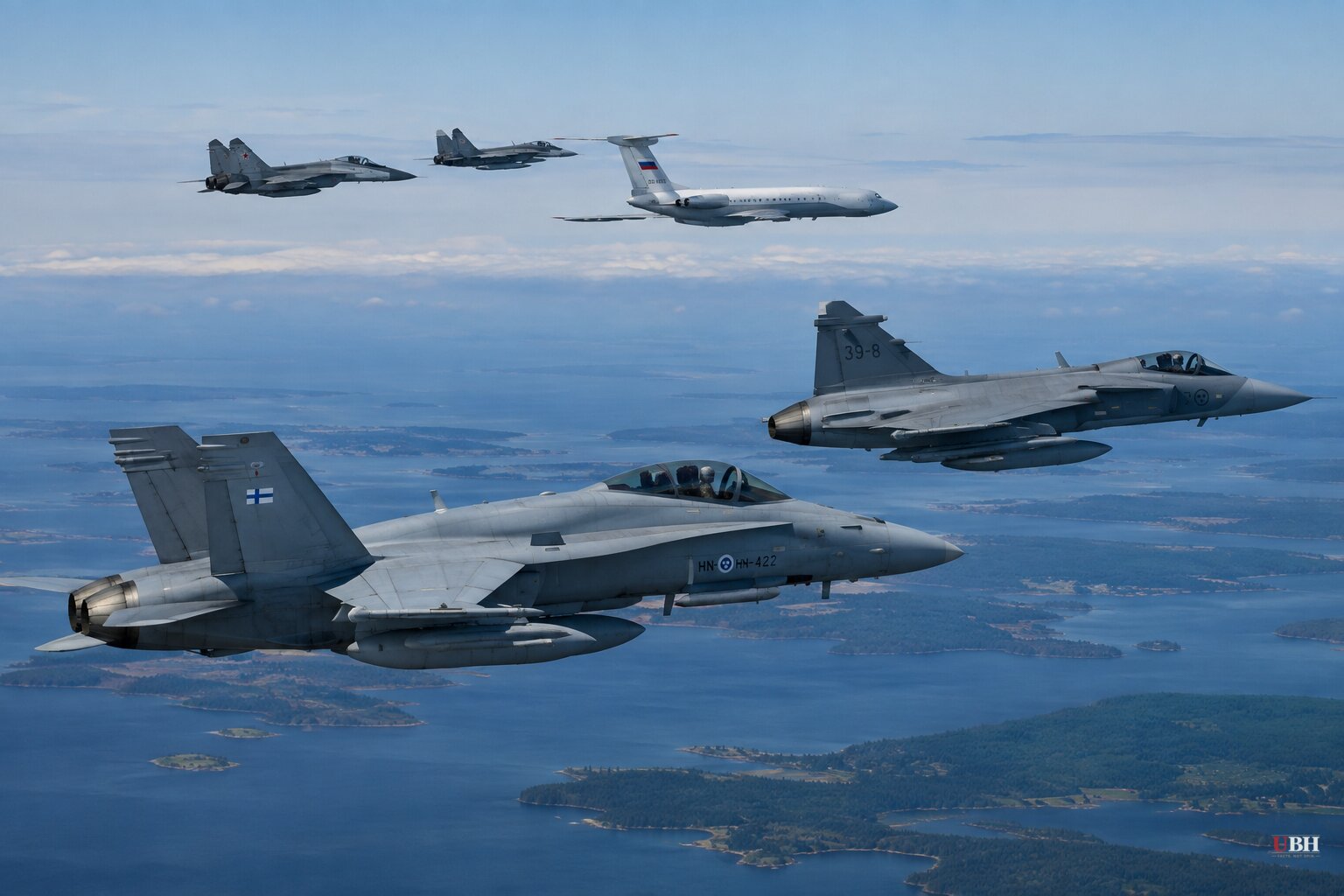
Finnish and Swedish fighter jets scrambled together for the first time on Thursday, September 24, 2026, to identify a group of Russian military aircraft flying in international airspace over the Gulf of Finland, according to a joint statement from Finland's air force. The Russian formation included a Tu-134 transport plane, MiG-31 interceptors and Su-30 fighters, the Finnish Air Force said.
Finnish F/A-18 Hornets and Swedish JAS 39 Gripens flew the mission, directed out of Finland's Air Operations Centre. Finland's air force called it "the first joint operational identification mission" for the two countries' air forces, a statement echoed word for word by Sweden's armed forces.
Finland and Sweden announced deeper Quick Reaction Alert cooperation on August 28, 2026, letting each country's jets operate from the other's air bases, according to the Finnish Defence Forces via aerocorner. Under that arrangement Sweden also contributes a Visby-class corvette to help patrol the Baltic, with the cooperation set to run through at least the end of 2026.
"The deeper cooperation that began this autumn enables joint identification missions and allows QRA fighter jets to operate from the other country's air bases," said Colonel Vesa Mäntylä, deputy chief of staff at Air Force Command Finland. Swedish Air Force commander Major General Jonas Wikman put it plainer: "This is what close cooperation looks like in practice."
Swedish Prime Minister Ulf Kristersson posted on X that the operation was "a concrete expression of the readiness and trust we have built together," adding that "the Baltic Sea has never been as vulnerable as it is now, but it has also never been better protected than it is right now," as reported by Reuters via Global Banking and Finance.
A wider warning from Denmark
The intercept landed the same day Denmark's Defence Intelligence Service (DDIS) briefed reporters on an updated Russia threat assessment. DDIS chief Thomas Ahrenkiel said there is "a low but growing risk that Russia will launch a limited military attack against one or several NATO countries bordering Russia," while stressing a full invasion remains "highly unlikely" though not impossible, according to Euronews.
Ahrenkiel's agency said Russian hybrid activity, once mostly aimed at spreading fear and eroding Western support for Ukraine, has shifted toward disrupting aid outright, including sabotage against defense contractors and rail shipments of military equipment. DDIS expects more of it, including possible cyberattacks on critical infrastructure.
Those numbers track with what NATO itself has reported. The alliance said its jets were scrambled more than twice as often in July 2026 as in July 2025, and Norway alone launched fighters 62 times in the first half of 2026 in response to Russian flights near its northeastern border, Newsweek reported.
The other side of the airspace argument
A fair skeptic would point out that flying in international airspace is legal. Russian aircraft moving between the mainland and the Kaliningrad exclave routinely cross the Baltic without transponders or flight plans, and NATO's own Allied Air Command treats that as a recurring, largely procedural nuisance rather than a fresh provocation each time it happens.
Aerocorner's reporting adds a detail that cuts against a purely one-sided narrative: Finland has linked some of the airspace tension not just to Russian activity but to Ukrainian drones straying into Finnish territory during Kyiv's strikes on Russia. Finnish officials said that spillover is unlikely to stop soon, while explicitly stating there is no direct military threat aimed at Finland right now.
The Independent's live-blog coverage folded Thursday's intercept into the same feed as a separate CIA warning about possible Russian drone attacks on Spain, France or Italy and unrelated Trump-Xi comments on Iran. None of the sourcing ties those stories together as cause and effect; they are simply concurrent items in a busy news cycle, not evidence of a single coordinated Russian campaign.
What's confirmed: this was Finland and Sweden's first joint identification mission since their August cooperation deal, the Russian aircraft stayed in international airspace, and neither the Russian embassy in Stockholm nor Helsinki responded to Reuters' request for comment. The cooperation agreement runs through the end of 2026. Whether it gets extended, and whether joint Nordic scrambles become routine rather than a first, is the next thing to watch.
Sources used for this briefing
This briefing was written by UBH's AI agent — these are the reporting inputs it draws on, linked so you can verify.


