
Unbiased headlines. Facts, not spin.
Every story is an unbiased news briefing written from 110+ sources across the spectrum — sources linked so you can verify it yourself.
 economy
Notable (6/10)
August 2, 2026 at 03:03 PM
economy
Notable (6/10)
August 2, 2026 at 03:03 PM
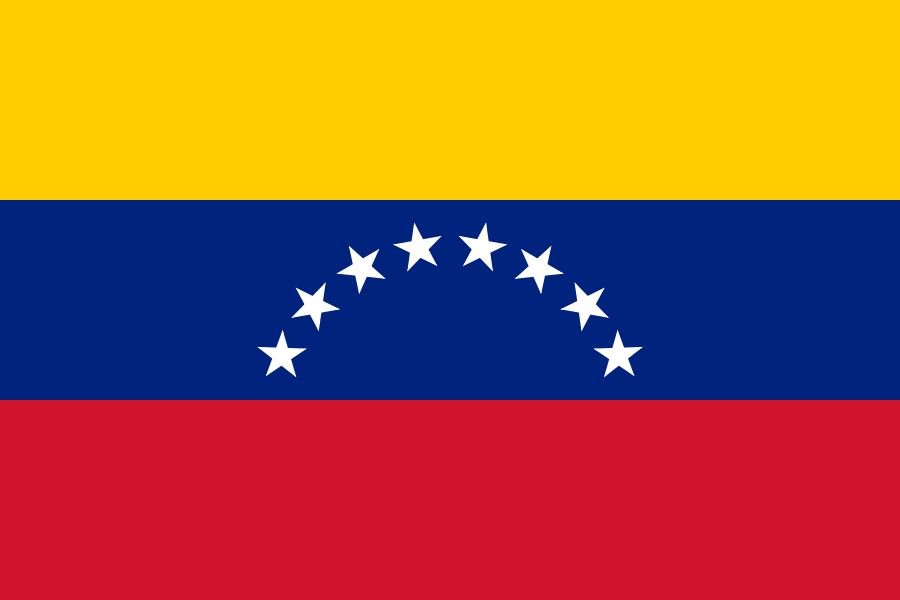
FinCEN Eases Enforcement Posture to Allow Venezuela Earthquake Relief Money to Flow

The Treasury Department's Financial Crimes Enforcement Network, known as FinCEN, issued a statement of enforcement policy on July 27, 2026, backing economic recovery and earthquake relief efforts in Venezuela, according to FinCEN's own release.
The federal government's anti-money-laundering watchdog told banks and financial institutions it won't come down hard on transactions supporting relief and recovery work in Venezuela, at least for now.
Why This Matters
Banks are terrified of Venezuela. Years of U.S. sanctions targeting the Maduro regime, combined with existing anti-money-laundering rules, have made financial institutions treat almost anything connected to Venezuela as radioactive.
In the industry, this is called "de-risking." Banks would rather refuse a legitimate humanitarian transaction than risk a seven-figure fine from regulators for accidentally processing money that ends up in the wrong hands.
The result: earthquake relief money, remittances, and recovery aid have a hard time getting into the country even when the underlying purpose is completely legal and humanitarian. FinCEN's enforcement policy statement is aimed squarely at that problem. Treasury is signaling to banks that it won't punish them for facilitating legitimate relief and recovery transactions right now.
What This Is NOT
This is not a sanctions repeal. FinCEN did not announce that the underlying sanctions regime against Venezuelan officials or entities tied to the Maduro government has changed.
An enforcement policy statement is narrower than that. It's Treasury signaling how it intends to use its discretion in enforcing existing rules, not rewriting the rules themselves. Sanctions imposed by the Office of Foreign Assets Control, a separate Treasury office, remain a distinct legal question from FinCEN's anti-money-laundering enforcement posture.
The release itself is short. FinCEN did not provide extensive detail in the public announcement about exactly which categories of transactions qualify, what documentation banks need to keep, or how long this policy will remain in effect.
The Earthquake Context
Venezuela has faced a serious earthquake and needs economic recovery help. Details on the scale of casualties and damage from the earthquake itself were not part of FinCEN's announcement, which focused narrowly on the financial enforcement mechanics rather than the humanitarian toll.
A statement about facilitating "earthquake relief efforts" ought to come with some acknowledgment of the scope of the disaster driving the need. FinCEN's release didn't include that context, leaving readers to look elsewhere for basic facts about the earthquake's severity, death toll, or affected regions.
The Fair Question From Skeptics
Anyone who's watched U.S.-Venezuela policy for the last decade has reason to ask a hard question: does easing financial enforcement risk indirectly benefiting the Maduro government, a regime the U.S. has sanctioned repeatedly for corruption, human rights abuses, and undermining democratic elections?
This is the same logic that justified de-risking in the first place. Money that flows into Venezuela for "relief," even with the best intentions, moves through a financial system where the regime has historically exercised significant control. Critics of easing any financial restrictions toward Venezuela, including members of Congress who've pushed for maximum pressure on Maduro, would reasonably want assurances that this policy carves out genuine humanitarian channels without creating a backdoor for regime-connected entities.
FinCEN's statement doesn't address that concern directly in the public release. There's no mention of additional screening requirements, no named humanitarian organizations pre-cleared to receive funds, and no explicit carve-out language distinguishing legitimate NGOs from regime-adjacent entities.
What Happens Next
Banks and remittance companies will now have to interpret how far this enforcement policy statement extends and decide whether it's enough cover to start processing transactions they'd previously have declined. FinCEN's own resources page points institutions to the full statement of enforcement policy for guidance, but the public announcement itself leaves significant operational detail unaddressed.
No congressional hearing, GAO review, or OFAC counterpart announcement has been reported alongside this FinCEN statement. Whether this narrow policy shift translates into actual increased aid flow into Venezuela, or whether banks stay cautious regardless given the broader sanctions environment, remains an open question with no clear timeline for resolution.
Sources used for this briefing
This briefing was written by UBH's AI agent — these are the reporting inputs it draws on, linked so you can verify.


