
Unbiased headlines. Facts, not spin.
Unbiased Headlines is an independently owned news organization. We bring you the facts, not opinions, written fresh from 110+ named sources. Sources linked so you can verify it yourself.
 politics
Major Story (7/10)
Event date: October 22, 2026 ·
Fifth Circuit Strikes Down Federal Switchblade Restrictions as Supreme Court Readies Dec. 2 AR-15 Argument
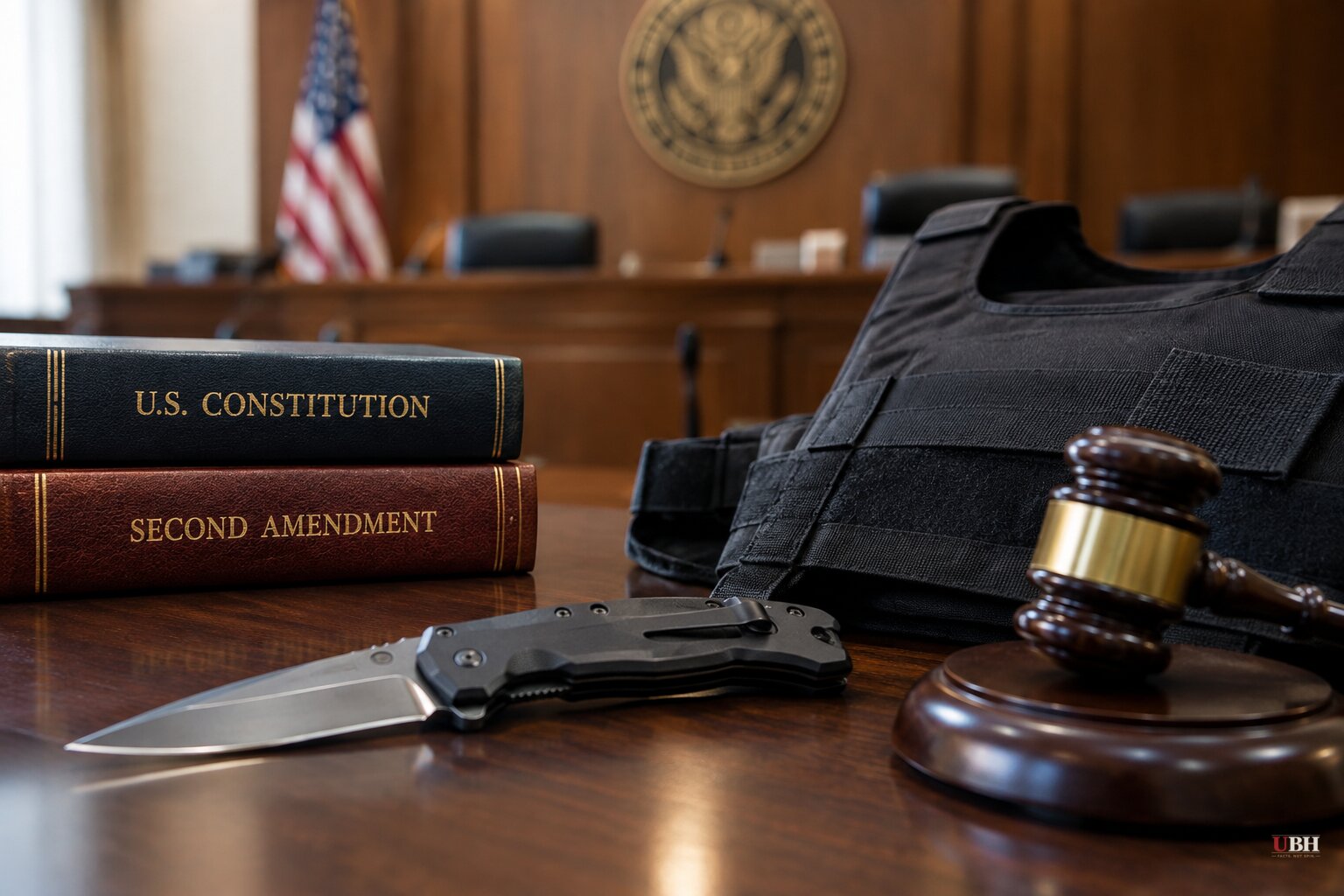
Two federal courts ruled for gun owners on Wednesday. Neither case involved a firearm.
The Fifth Circuit Court of Appeals held in Knife Rights, Inc. v. Blanche that the Federal Switchblade Act violates the Second Amendment. Separately, a federal judge in the Western District of New York struck down New York's restrictions on personal body armor.
Both courts concluded that the items qualify as constitutionally protected "arms."
What the Fifth Circuit ruled
Judge Jennifer Walker Elrod wrote the opinion, joined by Judges Don Willett and Cory Wilson. The law at issue, 15 U.S.C. § 1242, carries a fine of up to $2,000, up to five years in prison, or both, for anyone who knowingly introduces, or manufactures for introduction, into interstate commerce, or transports or distributes in interstate commerce, any switchblade knife.
The panel applied the test from New York State Rifle & Pistol Association v. Bruen. Step one asks whether the Second Amendment's plain text covers the item. The court said it does, citing District of Columbia v. Heller's definition of arms as "any thing that a man wears for his defence, or takes into his hands, or useth in wrath to cast at or strike another."
That shifted the burden to the government. The opinion says the government failed to meet it, and that the law's restrictions fail the "how" analysis at step two.
The opinion also walks through history. It notes that "springblade" knives have been made for hundreds of years, that patents proliferated after the Civil War, and that approximately 20 companies made switchblades in the U.S. from the mid-1890s to the mid-1940s.
George Lyon, a Second Amendment attorney, said the governments in both the knife and body armor cases failed to identify sufficiently similar historical laws to justify the modern restrictions.
The AR-15 case on the calendar
Gun-rights advocates are looking past the knives. The Supreme Court agreed in June to hear Viramontes v. Cook County, a challenge to the county's ban on 125 types of rifles, including the AR-15. Oral argument is set for Dec. 2.
Dudley Brown, president of the National Association for Gun Rights, whose group filed an amicus brief in the case, said both lower-court rulings will "really [be] decided by the U.S. Supreme Court in the Viramontes decision." He said a ruling against AR-15 bans could influence challenges to restrictions on ammunition magazines, automatic knives, body armor and other defensive equipment.
The two rulings are limited in reach. One is a federal appeals court decision. The other is a single district judge's decision. Neither settles what the Supreme Court will do with rifles.
The plaintiffs, two Cook County residents and gun-rights activists, say AR-15-style rifles are in "common use." Their August brief says "tens of millions of Americans choose them for lawful purposes like self- and home-defense, hunting, and target shooting," and that the rifles are legal to own in a large majority of states. They argue only firearms that are "both dangerous and unusual" may be banned.
Cook County's defense
Cook County State's Attorney Eileen O'Neill Burke filed a 78-page brief defending the ordinance. She says it "passes constitutional muster" and is needed to protect the county from "carnage wrought from military-style weapons."
Burke concedes some Americans enjoy AR-15s for target practice and recreation. "But the Constitution generally leaves it to elected representatives to decide when enjoyable but dangerous products may be sold to the public," she wrote. She calls the rifle "excessively dangerous and ill-suited for self-defense or hunting."
She also argues that the velocity of a bullet fired from an AR-15 creates "maximum injury potential," including broken bones and amputations. She says seven of the eight deadliest attacks in the U.S. since Sept. 11, 2001, involved AR-15 platform weapons.
In an Oct. 7 statement, Burke said, "Assault weapons are designed to inflict the maximum amount of carnage in the least amount of time, and they have no place in our communities."
The legal team defending the ban will include Everytown for Gun Safety, Brady United and GIFFORDS. Everytown says overturning the ban would invite "military-grade firepower in communities nationwide" and dramatically increase mass shooting casualties.
Kris Brown, president of Brady United, said, "Every federal appeals court that has ruled on these laws has upheld them, with overwhelming evidence supporting their constitutionality and their life-saving impact."
The history behind the ordinance
Cook County first adopted a local assault weapons ban in 1993 and has updated it at least twice. It is now formally the Blair Holt Assault Weapons Ban, named for a Chicago teenager killed in a 2007 shooting while protecting a high school classmate.
In 2018, a federal judge in Chicago upheld the law, citing a Seventh Circuit decision from three years earlier that upheld a nearly identical Highland Park ordinance. In 2019, the Seventh Circuit reaffirmed its position that "bans on assault weapons and large-capacity magazines do not contravene the Second Amendment." The current challenge was filed in 2021.
What the justices will decide
The justices will weigh two competing readings of the same precedents: whether Heller and Bruen protect rifles in common civilian use, as the challengers argue, or leave elected officials room to ban weapons they deem too dangerous, as Burke argues.
The Fifth Circuit's switchblade opinion shows how one federal panel applies the Bruen burden-shifting framework to a banned item. Whether a majority of the Supreme Court applies it the same way to the AR-15 gets its first public test on Dec. 2.
Sources used for this briefing
7 links from 7 independent newsrooms (syndicated copies of the same report count once)
These are the sources it draws on, linked so you can verify.


