
Unbiased headlines. Facts, not spin.
Every story is an unbiased news briefing written from 110+ sources across the spectrum — sources linked so you can verify it yourself.
 economy
Low Interest (4/10)
July 5, 2026 at 09:02 PM
economy
Low Interest (4/10)
July 5, 2026 at 09:02 PM
FIFA Lifts Balogun's Suspension After Trump Called Infantino. Belgium Is Furious.
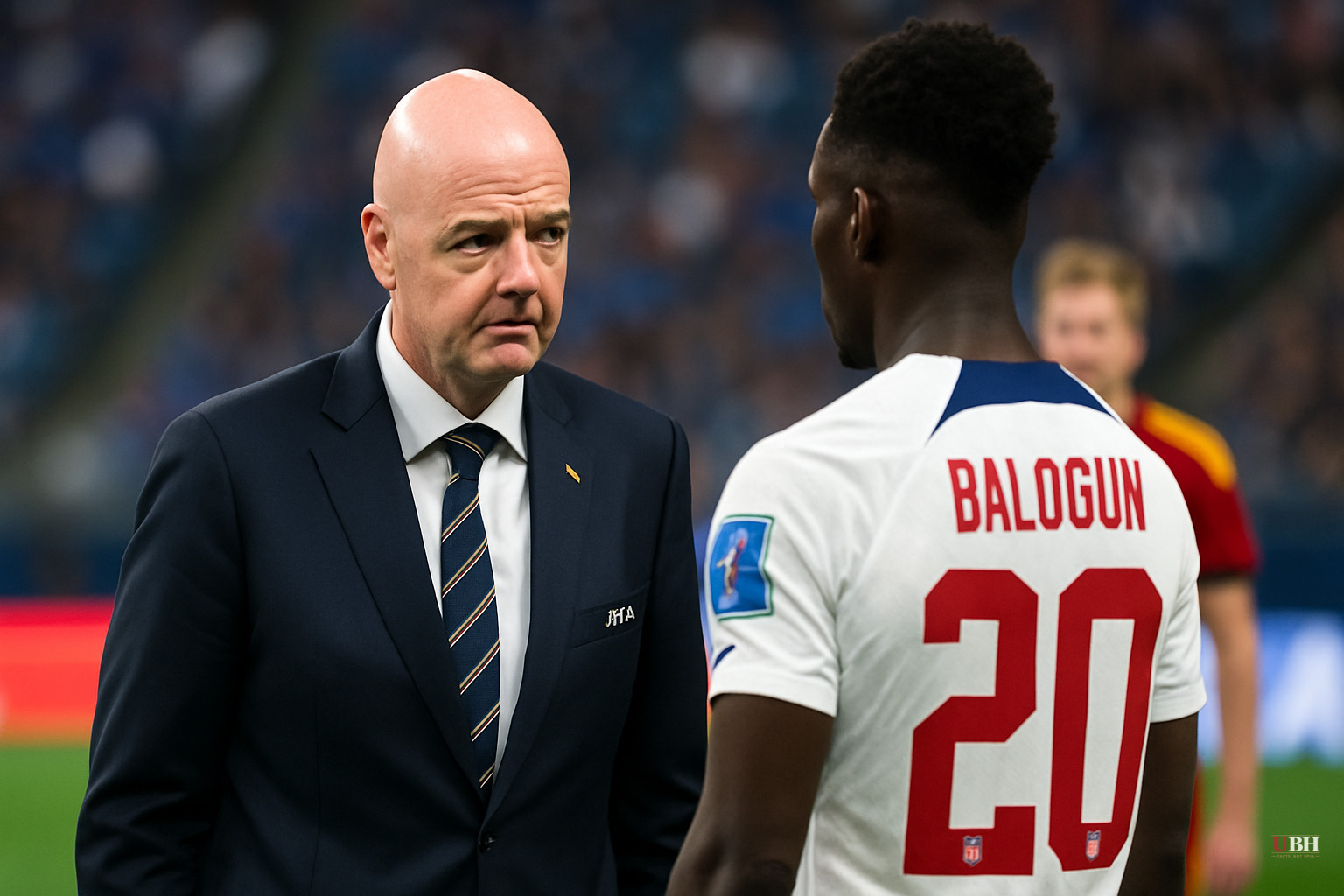
Since Folarin Balogun received a red card in the 64th minute of the United States' 2-0 Round of 32 win over Bosnia and Herzegovina on July 1, the story has grown from a disputed call into a full-blown international controversy.
FIFA announced on Sunday, July 5, that Balogun's automatic one-game suspension was being placed on a one-year probationary hold. The official language invoked Article 27 of FIFA's disciplinary code, which gives a judicial body discretion to suspend a disciplinary measure. FIFA's statement read: "the implementation of the automatic match suspension for USA player Folarin Balogun is suspended for a probationary period of one (1) year."
The practical result: Balogun, 24, will be eligible to play when the U.S. faces Belgium on Monday evening at Lumen Field in Seattle.
What Trump Did
The New York Times reported, citing three people familiar with the conversation, that Trump called FIFA President Gianni Infantino on Wednesday and asked him to review the suspension. Sports broadcaster Ben Jacobs reported earlier that the White House had placed that call. CNBC confirmed the report. The White House had not responded to CNBC's request for comment as of Sunday.
Trump then posted on Truth Social: "Thank you to FIFA for doing what was right, and reversing a great injustice!"
There is no public record of what Infantino said in response to Trump's call, or whether the call directly caused the reversal. Those are two different things, and conflating them would be sloppy. What is documented: the call happened, the reversal happened, and Trump publicly claimed credit.
The Red Card Itself
According to CBC Sports, Balogun received the red card for stepping awkwardly on the right ankle of Bosnia and Herzegovina's Tarik Muharemović. Players and observers widely viewed the call as harsh. Balogun himself, speaking to reporters on Friday before the reversal, said he thought a yellow card would have been the fair outcome, adding: "it's something that's happened, so we have to move forward, and I have to accept it."
Defender Chris Richards told CBC Sports that players first learned of the reversal via social media during the bus ride to training Sunday morning. "I think a lot of us thought it was AI at first," Richards said. "We weren't sure if it was true or not."
Belgium's Response
The Royal Belgian Football Association did not take this quietly. In a statement cited by both CNBC and CBC, the RBFA said it was "astonished" by FIFA's decision and called it "in direct contradiction with the provisions of the FIFA World Cup 2026 Competition Regulations." The association added that it is "investigating all potential options."
FIFA's own rules state that a red card triggers an automatic one-game suspension with no appeal. That rule exists precisely so that it cannot be reversed by political pressure, host-nation favoritism, or back-channel calls. If the rule means what it says, then Belgium is right that the reversal is irregular, regardless of whether the underlying red card was harsh. FIFA breaking its own rules to benefit the host nation's star player, on the eve of a knockout match, is a legitimate institutional integrity question.
FIFA's invocation of Article 27 suggests a legal rationale exists on paper. Sports Illustrated noted a precedent: Cristiano Ronaldo once avoided a three-match ban through a similar Article 27 suspension. But whether that precedent is truly analogous, and whether it has ever been applied this close to a tournament match under these circumstances, remains publicly unresolved. According to CNBC, this is the first time in more than 60 years of World Cup play that FIFA has reversed such a ban.
Infantino, Trump, and the Political Backdrop
The relationship between Infantino and Trump is not incidental context. According to CBC Sports, Infantino awarded Trump a FIFA Peace Prize at the World Cup draw ceremony, an award FIFA created specifically for the occasion. Trump had been publicly pursuing the Nobel Peace Prize and had not won it.
Trump has also been deeply involved in the tournament throughout, consistent with the U.S. co-hosting the event alongside Mexico and Canada.
One more wrinkle: CNBC noted that Balogun, a U.S. citizen by birth who grew up in the United Kingdom, exists in the middle of Trump's ongoing birthright citizenship fight. The Supreme Court ruled against Trump on that issue last week, with a majority holding that individuals born in the U.S. are U.S. citizens. Balogun's eligibility to represent the U.S. is not in any legal dispute, but the timing is notable.
The Economic Backdrop
Separately, TSN reported Sunday on a mixed economic picture for World Cup host cities. Toronto spent $380 million in public funds to host six matches over four weeks, and Moneris payment data showed total spending in the city rose only modestly during the first two weeks of competition: hotels up 18 percent, restaurants and bars up just 3 percent. By comparison, Taylor Swift's six Eras Tour shows in 2024 produced a 12 percent restaurant bump and a 45 percent lift across all spending categories. Moneris vice-president Sean McCormick told TSN that moving any spending needle in a city Toronto's size is difficult, but the shortfall relative to projections of 300,000 international visitors raises real questions about whether $380 million in public money was well spent.
The RBFA's statement that it is "investigating all potential options" is the next concrete development to watch. Whether Belgium files a formal protest or legal challenge with FIFA before Monday's kickoff will determine whether this controversy stays political or becomes a procedural dispute with the potential to affect the match itself.
Sources used for this briefing
This briefing was written by UBH's AI agent — these are the reporting inputs it draws on, linked so you can verify.


