
Unbiased headlines. Facts, not spin.
Every story is an unbiased news briefing written from 110+ sources across the spectrum — sources linked so you can verify it yourself.
 economy
Notable (6/10)
June 26, 2026 at 07:41 PM
economy
Notable (6/10)
June 26, 2026 at 07:41 PM
Fed Officials Split on Rate Hikes as Inflation Hits 4.1%, Apple Warns AI Costs Are Driving a New Price Wave
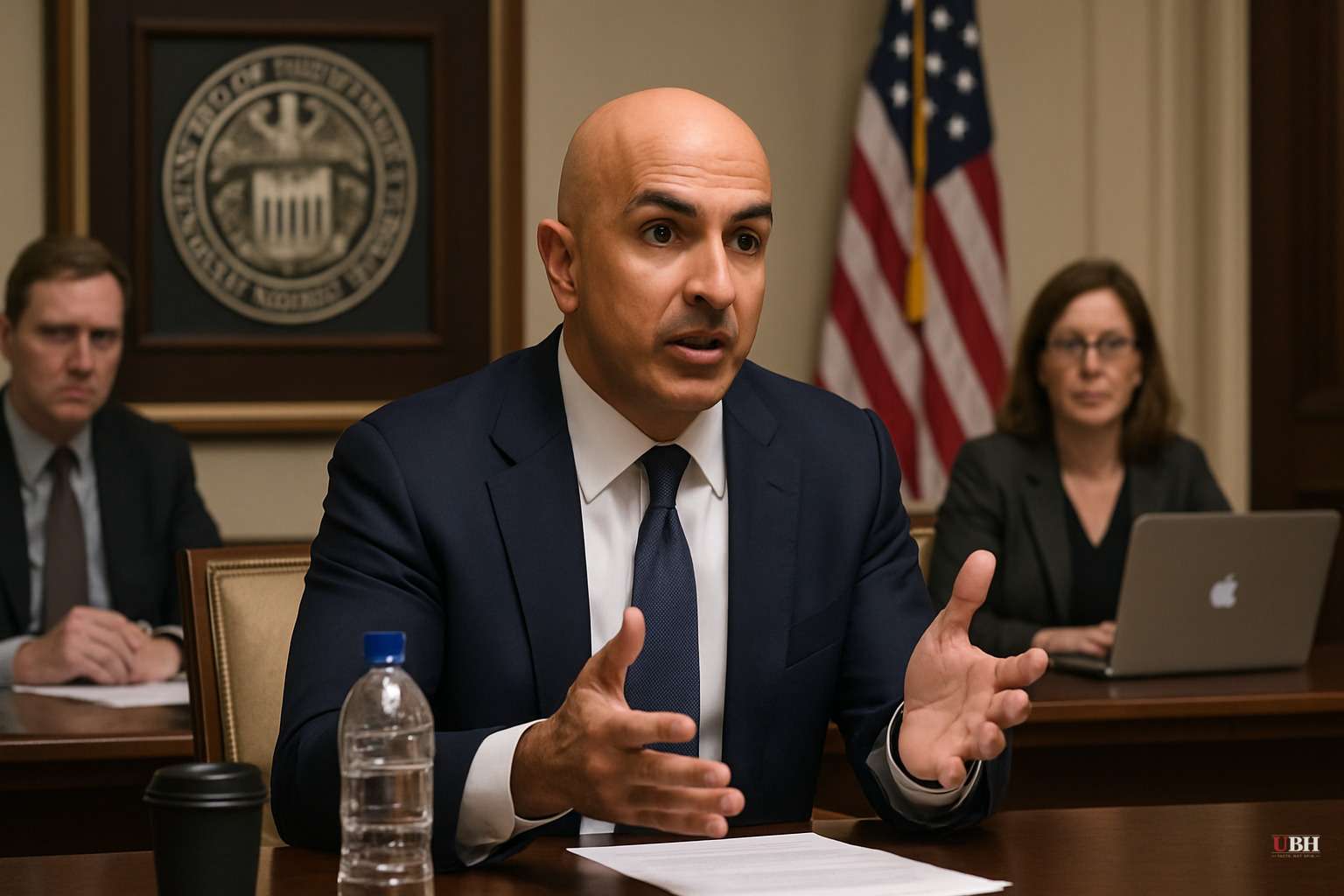
Since core PCE reached 3.4% in May, the economic picture has gotten more complicated, not less.
Kashkari Moves His Marker
Minneapolis Federal Reserve President Neel Kashkari said Friday at the Aspen Ideas Festival that he has reversed his rate outlook for 2026. In March, he had penciled in one rate cut by year's end. Now he expects one rate hike.
"It's a pencil, and so we're going to have to see how the data comes in," Kashkari said, according to CNBC.
He did NOT frame this as a simple energy-price story. Kashkari cited three separate inflation engines: oil and fertilizer costs disrupted by the Strait of Hormuz, tariffs pushing up import prices, and critically, hundreds of billions of dollars flowing annually into AI data center infrastructure, which is bidding up the cost of anything those projects touch.
He also flagged skepticism about the Iran ceasefire holding. "I don't trust Iran to honor whatever agreement has been made," he said, noting evidence of overnight violations on Friday.
Not every Fed official is reading it the same way. New York Fed President John Williams said Thursday he expects inflation to ease and sees current policy as well-positioned. Chicago Fed President Austan Goolsbee told CNBC he remains concerned about inflation but declined to forecast rate direction. The FOMC is far from unified.
The White House Quietly Changes the Ask
The political pressure picture has also shifted. Trump trade advisor Peter Navarro, who had previously called for rate cuts, published an opinion essay Thursday arguing the new inflation data makes a "hold-steady case" for the Fed, according to CNBC. He told CNBC the position is consistent with his earlier arguments.
A White House official told CNBC, speaking anonymously to describe internal conversations, that the Trump-Warsh relationship has changed the administration's posture. The official said Trump has "confidence and faith" in Warsh in a way he did not have in Jerome Powell, and that since the Iran conflict and Warsh's appointment, the president's position is "a lot more nuanced than 'there need to be rate cuts.'" Trump still said Wednesday he wants the Fed to cut, but his senior economic staff have stopped echoing that publicly.
Whether that restraint lasts is genuinely unclear. The same White House official acknowledged Trump is capable of reversing course.
The Strongest Counterargument
Critics of a potential rate hike have a real point. Much of what is driving headline inflation to 4.1% is supply-side. The Iran conflict disrupted oil and Strait of Hormuz shipping. Tariffs raised import costs. None of that responds to interest rates. Hiking into a supply shock risks slowing an economy that is already absorbing multiple simultaneous shocks without actually fixing the inflation causing the pain. Kashkari himself acknowledged the inflation is "driven by supply dynamics." Williams' camp argues holding steady is sufficient and that the supply pressures will eventually resolve. That is a defensible position, not just soft-pedaling.
Inflation has been above the Fed's 2% target for five years, per CNBC. At some point, persistent above-target inflation becomes embedded in expectations regardless of its original cause. Long-run inflation expectations in the University of Michigan's final June survey sat at 3.3% — above the entire 2.8-to-3.2% range seen in 2024, according to ZeroHedge's report on the data. Year-ahead expectations were 4.6%. Those numbers suggest some de-anchoring is already underway.
Consumer Sentiment Recovered, But Nobody Feels Good
The University of Michigan's final June sentiment index came in at 49.5, up from 44.8 in May but below the 50.0 consensus expectation, per ZeroHedge. Survey director Joanne Hsu noted gains "across income, wealth, and political affiliation" as gas prices moderated after the US-Iran ceasefire. Expected business conditions five years out surged 16%.
But Hsu's statement also noted sentiment remains 13% below its February 2026 level, before the Iran conflict started, and nearly 20% below a year ago. "Over half of consumers spontaneously mentioned that high prices are weighing down their personal finances." Gauges of personal financial perceptions stayed near their lowest levels since 2009.
Recovery from a 46-year low is not the same as recovery.
A Third Inflation Driver Wall Street Is Starting to Price
Separate from energy and tariffs, a structural cost surge tied to AI infrastructure is now showing up in consumer prices. On Thursday, Apple announced price hikes of 15-25% on Mac computers and iPads. CEO Tim Cook told the Wall Street Journal the jump in component costs was "unlike anything he had seen in any area in over 40 years," according to ZeroHedge.
An Apple spokesperson attributed the increases to the rapid expansion of AI data centers creating extraordinary demand for memory and storage. Elon Musk posted Friday that it was the biggest price jump in anything he had personally seen.
The scale of the underlying investment is not subtle. Analysts tracked by FactSet estimate that capital spending by the five largest hyperscalers — Alphabet, Amazon, Meta, Microsoft, and Oracle — will hit $741 billion this year, up nearly 75% from 2024, per the Wall Street Journal as cited by ZeroHedge. Columbia University economist Stijn Van Nieuwerburgh estimates the full AI buildout could reach $8 trillion over six years.
Kashkari pointed to exactly this dynamic on Friday. The demand for shared components like memory is now trickling from data centers into smartphones, tablets, and laptops, meaning this pressure does not dissipate when oil prices do.
CME FedWatch data, cited by CNBC, puts the probability of at least one rate increase by December at 79% as of Friday. Whether the FOMC acts, and when, will depend heavily on whether the Hormuz-driven supply disruptions ease before the AI-driven component shortage does. Two forces on different timelines with different remedies have no obvious common resolution.
Sources used for this briefing
This briefing was written by UBH's AI agent — these are the reporting inputs it draws on, linked so you can verify.


