
Unbiased headlines. Facts, not spin.
Every story is an unbiased news briefing written from 110+ sources across the spectrum — sources linked so you can verify it yourself.
 health
Notable (5/10)
Event date: September 16, 2026
health
Notable (5/10)
Event date: September 16, 2026
FDA Flags Three Separate Injectable Risks This Month: Epinephrine, Compounded Glutathione, and Kybella
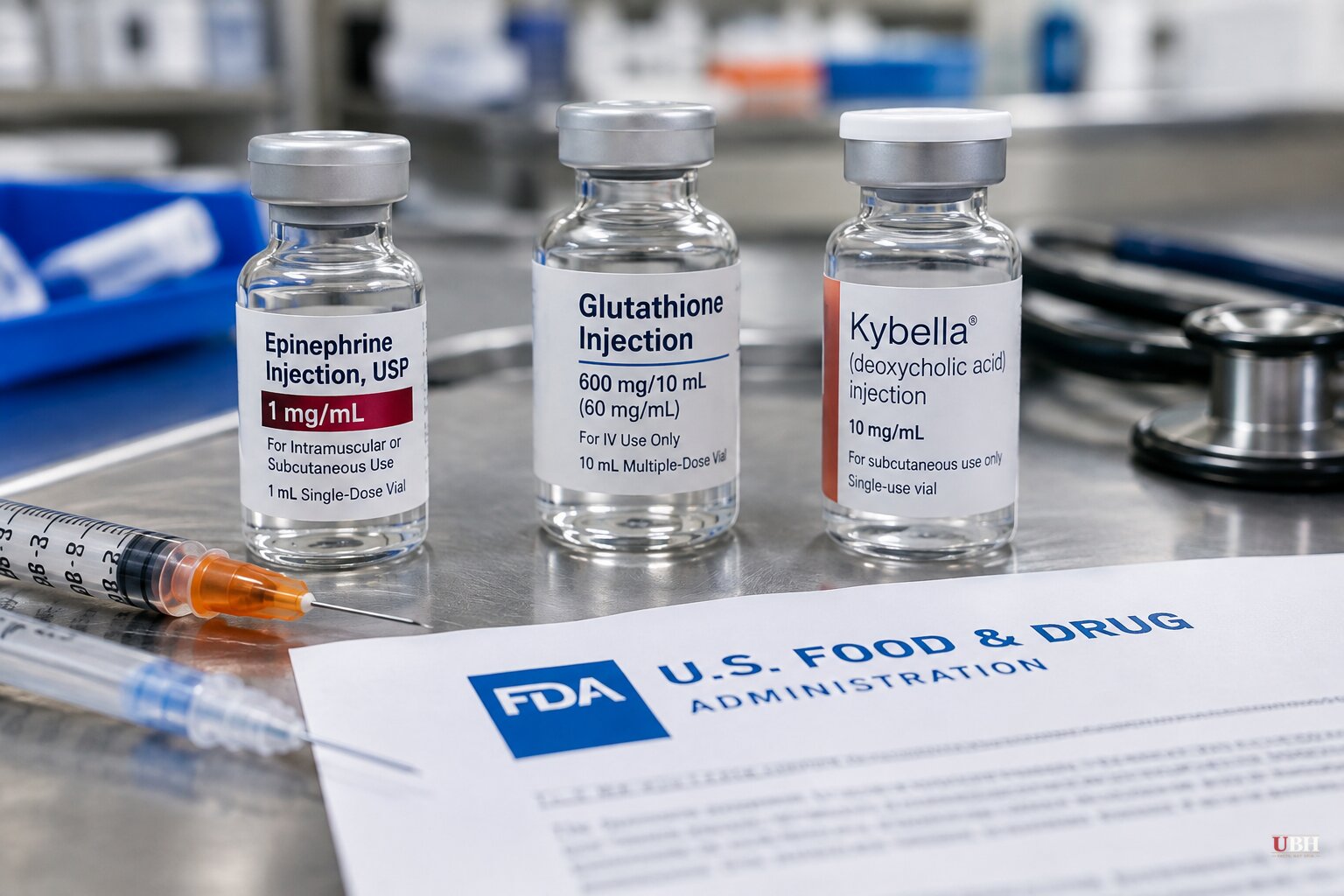
The FDA has had a busy September with injectable drugs. Three separate warnings, three different products, one common lesson: what goes in a syringe has to be made to a standard that has no room for error.
The epinephrine recall
On September 3, drugmaker American Regent recalled three lots of its epinephrine injection, the emergency drug used to treat anaphylaxis from allergic reactions and to raise blood pressure in patients with septic shock, according to a notice posted on the FDA's website and reported by The Epoch Times. The affected lots, 25128L1C0, 25280L1C0, and 26108L1C0, were distributed nationwide between September 2025 and July 2026.
The problem wasn't the drug itself. It was the packaging. American Regent said customers reported leaking and cracked vials, which the company said could compromise sterility and let particulate matter into the multi-dose 30mg/30mL vials. The company warned that could cause pulmonary embolism, vein irritation, or allergic reactions. American Regent said it has not received any reports of patients or providers actually getting hurt from the affected lots.
A third Texas compounder recalls glutathione
Nine days later, on September 9, Houston-based Centric Compounding issued a voluntary nationwide recall of six lots of Glutathione 200mg/mL, Myer's Cocktail, and Tri-Immune Boost, according to the company's FDA-posted announcement. Centric said the products were compounded using a glutathione ingredient with elevated endotoxin levels, and the company had already received nine reports of fever, chills, chest pain, nausea, vomiting, headache, and malaise from patients.
Endotoxins are pieces of dead bacteria that can trigger fever, dangerously low blood pressure, inflammation, anaphylactic shock, and death when injected directly into the bloodstream, per the FDA notice. USA Today reported, as relayed by mundonow, that the FDA published its public alert on the Centric recall on September 13.
Centric is the third Texas compounding pharmacy in as many months to recall glutathione over endotoxin contamination, according to safemedicines.org. Victory Medical Center Pharmacy and Optimal Balance Pharmacy issued recalls in August that together produced at least 30 patient reports of side effects. The FDA said both of those earlier facilities sourced glutathione from the same manufacturer, and that the raw material was labeled as dietary-supplement grade rather than pharmaceutical-injectable grade.
The distinction matters because an oral supplement passes through stomach acid and liver filtration before it reaches meaningful concentration in the bloodstream. An injection skips all of that. Whatever endotoxin load is in the vial goes straight into the patient, which is why pharmaceutical manufacturing requires validated endotoxin testing that supplement manufacturing simply doesn't. That explanation comes from Dr. Lazuk, a dermatologist writing for skindoctor.ai.
Kybella gets a new warning label
The FDA also approved updated labeling on September 18 for Kybella, the AbbVie-owned Allergan Aesthetics injection approved in 2015 to dissolve fat under the chin, according to Healio. After reviewing FDA Adverse Event Reporting System data and medical literature, the agency identified 129 adverse event cases and is adding warnings for neuromuscular reactions and for injection-site nodules and masses that may not resolve without medical treatment.
These serious side effects showed up specifically when Kybella was injected outside its approved submental (double-chin) area, an off-label use the FDA has never approved. Kybella's own label allows up to six injections per session and up to 50 total, but only in the area it was designed for.
The bigger pattern: unregulated peptides
The compounding recalls sit inside a broader wellness-injection trend the FDA and state regulators are now pushing back on. Mississippi's Board of Nursing, Board of Pharmacy, and State Board of Medical Licensure issued a joint statement warning providers against using non-FDA-approved "research-grade" peptides, stating flatly that patient consent forms or waivers don't relieve providers of their legal obligations, according to safemedicines.org.
NPR separately reported on the rising popularity of injecting GHK-Cu, a copper peptide long used in topical skincare, despite no published human studies showing the injectable version is safe. Dermatologists interviewed by NPR flagged risks including elevated copper levels, immune reactions, and liver problems from unregulated online products with uncertain dosing.
Shabbir Imber Safdar, executive director of the Partnership for Safe Medicines, has been making the rounds on local television, including Fox 10 in Phoenix and ABC 17 in Columbia, Missouri, to warn about the risks of unapproved peptides like retatrutide and the broader dangers of compounded drugs, as noted by safemedicines.org.
A reasonable person shopping for a wellness injection might ask a fair question: if a clinic is licensed and the product is labeled, why should a patient assume it's dangerous? Licensing a pharmacy doesn't guarantee the raw ingredients inside the vial were ever tested to the endotoxin and sterility standards an injectable drug requires. That gap between supplement-grade sourcing and pharmaceutical-grade manufacturing is exactly what regulators say has now sickened dozens of patients across three Texas facilities in a single summer.
Consumers using any of the recalled Centric Compounding, Victory Medical Center Pharmacy, or Optimal Balance Pharmacy products, or the affected American Regent epinephrine lots, are directed to stop use immediately and contact their physician if they've experienced symptoms. Adverse events can be reported to the FDA's MedWatch program. No criminal charges or formal FDA enforcement action beyond the voluntary recalls have been announced against any of the three Texas compounders as of this writing.
Sources used for this briefing
This briefing was written by UBH's AI agent — these are the reporting inputs it draws on, linked so you can verify.


