
Unbiased headlines. Facts, not spin.
Every story is an unbiased news briefing written from 110+ sources across the spectrum — sources linked so you can verify it yourself.
 health
Major Story (7/10)
Event date: August 19, 2026
health
Major Story (7/10)
Event date: August 19, 2026
Montana Approves First Drug Under Law Letting Companies Sell Unproven Treatments to Any Paying Patient
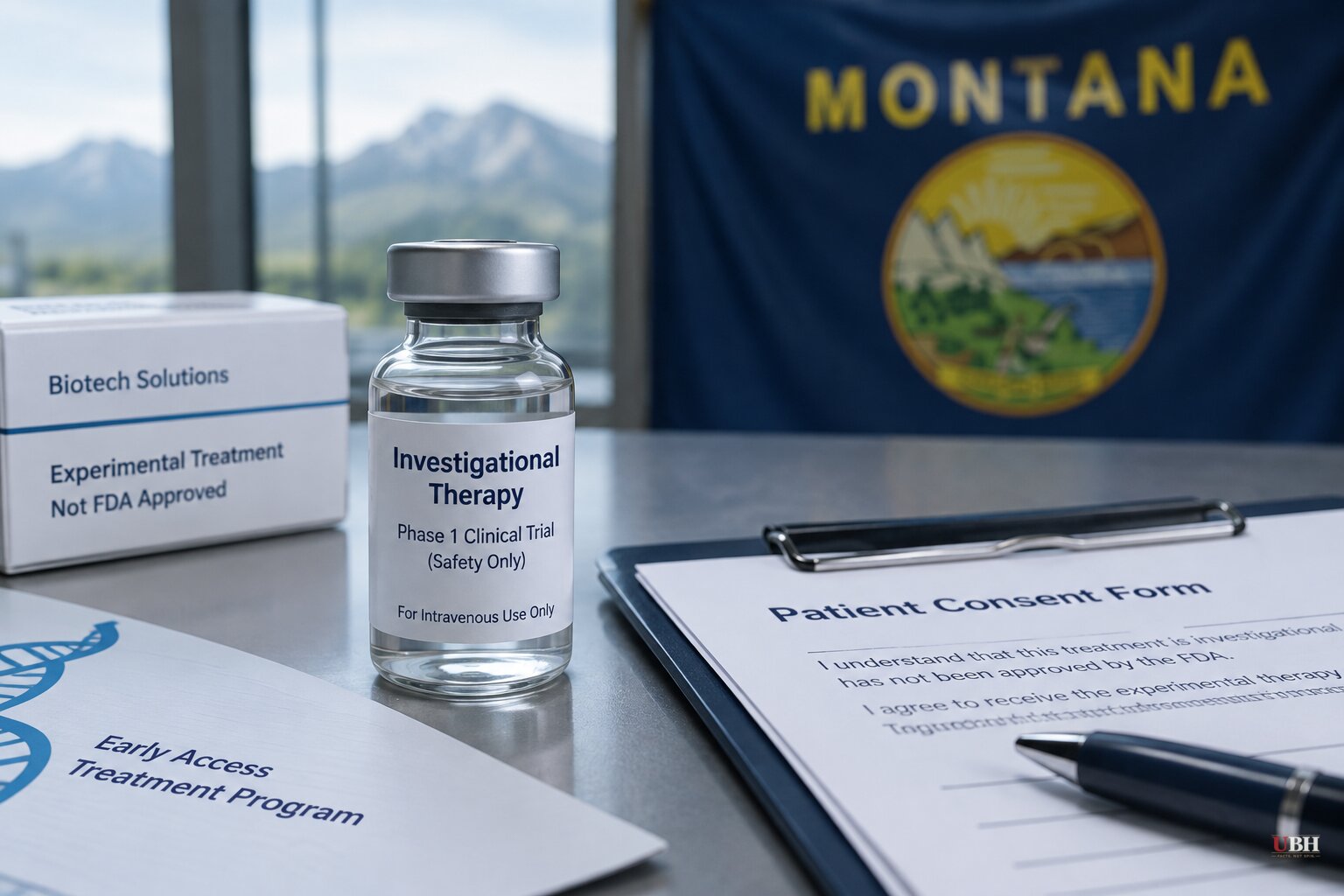
Montana just built a bypass around the FDA, and the first drug rolled through it last month.
The state's Senate Bill 535, passed by the legislature last year, lets any patient with any condition access experimental treatments that have cleared only Phase 1 safety trials. No proof the treatment works. No FDA sign-off. Just a private review board, informed consent, and a provider's recommendation.
The federal Right to Try Act, which President Donald Trump signed in his first term, only covers patients with life-threatening conditions and bars companies from charging for the treatment. Montana's law tosses both restrictions. Companies can charge whatever they want, to whoever wants it.
The First Approval
Last month the state's privately run review board approved its first treatment: a daily antihistamine paired with a proprietary sound program from a Denver company, marketed as a cure for neurological hearing loss, according to Business Insider. Patients listen to it an hour a day.
There's a catch. Patients can't actually get the treatment yet. Montana hasn't licensed an experimental treatment center to administer it, though two applications are pending, according to Politico's reporting as relayed by newsbreak.
Who's Running the Board
Niklas Anzinger, founder of Infinita City, a biotech hub tied to the Honduran special economic zone Próspera, worked with the Alliance for Longevity Initiatives to draft the Montana law. Then he assembled the only active review board that decides which treatments get approved under it.
Business Insider notes Próspera's investors include Peter Thiel and Marc Andreessen, and that the zone gained attention when longevity influencer Bryan Johnson was filmed getting a $25,000 gene therapy treatment there for the Netflix documentary "Don't Die." This is the same circle now trying to turn Montana into a domestic version of that model.
The Case For It
Anzinger's argument isn't crazy on its face. He says small biotech companies can't compete when a clinical trial costs hundreds of millions of dollars, and that patients are already flying to Mexico for psychedelics, Turkey for hair treatments, and Switzerland for stem cells anyway. Cut the cost of doing business, he argues, and patients get access closer to home instead of overseas.
He told Montana lawmakers, according to Politico, that the state "would no doubt have the potential to become the world's leader in accelerating patient access to innovative, potentially life-saving treatments."
The Case Against It
State Rep. Kathy Love, a Hamilton Republican, raised the obvious question during debate over the bill: who actually benefits. "In the committee, also, the proponents were the biotech industry," Love said. "It was not private citizens."
Arthur Caplan, former head of the division of medical ethics at NYU Grossman School of Medicine, told Business Insider the program "is really a program to facilitate access to anybody and everybody who wants it, to novel experimental interventions for anything." Caplan compared it to a prediction market rather than medical research, a fair description given that Phase 1 trials only test safety in small groups, not whether a treatment actually helps anyone.
Phase 1 clearance means a drug probably won't kill you in the short term. It says nothing about whether the hearing-loss treatment, or anything else approved down the line, does what the company selling it claims.
The Federal Wildcard
The whole experiment survives at the pleasure of the FDA. No enforcement action or investigation into Montana's program has been announced. Business Insider reports the biotech industry has reason for optimism here: Health and Human Services Secretary Robert F. Kennedy Jr. has pledged to expand access to longevity treatments like stem cell therapies and peptides.
But there's tension underneath that optimism. KFF Health News, citing Bloomberg's Chris Wainer, reported this week that rare-disease drugmakers have seen their shares plunge under the current FDA, which has grown more skeptical of approving drugs based on limited evidence from small trials without placebo controls. That's the opposite instinct from what Montana's law assumes federal regulators will tolerate.
So the open question isn't whether Montana's law is legal within the state. It clearly is. It's whether the FDA treats a Denver company selling an unapproved hearing treatment to Montana patients as business as usual, or as exactly the kind of unproven claim it's been cracking down on elsewhere. Two license applications for treatment centers are sitting in Helena waiting for an answer nobody in Washington has given yet.
Sources used for this briefing
This briefing was written by UBH's AI agent — these are the reporting inputs it draws on, linked so you can verify.


