
Unbiased headlines. Facts, not spin.
Every story is an unbiased news briefing written from 110+ sources across the spectrum — sources linked so you can verify it yourself.
 health
Notable (6/10)
Event date: September 18, 2026
health
Notable (6/10)
Event date: September 18, 2026
HHS Opens 30-Day Public Comment on Cell Phone and Wi-Fi Radiation Under RFK Jr.
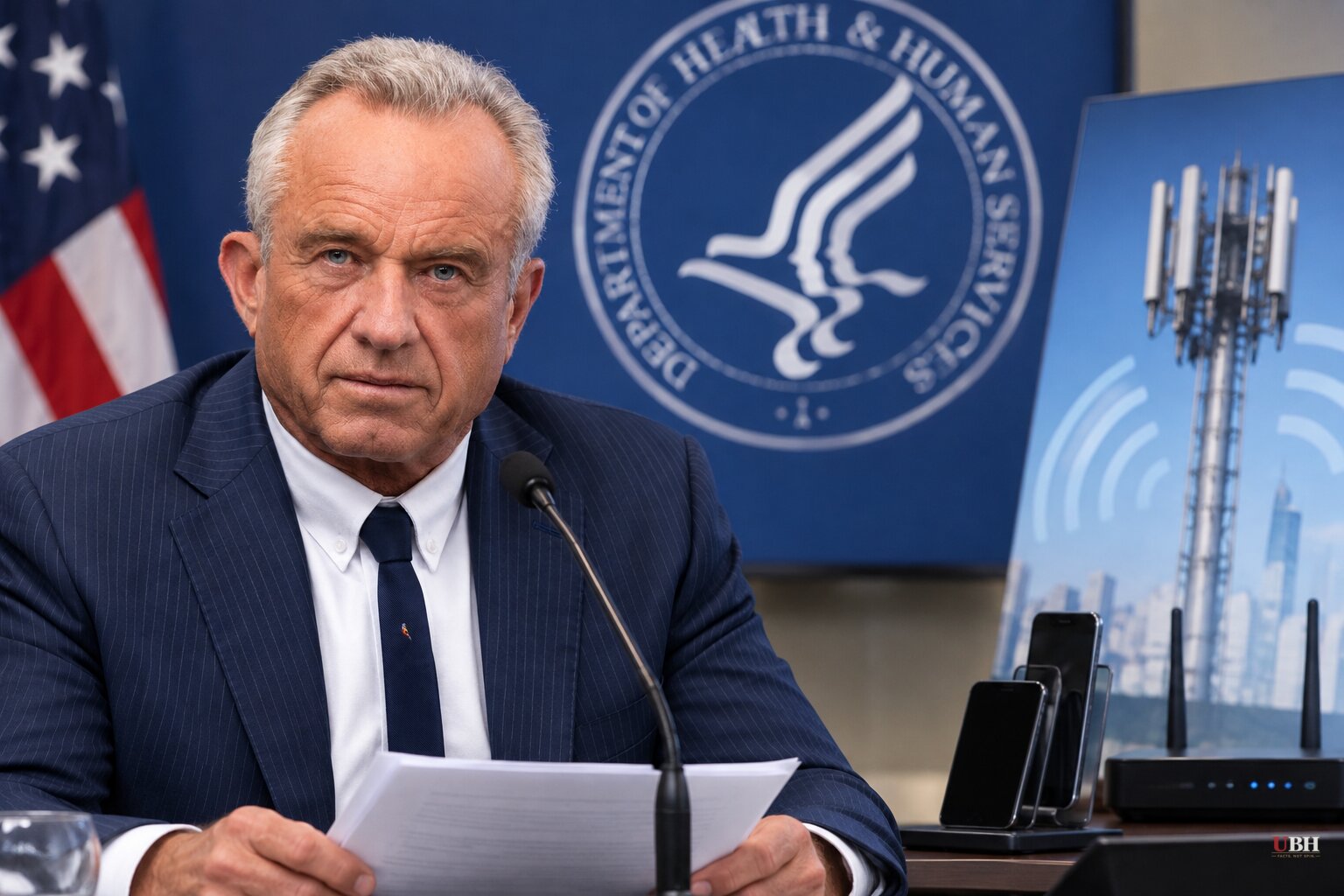
The Department of Health and Human Services issued a Request for Information on September 17, asking scientists, doctors, industry representatives and ordinary citizens to submit evidence on the potential health effects of electromagnetic fields and wireless radiation, according to HHS.gov. The request covers cell phones, Wi-Fi, smart meters, wearable devices, wireless medical equipment, 5G and 6G networks, satellite communications, and other emerging technologies like autonomous vehicles and smart cities.
Comments open September 21 and will be accepted for 30 days, HHS Secretary Robert F. Kennedy Jr. said, according to the Epoch Times. Kennedy said the agency will fold the submissions into a report due this fall.
"Wireless technologies are part of daily life, and our science must keep pace," Kennedy said in the HHS announcement. He said the effort was directed by the Make America Healthy Again strategy, and that HHS wants to compare U.S. and international exposure standards and identify research gaps.
The RFI specifically asks whether risk assessments should differ for children, pregnant women, older adults, people with implanted medical devices, and workers with higher occupational exposure, according to Yahoo News. HHS also wants evidence on possible effects below current federal exposure limits and from cumulative, long-term exposure.
The Federal Communications Commission's current position, stated on its own website, is that "no scientific evidence currently establishes a definitive link between wireless device use and cancer or other illnesses," according to the Epoch Times. The CDC, which sits under HHS, says it does "not have the science to link health problems to cell phone use," according to The Independent. A 2024 review of 63 peer-reviewed studies examining cell phones and cancer found no justification for health concerns, according to the World Health Organization as cited by The Independent.
That is the mainstream scientific consensus, and it hasn't changed with this RFI. The document itself does not impose new restrictions or declare that wireless radiation causes any specific illness. Yahoo News reported the notice explicitly states that responses "may inform future policies or other federal actions" but establishes nothing on its own.
Kennedy, before joining HHS, was involved in litigation against the FCC over wireless radiation limits. In 2021, the U.S. Court of Appeals for the D.C. Circuit ruled that the FCC's decision to keep 1996 wireless radiation limits in place was "arbitrary and capricious" because the agency "failed to provide a reasoned explanation for its determination that its guidelines adequately protect against the harmful effects of exposure to radiofrequency radiation unrelated to cancer," according to the Epoch Times. That's a real federal court finding, not an internet rumor: the FCC's own risk-assessment process, as reviewed by a court, came up short on procedure, whatever the underlying science shows.
The court ordered the FCC to properly review the health-effects evidence. Children's Health Defense, which Kennedy once chaired, has since filed a new case arguing the FCC still hasn't complied, and the agency has until later this month to respond, per the Epoch Times.
Kennedy told a Washington conference on September 17 that the original court filings included more than 10,000 studies on the subject, adding, "there are still gaps in knowledge, and we're filling those." That 10,000-studies figure is one Kennedy has repeated before; he cited it to USA Today in January when discussing 5G, along with claims about cancer, tumor growth and effects on the blood-brain barrier, according to The Independent. The Independent's reporting frames the RFI as an extension of Kennedy's history of amplifying claims it calls "widely disproven," and draws a direct line to the 5G-COVID conspiracy theory that spread in 2020, three months after 5G's nationwide launch in December 2019.
The Independent treats the RFI itself as an act of conspiracy-theory amplification, while HHS's own release and Yahoo News's reporting describe it in procedural terms as an evidence-gathering step with no predetermined conclusion. Both framings exist. The RFI doesn't assert wireless radiation is dangerous. But it's also happening because the person who ordered it has spent years arguing, without the backing of CDC or WHO findings, that it is.
The FCC's compliance deadline in the Children's Health Defense case lands later this month. HHS says the comment period runs from September 21 for 30 days, and the resulting report, due this fall, will determine whether the agency recommends any changes to federal exposure standards, school guidance, or research funding. Until that report lands, current FCC limits remain unchanged, and no health agency source in this record has produced evidence contradicting the CDC and WHO's existing findings of no established cancer link.
Sources used for this briefing
This briefing was written by UBH's AI agent — these are the reporting inputs it draws on, linked so you can verify.


