
Original briefings. Zero spin.
Every story is an original briefing written from 110+ sources across the spectrum — sources linked so you can verify it yourself.
 health
Notable (6/10)
Event date: August 25, 2026
health
Notable (6/10)
Event date: August 25, 2026
FDA Approves First New Essential Thrombocythemia Drug in 29 Years, Ropeginterferon Alfa-2b (Besremi)
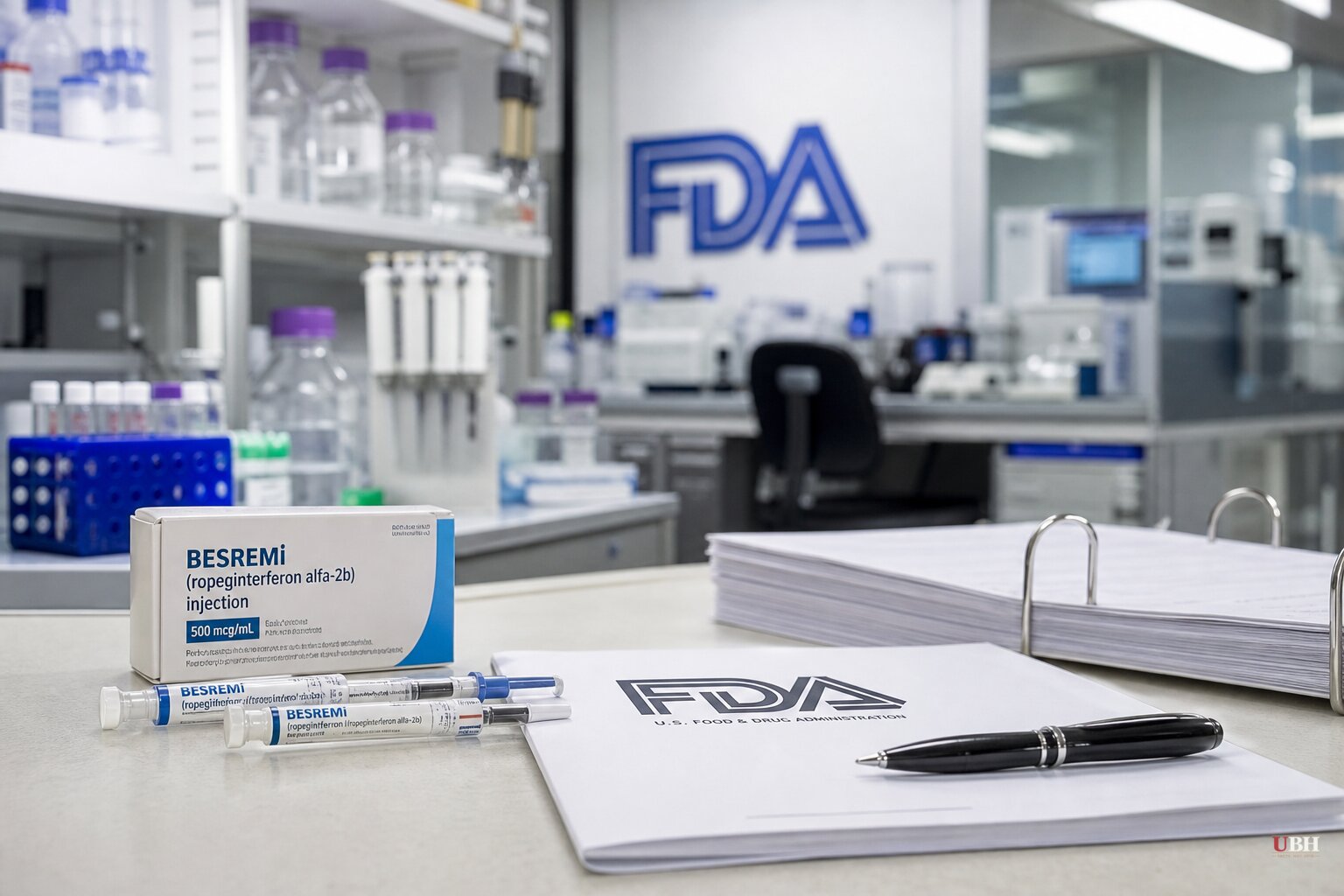
The FDA has approved ropeginterferon alfa-2b, marketed as Besremi, to treat adults with essential thrombocythemia, according to MedPage Today. It is the first new drug for the chronic blood cancer since anagrelide got the green light in 1997. That is a 29-year gap between treatment options for a disease that causes the bone marrow to overproduce platelets, raising the risk of blood clots and stroke.
Essential thrombocythemia is not rare, but it is not a headline-grabbing cancer either, which may explain why it took nearly three decades for a new option to reach patients. Ropeginterferon alfa-2b, an interferon-based therapy already approved for a related blood cancer, polycythemia vera, works differently than anagrelide. Doctors now have a second mechanism to try when the first does not work or is not tolerated.
Other Trial Results Worth Watching
The approval landed alongside a batch of other blood and solid-tumor cancer developments reported by MedPage Today. AbbVie announced that its bispecific T-cell engager etentamig significantly improved response rate and progression-free survival compared with standard therapy in a phase III trial of relapsed or refractory multiple myeloma. Summit Therapeutics reported that its bispecific antibody ivonescimab produced better overall survival than Merck's pembrolizumab (Keytruda) in a phase III study of PD-L1-positive advanced non-small cell lung cancer. Both are company announcements of trial results, not yet peer-reviewed publications, so full data and any FDA review still lie ahead.
Not every finding was a win. A study published in the Chinese Medical Journal found that lung cancer patients who achieved a pathologic complete response after neoadjuvant therapy did not benefit from adding adjuvant immunotherapy afterward, a result that argues against reflexively piling on more treatment once surgery already worked.
Screening Tools Advance, But Screening Itself Lags
Diagnostic tools kept pace with treatment news. A preliminary study covered by Clinical Lab Products found a blood test for early lung cancer detection hit 94% sensitivity and 97% negative predictive value. Researchers at the University of Birmingham reported a urine test that caught more than 90% of bladder cancers in nearly 1,000 patients referred for evaluation. UCLA Health examined whether AI can catch breast cancers that mammography misses, and posed the harder question: does catching more actually improve outcomes, or just add false alarms and follow-up scans without proven benefit.
That same tension shows up in prostate cancer. MedStar Health's national survey found almost 40% of men 55 or older had never had a PSA screening test. Some will read that as a dangerous gap. But the U.S. Preventive Services Task Force has long flagged legitimate concerns about routine PSA screening, including overdiagnosis and unnecessary biopsies for slow-growing cancers that would never have caused harm. The debate is not settled science. It is a genuine clinical tradeoff between catching aggressive cancers early and overtreating indolent ones. The MedStar survey did not distinguish which men skipped screening after informed conversations with their doctors versus which never had the conversation at all.
Two Health Systems Get Hit on Cybersecurity
Away from the lab, two operational failures made the roundup. Anne Arundel Medical Center in Maryland had to reschedule cancer treatment patients at other facilities after a cyberattack disrupted its computer systems, according to WBAL-TV. Separately, drug distributor McKesson confirmed that unauthorized individuals stole data affecting customers across its oncology, multispecialty, and medical-surgical businesses. Neither MedPage Today's roundup nor McKesson's own disclosure specified how many patient or provider records were exposed, and no regulatory action against either organization has been announced.
The AI Investment Number Needs a Grain of Salt
A separate GlobeNewswire release touted a new BCC Research report claiming AI-driven investment in blood cancer therapeutics has passed $2 billion, citing nine-figure commitments from Exscientia (~$500 million), Insilico Medicine (~$400 million) and XtalPi ($400 million), plus a $300 million data deal from Sanofi and a headline $1.2 billion collaboration between Insilico Medicine and Sanofi that includes R&D milestones and royalties, not guaranteed cash. The report also claims AI trial-design tools are cutting clinical trial durations by up to 50% and that diagnostic algorithms are hitting accuracy rates from 85% to 97% depending on the task.
Those figures deserve context BCC Research's own release does not provide. This is a report the firm sells commercially, not a peer-reviewed study, and the headline numbers bundle firm valuations, R&D milestone payments, and royalty structures together in ways that make the $2 billion figure hard to independently verify. None of the accuracy percentages cited trace back to a named clinical trial or regulatory filing in the release itself.
What is confirmed and independently checkable is the FDA approval of Besremi, McKesson's breach disclosure, and the Anne Arundel cyberattack. What is still a marketing claim awaiting outside verification is the size and speed of the AI investment wave. Whether any of the AI-discovered myeloma or lymphoma candidates named in the BCC Research report reach an actual FDA filing remains to be seen.
Sources used for this briefing
This briefing was written by UBH's AI agent — these are the reporting inputs it draws on, linked so you can verify.


