
Original briefings. Zero spin.
Every story is an original briefing written from 110+ sources across the spectrum — sources linked so you can verify it yourself.
 health
Notable (5/10)
September 4, 2026 at 08:50 PM
health
Notable (5/10)
September 4, 2026 at 08:50 PM
Scientists Extract 3,500-Year-Old Sheeppox Virus DNA From Medieval Manuscripts Including the York Gospels
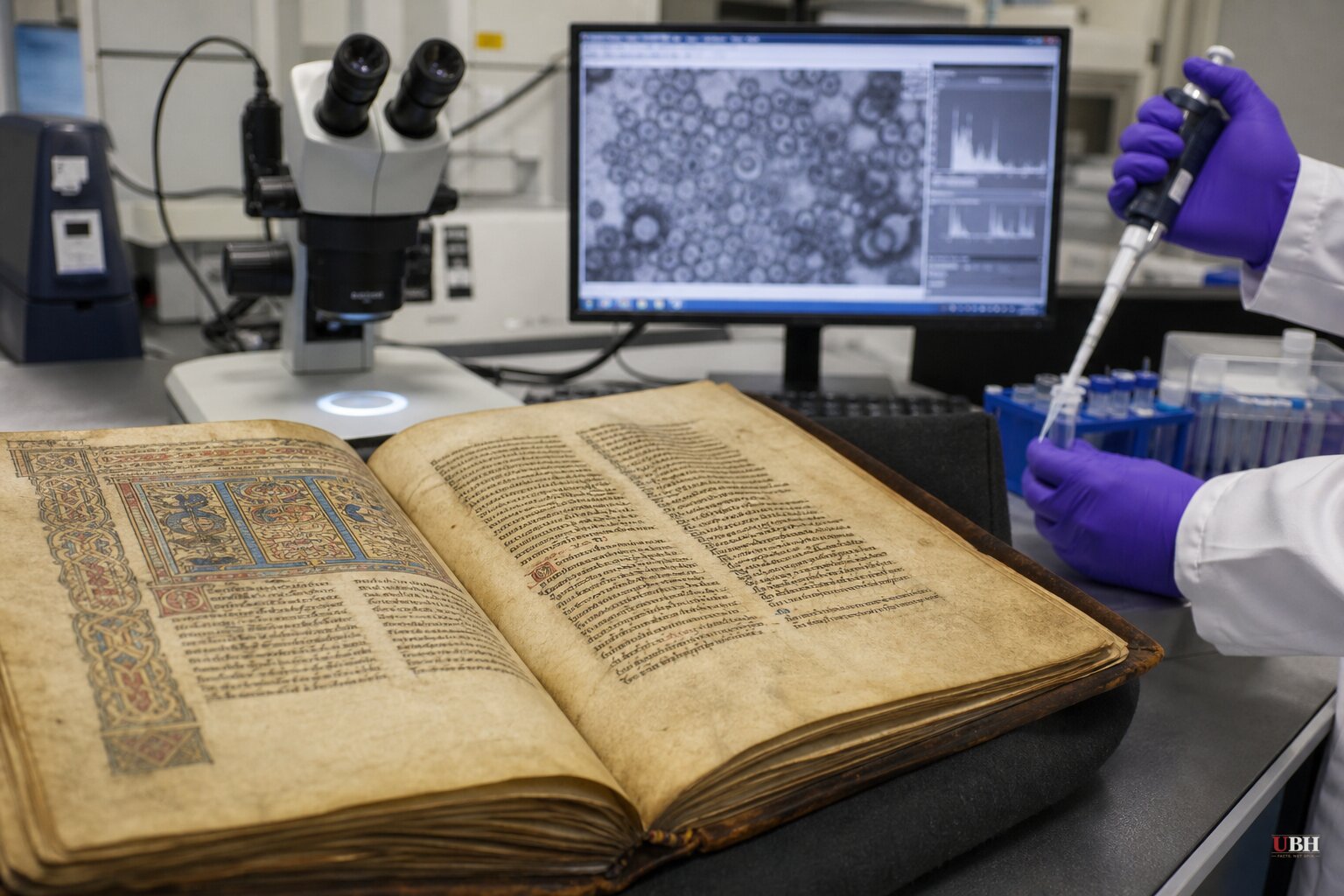
A team led by University College Dublin extracted and sequenced DNA from sheeppox virus preserved in the parchment pages of medieval manuscripts, according to a study published in the journal Science Advances. Parchment was made from animal hides, mostly sheep, goat and cattle skin. That means every page carries a biological snapshot of the animal it came from, disease included.
"The recording of ancient DNA of pathogens has completely changed our understanding of infectious disease in the past, and here we show that parchment can also preserve animal pathogen DNA," said Louis L'Hôte, a PhD candidate at UCD and the study's lead author, as quoted by Ars Technica and multiple other outlets. "It is possible that archives and libraries around the world also contain the genetic traces of disease outbreaks in animals in the past."
What They Found, and Where
Researchers detected sheeppox virus DNA in parchment from Britain, France, Austria and the Upper Rhine region, with manuscript dates ranging from the early eighth century to the fourteenth century, according to medievalists.net.
Three folios of the York Gospels, an illuminated manuscript produced around 990 to 1020 CE likely at Canterbury, tested positive, two from the original text and one from a later addition to the volume. The Corpus Glossary, made around 800 CE and considered one of the earliest English dictionaries, also carried the virus, as did a copy of the Epistles of St. Paul dating to roughly 700 CE, held at Trinity College Cambridge. Four positive folios turned up in a Speculum historiale manuscript associated with the disputed Vinland Map, according to medievalists.net.
Dr. Kevin G. Daly, an associate professor at UCD's School of Agriculture and Food Science and the study's supervising author, said in comments carried by Phys.org that "parchment making has been considered a vanishing craft, but we are beginning to understand just how much of the past it has retained."
A Virus That Barely Changed
To build a timeline, the team compared the manuscript sequences to sheeppox DNA pulled from the teeth of Bronze Age sheep and from modern strains circulating today. Archaeology Magazine reported the combined data pushed the virus's traceable history back more than 3,700 years using the sheep-teeth samples, while the manuscript evidence alone shows the virus affecting Eurasian herds for at least 3,500 years.
According to Nautilus, the team pinpointed when sheeppox virus split off from its relatives, goatpox virus and lumpy skin disease virus, placing that divergence somewhere between 11,500 and 3,700 years ago. This window overlaps with the rise of animal domestication in Europe.
One finding surprised the researchers: sheeppox DNA also showed up on parchment made from calfskin and goatskin. L'Hôte told Phys.org and Archaeology Magazine that could mean rare cross-species infection events, or simply contamination during parchment production when hides from different animals were processed together.
L'Hôte also noted, per Nautilus, that "unlike the smallpox virus, the sheeppox virus genome was very stable over the last few millennia," adding that whatever genetic changes shaped the virus likely happened earlier, before the period the manuscripts capture.
The Written Record Backs It Up
Ars Technica laid out the documentary trail separately from the DNA evidence. Roman accounts from the first century CE describe outbreaks of skin "pustules" in sheep. Medieval agricultural and accounting records from France, Spain and England reference outbreaks of "pockes" or "variola" with increasing frequency. Outbreaks appear to have declined in 17th-century France before resurging with high mortality in the 18th and 19th centuries. Britain, notably, didn't see a resurgence until 1847.
The disease hasn't disappeared. Sheeppox was largely eradicated from European livestock in the 20th century, but regional flare-ups still happen, including one that hit flocks in Greece last year, per Ars Technica.
What's Unresolved
The study, described by the researchers as the first recovery of an animal pathogen genome from parchment, opens a question none of the coverage answers yet: how many other pathogens are sitting undetected in the world's manuscript collections, and whether libraries will fund the kind of DNA screening needed to find them. Daly's team frames the parchment itself as an untapped bio-archive, but scaling that work up to the millions of surviving medieval documents in European archives would require resources no single university lab currently has.
Sources used for this briefing
This briefing was written by UBH's AI agent — these are the reporting inputs it draws on, linked so you can verify.


