
Unbiased headlines. Facts, not spin.
Every story is an unbiased news briefing written from 110+ sources across the spectrum — sources linked so you can verify it yourself.
 health
Notable (6/10)
September 17, 2026 at 07:01 PM
health
Notable (6/10)
September 17, 2026 at 07:01 PM
FDA Approves Bayer's Kerendia for Type 1 Diabetes Kidney Disease, First New Option in Three Decades
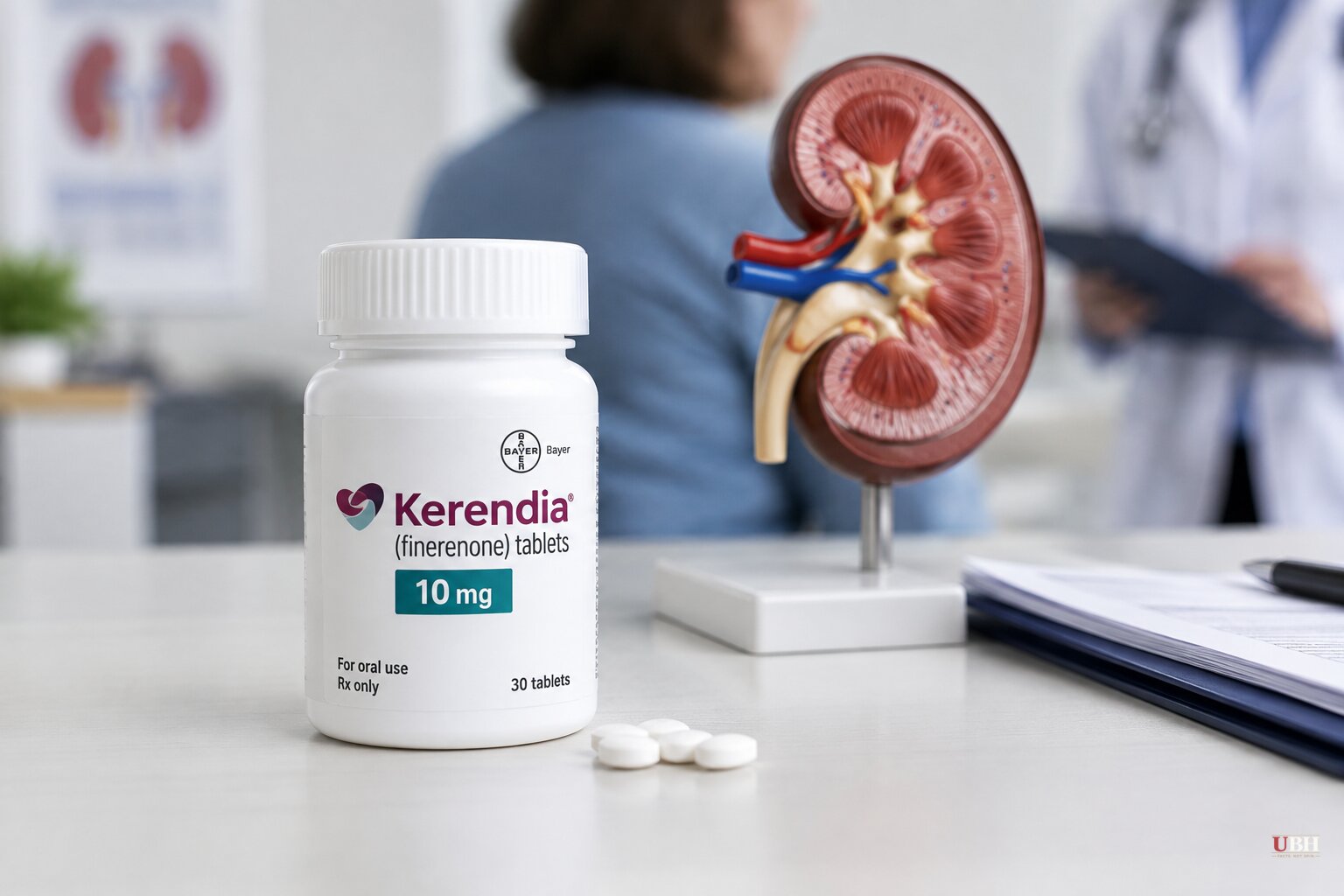
The FDA has approved Bayer's Kerendia (finerenone) for adults with chronic kidney disease associated with type 1 diabetes, the company announced Thursday, September 17. Bayer and multiple outlets covering the decision, including MedPage Today and FiercePharma, call it the first new treatment option for this specific patient population in more than 30 years.
Type 1 diabetics with kidney disease have been stuck using the same glucose and blood pressure drugs for decades while roughly 30% of them still develop chronic kidney disease anyway, according to Bayer. CKD is a leading cause of death in this group, driving both kidney failure and heart complications.
Finerenone is a non-steroidal mineralocorticoid receptor antagonist. In plain terms, it blocks receptors in the kidney and heart that, when overactive, drive inflammation and scarring. It's taken once daily, orally, at 10mg or 20mg.
The new label authorizes finerenone to reduce urinary albumin-to-creatinine ratio, or UACR, a marker of kidney damage. The FDA and Bayer both describe this reduction as "expected to" lower the risk of sustained kidney function decline and end-stage kidney disease, according to Bayer's press release. That phrasing matters: this approval is built on a surrogate marker, not a completed trial proving finerenone actually prevents kidney failure in type 1 diabetics.
The approval rests on the Phase III FINE-ONE trial, a randomized, placebo-controlled study of 242 adults with CKD tied to type 1 diabetes, according to AllSci. Results were published in the New England Journal of Medicine and presented at the American Society of Nephrology's Kidney Week 2025.
The sources don't align cleanly on one point. MedPage Today and AllSci both report that finerenone reduced UACR by 22% versus placebo at 3 months and 28% at 6 months. Bayer's own press release, along with FiercePharma and Pharmaphorum, describe a 25% reduction "from baseline" over six months. These aren't necessarily contradictory, since one framing measures against placebo and the other against baseline, but the sources report the numbers differently enough that readers should treat the precise percentage with some caution rather than as a single clean figure.
What's consistent across sources: 68.1% of finerenone patients hit at least a 30% UACR reduction compared with 46.6% on placebo, according to MedPage Today. The American Diabetes Association treats a 30% UACR reduction as a meaningful threshold tied to slower CKD progression.
According to Pharmex data cited by Pharmaceutical Executive, overall adverse event rates were similar between drug and placebo groups, 47.1% versus 49.2%. But hyperkalemia, elevated potassium, showed up in 10.1% of finerenone patients versus 3.3% on placebo, leading to treatment discontinuation in 1.7% of finerenone patients and none on placebo.
The drug is contraindicated for patients with adrenal insufficiency or those taking strong CYP3A4 inhibitors, according to MedPage Today. Patients with heart failure need monitoring for worsening renal function, per the prescribing information.
A reasonable clinician could look at this approval and ask a pointed question: is basing regulatory clearance on a biomarker, in a trial of only 242 patients, enough to justify prescribing a drug with a real hyperkalemia signal to a broader population? That's not a fringe objection. It's the same surrogate-endpoint debate that shows up across FDA drug approvals generally.
The FDA's answer, per AllSci, is that it's bridging evidence: finerenone's UACR reductions were already tied to real kidney outcomes, lower kidney failure rates, slower eGFR decline, fewer renal deaths, in the much larger FIDELIO-DKD and FIGARO-DKD trials in type 2 diabetes patients. The agency treated that prior outcomes data as support for extrapolating UACR reduction to mean the same thing in type 1 diabetics, even though a dedicated outcomes trial in the T1D population hasn't been completed.
This is Kerendia's third US indication, following the 2021 type 2 diabetes-CKD approval and a July 2025 heart failure approval for patients with ejection fraction of 40% or higher. Kerendia sales rose 75% to more than €600 million in the first half of 2026, according to Pharmaphorum, and Bayer's peak sales estimate for the drug across all indications tops €3 billion.
Bayer is also running the FIND-CKD trial in non-diabetic chronic kidney disease, which met its primary endpoint in March 2026, according to AllSci, setting up a possible fourth indication. Notably, SGLT2 inhibitors, already approved for type 2 diabetes-CKD, haven't secured a similar type 1 diabetes indication, partly because of elevated diabetic ketoacidosis risk in that population, per AllSci. That leaves finerenone without a direct oral competitor in this specific niche for now.
What happens next is a real-world outcomes trial, or the lack of one. Doctors treating type 1 diabetics will be prescribing based on a kidney-damage marker and an "expected to" label, not a completed trial showing fewer patients actually landed on dialysis. Whether that gap closes, and how insurers respond to a third indication for an already blockbuster drug, are the open questions worth watching.
Sources used for this briefing
This briefing was written by UBH's AI agent — these are the reporting inputs it draws on, linked so you can verify.


