
Unbiased headlines. Facts, not spin.
Every story is an unbiased news briefing written from 110+ sources across the spectrum — sources linked so you can verify it yourself.
 health
Notable (5/10)
Event date: September 3, 2026
health
Notable (5/10)
Event date: September 3, 2026
CDC Survey Finds 71.5% of U.S. Adults Report Fatigue, With Rural Women Hit Hardest
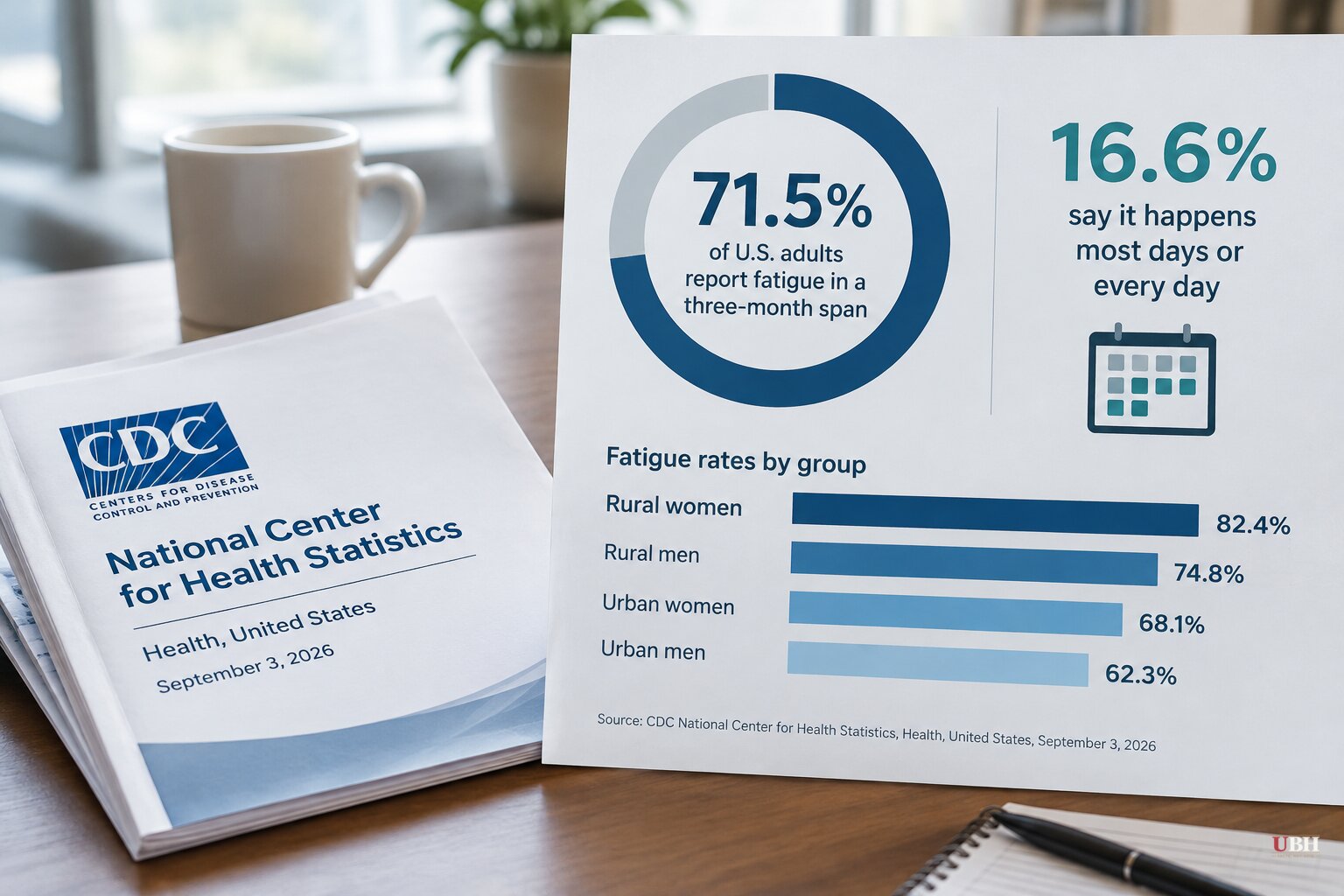
Since the Centers for Disease Control and Prevention's National Center for Health Statistics published its report on September 3, 2026, outlets across the spectrum have picked up the same headline number: 71.5% of American adults say they've felt fatigued on at least some days over the past three months.
The report, titled "Fatigue Among Adults Age 18 and Older: United States, 2024," pulled from the 2024 National Health Interview Survey, a nationally representative poll of roughly 27,000 adults, according to Healthline. It's the first time NCHS has specifically measured general fatigue at this scale, according to NBC News, which means there's no prior-year data to compare it against.
The numbers break down further, according to Medindia's reporting on the underlying data: 54.9% of adults felt fatigue on some days, 10.7% on most days, and 5.9% every single day. Add those last two together and you get 16.6% of U.S. adults classified as having "frequent fatigue" — the CDC's term for feeling worn out most days or every day for three months straight. Meanwhile 28.5% of adults said they never experienced fatigue in that window.
The CDC draws a hard line between fatigue and ordinary tiredness. Fatigue, as NBC News reported, is "physical or mental tiredness or exhaustion that does not improve with additional sleep or rest." Sleep doesn't fix it. That distinction matters, because it means this isn't just a story about people staying up too late.
Who's hit hardest
Women report frequent fatigue at nearly double the rate of men — 20% versus 13%, according to both Fox News and Medindia. Younger adults ages 18 to 34 report the highest rate at 19.5%, dropping steadily by age group to 12.9% among adults 65 and older, per Medindia's breakdown of the data.
Race and geography matter too. American Indian and Alaska Native adults reported the highest rate of frequent fatigue at 25.5%, followed by White non-Hispanic adults at 18.0% and Black non-Hispanic adults at 17.3%. Hispanic adults reported 12.9%, and Asian non-Hispanic adults reported the lowest rate at 9.1%, according to Medindia.
Rural Americans report frequent fatigue at 20.5%, well above the 14.5% rate in urban areas, Healthline reported. Regionally, the South (17.7%) and Midwest (17.5%) outpace the West (15.6%) and Northeast (14.5%), according to NBC News.
The real cost: work, mood, relationships
This isn't just people feeling sluggish. Among adults with frequent fatigue, 50.9% reported difficulties in three or more areas of daily functioning — mood, mobility, memory — according to Fox News. More than a third, 36%, said fatigue limits their ability to work. Nearly 29% cut back on social activities, and Healthline reported that 12.8% said they had "a lot of difficulty" or couldn't engage in social activities at all.
The health links are stark. People with frequent fatigue were more than three times as likely to report symptoms of depression and roughly twice as likely to report cognitive difficulties or anxiety symptoms, compared with people who don't experience frequent fatigue, according to NBC News.
Natalie A.E. Young, a sociologist and lead author of the report, told NBC News that fatigue is "one of the most frequently reported health concerns in primary care visits in the U.S.," and that people with fatigue "are at higher risk of activity limitations and disability, including permanent work disability."
What the report doesn't tell you
This is entirely self-reported data. Nobody drew blood, tracked sleep with a wearable, or ran a clinical exam. Respondents defined their own exhaustion, and the CDC took their word for it. That's a real limitation of survey-based public health data, and it means the 71.5% figure reflects perception, not a diagnosed condition.
The CDC itself flags a bigger gap: the survey didn't examine underlying causes, and it doesn't indicate whether fatigue is worse than in prior years, according to NBC News. NBC's own story opened by speculating about causes — "the cost of healthcare, economic uncertainties, fears of AI-associated end times" — before later acknowledging the report never actually tested any of that. The data shows who's tired. It doesn't show why.
Dr. Earnest Lee Murray, a neurologist at Jackson-Madison County General Hospital in Tennessee, told Fox News Digital that most fatigue "is probably related to poor sleep quality as well as psychosocial stress, which a lot of times go hand-in-hand." Dr. Alana A. Lewis, a cardiologist at Northwestern Medicine's Bluhm Cardiovascular Institute, told NBC News the findings were "not unexpected," adding, "just living in this country, we all, at some point, feel fatigue."
Matt Glowiak, chief addiction specialist at Recovered, told Healthline that women and young adults "face unique pressures" — caregiving and career demands for women, financial uncertainty and life transitions for younger adults — but also noted both groups "may also be more aware of and willing to acknowledge their experiences with mental health," which could affect how honestly people answer a survey question about being tired.
Because this is the first NCHS survey of its kind, there's no way to know from this data alone whether American exhaustion is climbing, or whether the CDC simply asked a question nobody had bothered to ask nationally before. NCHS has not announced a follow-up survey to establish a trend line.
Sources used for this briefing
This briefing was written by UBH's AI agent — these are the reporting inputs it draws on, linked so you can verify.


