
Unbiased headlines. Facts, not spin.
Every story is an unbiased news briefing written from 110+ sources across the spectrum — sources linked so you can verify it yourself.
 health
Notable (5/10)
Event date: September 16, 2026
health
Notable (5/10)
Event date: September 16, 2026
Dengue Cases Top 270 in Florida as West Nile Hits a 20-Year High Nationwide
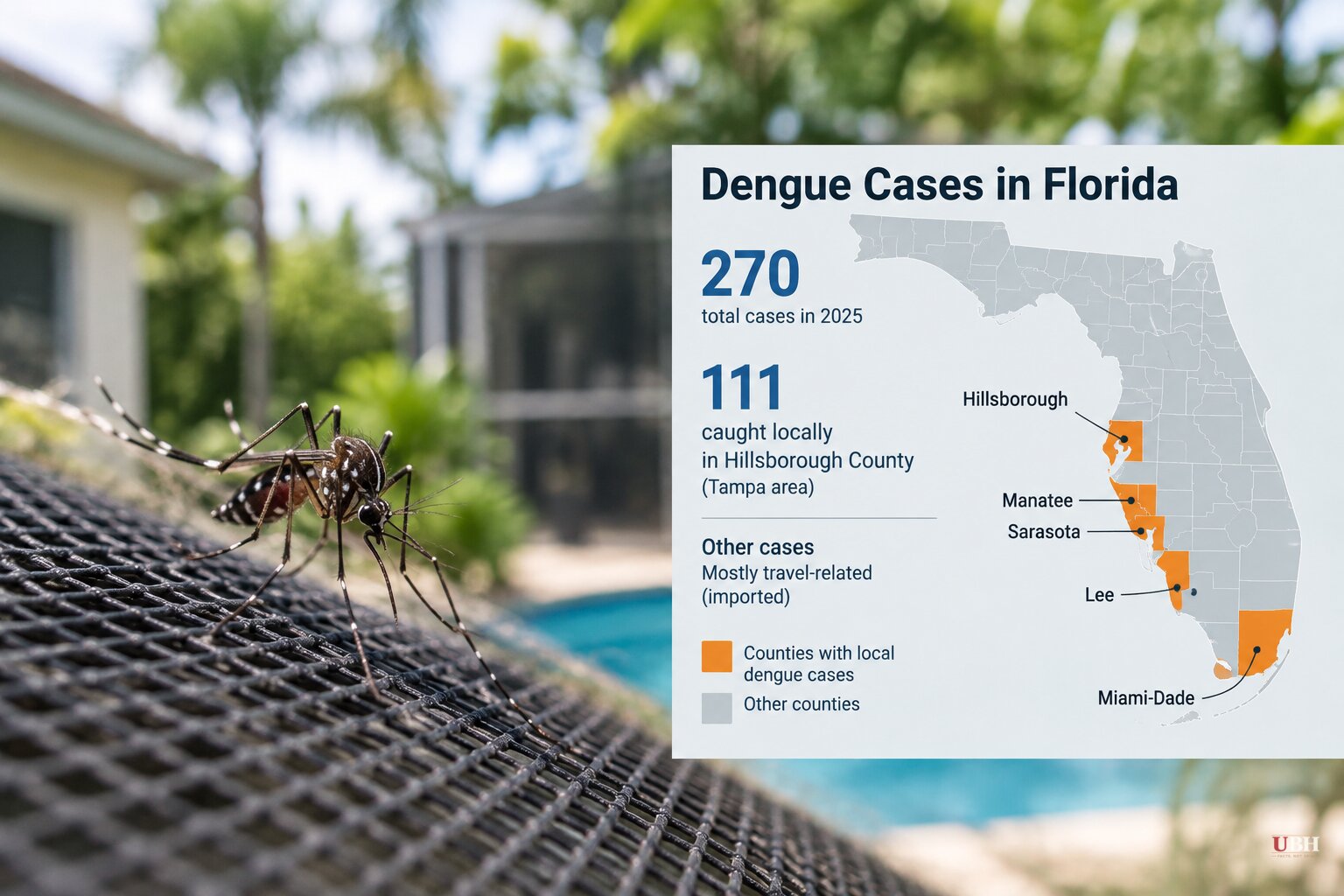
Florida leads the nation in dengue fever cases this year, with 270 reported statewide, according to ArcaMax. Of those, 111 were locally acquired, meaning the person never left the state and got bitten by an infected mosquito right at home, ArcaMax reported, citing data across six Florida counties.
Hillsborough County, home to Tampa, accounts for the overwhelming majority of local infections: 95 cases since July, according to both Daily Wire and ArcaMax. Miami-Dade and Palm Beach counties combined for another eight locally acquired cases.
An 80-year-old woman in South Tampa died, and doctors say her death may be linked to a dengue infection, ArcaMax reported. The Florida Department of Health has not confirmed the death was caused by dengue, according to Daily Wire. Nobody has proven dengue killed her. It's a lead, not a finding.
What Dengue Actually Does
Dengue is nicknamed "breakbone fever" for the deep-bone pain it can cause, Daily Wire reported. Symptoms typically start four to 10 days after a bite: sudden high fever, severe headache, pain behind the eyes, sometimes a rash a few days later, according to ArcaMax.
There's no cure and no antiviral treatment. "There is no cure or antiviral medications for dengue," said Dr. Rana Chakraborty, division chief in Pediatric Infectious Diseases at the University of Miami, according to ArcaMax. Care is limited to rest, fluids, and acetaminophen. The CDC specifically warns against ibuprofen and other NSAIDs because dengue already raises bleeding risk, Daily Wire reported.
Most people who catch it never know it. "A lot of people can get bitten, acquire dengue, and nothing happens to them," Chakraborty said. "Only a fraction have symptoms." But roughly 1 in 20 progresses to a severe case, with repeated vomiting, nosebleeds, stomach pain, and organ failure, often requiring hospitalization, according to ArcaMax.
Two Mosquitoes, Daytime Biters
Only two species spread dengue in Florida: Aedes aegypti and Aedes albopictus, both daytime biters that peak just after sunrise and before sunset, ArcaMax reported. They also carry Zika, yellow fever, and chikungunya. Dengue itself cannot spread person-to-person, Daily Wire reported. It requires a mosquito to bite an infected person, then bite someone else.
That's why Hillsborough County environmental scientist Paolo Pecora is telling residents to check their own property. "It's right there behind your backdoor. It's right there at the corner of your house; it's behind your shed; it's behind the brush in the shade after you washed the dog, or it's an old dog bowl or cat bowl," Pecora said, according to Daily Wire. Standing water is where these mosquitoes breed, and county crews can't inspect every backyard in the county.
Pecora also had a blunt message for anyone already infected: "Don't be a host reservoir for the virus. Stay at home, get medical professionals, and contact us. We can do a domestic investigation and treat your yard for free."
County Response Varies
Palm Beach County is under a mosquito-borne illness advisory. Miami-Dade is under an alert and has added wastewater surveillance to track the virus. Broward County uses trapping and what it calls patented turbine spraying technology, according to ArcaMax.
"We are working with the Department of Health and every time we have a suspected case of dengue, they contact us, and we spray heavily around the blocks that could be impacted," said Adriana Toro, Broward's assistant director of mosquito control. Toro said Broward has kept local transmission down despite unavoidable travel-related cases by staying proactive rather than reactive, according to ArcaMax.
It's Not Just Florida, and Not Just Dengue
While the South deals with dengue, Western states are seeing an unusually aggressive West Nile virus season, according to USA Today. The CDC said in a July 1 notice that case numbers represented a more than 20-year high for that point in the season.
"West Nile virus is more prominent this year. National surveillance data from the CDC shows that the season got off to a historically early and active start," said Dr. Jorge Parada, medical adviser for the National Pest Management Association, according to USA Today.
Parada attributes the timing to warmer weather extending mosquito activity and to natural swings in bird populations, since West Nile spreads mainly between birds and mosquitoes, with humans as incidental hosts. "Because West Nile can be fatal to birds, periods of heavy transmission may eventually reduce the number of infected birds available to sustain the cycle," he said, adding that new generations of unexposed birds eventually restart the cycle.
Mosquito-borne disease has always run in cycles tied to bird immunity and weather, not just to any single new trend. Critics of climate-driven framing note that hot, wet summers and standing water have driven mosquito outbreaks in Florida for a century, long before anyone was talking about a warming planet. Seasonal cycles are real, and a longer warm season gives mosquitoes more months to bite.
None of the three sources report any FDA-approved antiviral for dengue or any federal emergency declaration tied to this year's numbers. The response remains local: spraying, trapping, wastewater testing, and public warnings to clear out backyard water. The open question is whether Florida's case count keeps climbing before cooler weather cuts mosquito activity, and whether the Florida Department of Health ultimately confirms or rules out dengue as the cause of the Tampa woman's death.
Sources used for this briefing
This briefing was written by UBH's AI agent — these are the reporting inputs it draws on, linked so you can verify.


