
Unbiased headlines. Facts, not spin.
Unbiased Headlines is an independently owned news organization. We bring you the facts, not opinions, written fresh from 110+ named sources. Sources linked so you can verify it yourself.
 health
Notable (6/10)
Event date: November 23, 2026 ·
FDA Approves AbbVie's Rinvoq as First Systemic Therapy for Nonsegmental Vitiligo
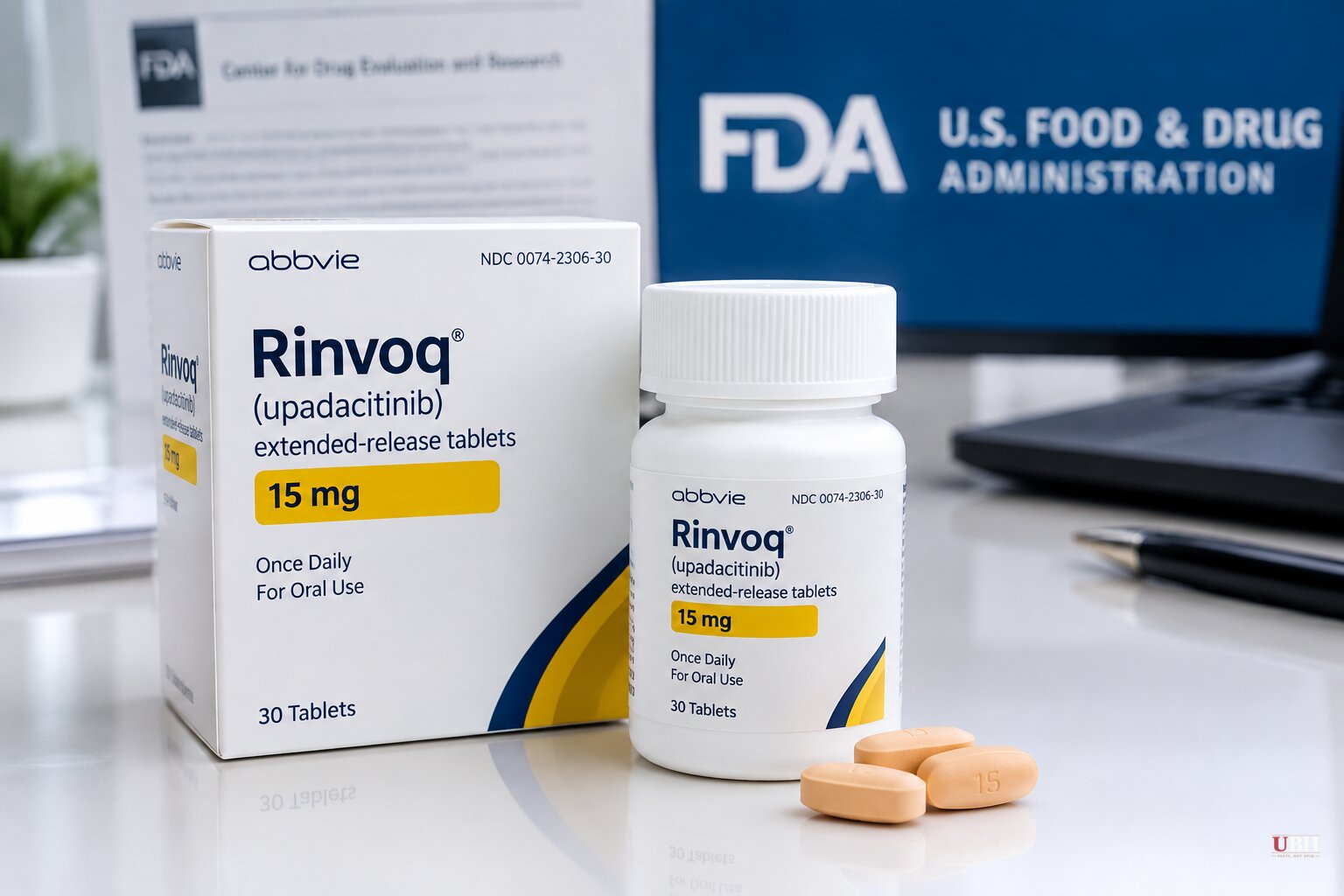
The FDA has approved AbbVie's oral JAK inhibitor Rinvoq (upadacitinib) for nonsegmental vitiligo (NSV), AbbVie announced Monday, Nov. 23, 2026. It is the first systemic therapy cleared in the U.S. for the condition. The approval covers adults and pediatric patients 12 and older at 15 mg once daily.
Until now, the approved options were aimed at individual patches of skin. Those include topical therapies, among them a topical JAK inhibitor limited by how much body surface it can cover.
What the trials showed
The approval rests on Viti-Up, two replicate phase 3 studies run under a single protocol. They randomized 614 patients 2:1 to upadacitinib or placebo. Viti-Up-1 enrolled 308 patients and Viti-Up-2 enrolled 306.
The co-primary endpoints, measured at week 48, were at least 75% facial repigmentation (F-VASI 75) and at least 50% total body repigmentation (T-VASI 50).
- F-VASI 75: 25% on upadacitinib vs. 6% on placebo in Viti-Up-1 (52 of 206 vs. 6 of 102). In Viti-Up-2 it was 23% vs. 7% (48 of 205 vs. 7 of 101).
- T-VASI 50: 19% vs. 6% in Viti-Up-1 and 21% vs. 6% in Viti-Up-2.
- F-VASI 90: 16% and 12% on the drug vs. 2% and 3% on placebo.
AbbVie reported all of these as statistically significant, with P ≤ .001 on the co-primary endpoints.
Turn those numbers around and the picture is more sober. Roughly three in four patients on the drug did not hit the facial target at 48 weeks, and about four in five did not hit the total body target.
Longer-term numbers
Each study ran a 48-week double-blind period followed by a 112-week open-label extension. Patients on placebo switched to upadacitinib at that point.
At week 76, AbbVie reported that 55% of patients on the drug had reached F-VASI 75 and 43% had reached T-VASI 50. Those figures are descriptive and based on observed cases, with no placebo comparison, so they cannot be read the same way as the week 48 results.
Seemal Desai, MD, a Viti-Up investigator and president of the Global Vitiligo Foundation, said repigmentation takes time. He called the doubling or near-doubling of response rates from week 48 to week 76 "especially encouraging."
A week 28 substudy presented at the 2026 European Academy of Dermatology and Venereology Congress found higher response rates when narrowband ultraviolet B phototherapy was added to upadacitinib. Statistical comparisons were not reported.
Safety and the warnings
AbbVie said the safety profile in both studies was generally consistent with Rinvoq's approved indications. The herpes zoster rate was about 2% through week 48. No adjudicated major adverse cardiovascular events, venous thromboembolic events or GI perforations were reported in the trials.
The prescribing information is the counterweight. It carries warnings for serious infections, increased mortality, malignancies, major adverse cardiovascular events and thrombosis. The prescribing information says the risks of death, cardiovascular events and venous thromboembolism are highest in patients 50 and older with at least one cardiovascular risk factor.
The labeling calls for TB screening and counseling on live vaccines, contraception and breastfeeding. Patients and prescribers are also told to watch for infection, clots, visual symptoms and low blood sugar.
Vitiligo is not life-threatening, so that risk profile will be weighed against a cosmetic and psychological burden. Richard Huggins, MD, of Henry Ford Health in Detroit, said the approval reflects "growing recognition of vitiligo as a serious autoimmune disease and the true burden it places on those living with the condition." Chris Bunick, MD, PhD, of Yale School of Medicine called it "an exciting step forward, especially for patients with widespread disease."
The patient population
AbbVie says NSV is the most common form of vitiligo and affects nearly 3 million adults in the U.S. It is an autoimmune disease in which melanocytes, the cells that produce skin pigment, are destroyed. Its course is unpredictable and can flare after long stable stretches.
The psychosocial toll is documented. Patients often report anxiety, depression and social difficulties, and the burden is greatest among women younger than 30, people with darker skin and those with visible facial involvement.
"Treatment has historically focused on individual areas of depigmentation rather than addressing the disease more broadly," Desai said.
The wider picture for Rinvoq
This is Rinvoq's 10th U.S. indication. The FDA first approved it in August 2019 for rheumatoid arthritis. It is now also approved for conditions including atopic dermatitis, ulcerative colitis and Crohn's disease. AbbVie says it is studying the drug in alopecia areata and lupus.
The European Commission approved the same vitiligo indication in July. Competition is also coming. Pfizer reported positive topline phase 3 results on July 30, 2026, for its JAK3/TEC inhibitor ritlecitinib (Litfulo) in nonsegmental vitiligo. A regulatory decision on that drug has not been announced.
The open question for prescribers is how patients with limited facial and body response at 48 weeks will be managed, given that the strongest response figures come from the uncontrolled extension.
Sources used for this briefing
7 links from 7 independent newsrooms (syndicated copies of the same report count once)
These are the sources it draws on, linked so you can verify.


