
Unbiased headlines. Facts, not spin.
Unbiased Headlines is an independently owned news organization. We bring you the facts, not opinions, written fresh from 110+ named sources. Sources linked so you can verify it yourself.
 health
Notable (5/10)
Event date: November 22, 2026 ·
Model Projects GLP-1 Drugs Could Prevent Up to 6.6 Million Deaths a Year by 2050
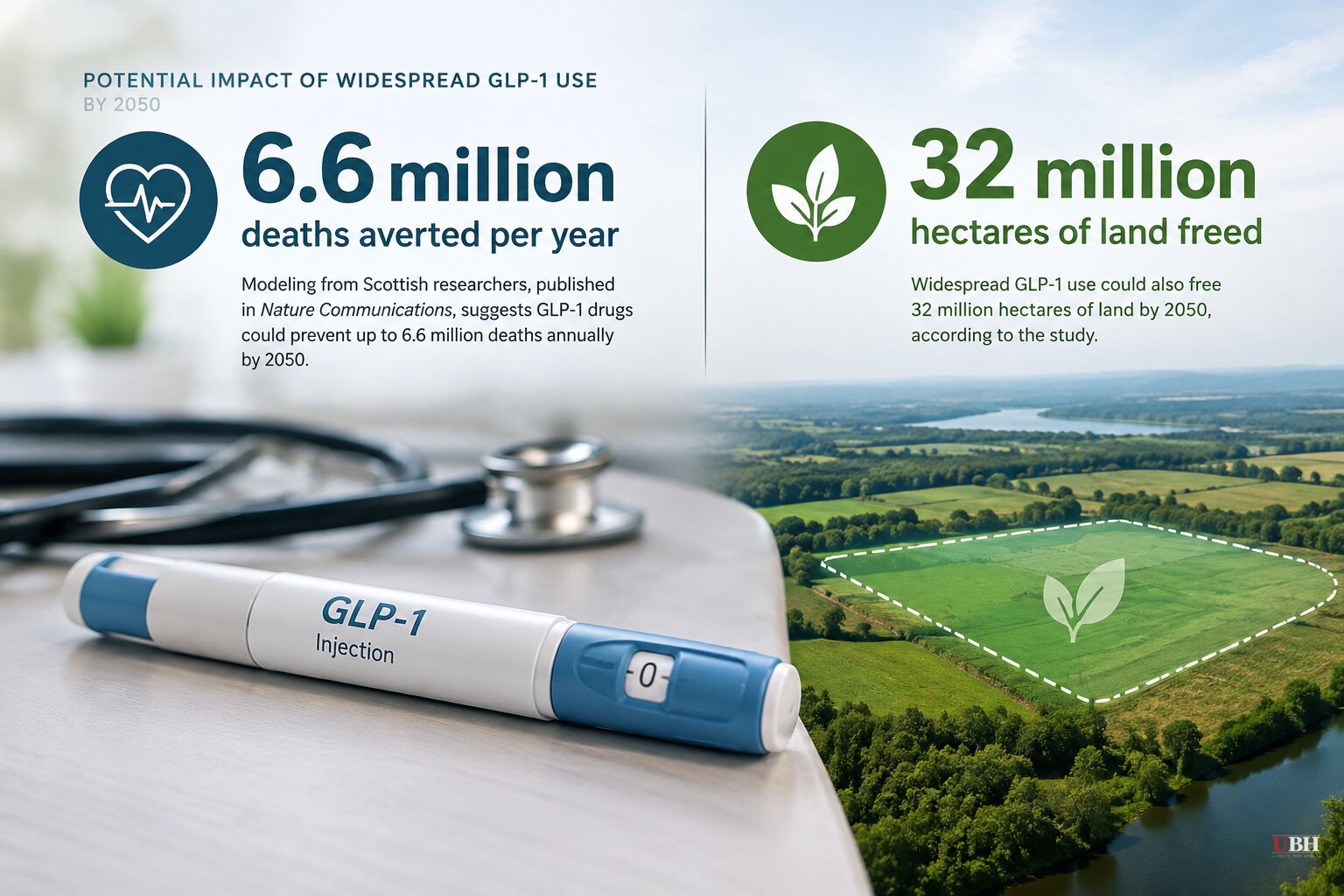
A new modeling study projects that widespread use of GLP-1 weight-loss drugs such as Ozempic and Mounjaro could prevent up to 6.6 million deaths a year worldwide by 2050. It also projects that the drugs could free up as much as 32 million hectares of agricultural land, an area slightly larger than Italy.
The research was published in Nature Communications. It was led by Dr Roslyn Henry of the University of Aberdeen, with colleagues from the University of Edinburgh and Scotland's Rural College.
This is a projection, not a measurement. Nobody has counted these deaths or this land.
How the model works
The team used LandSyMM, a global simulation linking land use, crop yields, food demand, trade and prices. They compared a reference scenario, built on projected population growth, economic development, climate and dietary trends through 2050, against six hypothetical scenarios of GLP-1 uptake.
The scenarios ranged from use concentrated in wealthy countries to broad global access. GLP-1 drugs can cut calorie intake by 20 to 30 percent, according to the paper. Less eating means less demand, and less demand means less land under the plow.
The authors' own words: "With widespread use of these medicines among adults living with obesity, we estimate that reduced calorie intake could prevent up to 6.6 million deaths each year by 2050, while freeing up as much as 32 million hectares of agricultural land."
The biggest numbers came when the drugs were paired with a shift toward healthier diets. In that scenario the model shows more than 7 million avoided deaths a year and about 46 million hectares of land available for other uses.
The price effect
The model includes a catch. Lower food demand from GLP-1 users could push food prices down. Cheaper food could then increase consumption among people who are not taking the drugs, including consumption of unhealthy foods. That offsets part of the projected gain.
The authors note that food systems are tied together across borders. A drop in demand in one place can change farming, trade and prices elsewhere, including for people who never take the medication.
Access is also a constraint. Use of GLP-1 drugs remains concentrated in wealthier countries, and cost and supply limit uptake elsewhere. The World Health Organization issued its first conditional recommendation for GLP-1 drugs in treating adult obesity in December 2025. The WHO says roughly one in five adults worldwide has obesity, and prevalence has nearly tripled since 1975.
The authors push back on the obvious conclusion
The researchers do not argue for a pill-first answer. In their own write-up, they say it is tempting to read the findings as a case for putting more people on weight-loss medication, and that doing so "would miss the bigger picture."
They argue that diets are shaped by food availability, cost, marketing and the placement of shops. In many high-income countries, they write, it is easy to consume large amounts of cheap, energy-dense food. They point to the UK's national food strategy, finalized in 2021, which made the case that the wider food environment has to change so the better choice is the easy one.
That is a policy argument from the authors, and it is not a finding of the model. Their own numbers do show the diet-shift scenario outperforming drugs alone.
Other recent GLP-1 findings
The farmland study lands amid a run of research on what these drugs do beyond weight loss.
A study of 92,000 people published last year linked semaglutide to a 33 percent lower risk of dementia. A National Bureau of Economic Research study using Danish data found GLP-1 users took 17 percent less long-term sick time. The study defined long-term as absences of more than 30 days.
A newer observational study looked at adults with prediabetes and obesity. It covered health records for 256,492 adults averaging 52 years old. About half received GLP-1 drugs, including semaglutide, tirzepatide, liraglutide and dulaglutide, and half received metformin.
Over three years, the GLP-1 group had a 31 percent lower risk of developing type 2 diabetes and a 41 percent lower risk of death from any cause. They also had 20 percent fewer strokes, 15 percent fewer heart attacks and 25 percent fewer cases of heart failure.
"The 41% lower risk of death from any cause surprised me most," said study author Dr Vinicius de Sousa Barzon Serra, a Mayo Clinic research fellow in Scottsdale, Arizona. He said most earlier research focused on people who already had diabetes, and that prediabetes may be a key window to consider the drugs.
The American Heart Association says nearly 40 percent of U.S. adults have prediabetes. As many as 10 percent of those people go on to develop type 2 diabetes each year.
The results were slated for presentation at the AHA's Scientific Sessions 2026 in Chicago. They had not completed full peer review at the time of release. Because the design is observational, the figures describe associations between the drugs and outcomes, not proven cause and effect.
What is unresolved
The 6.6 million figure depends entirely on how many obese adults actually get these drugs, at what price, and with what supply. Today, access is concentrated in rich countries. The model's offset from cheaper food also raises a question the authors flag but do not settle: whether lower prices would erode the health gains among people not on the drugs.
The prediabetes findings face a nearer test. Peer review will show whether a 41 percent mortality gap over metformin survives scrutiny.
Sources used for this briefing
6 links from 4 independent newsrooms (syndicated copies of the same report count once)
These are the sources it draws on, linked so you can verify.


