
Unbiased headlines. Facts, not spin.
Unbiased Headlines is an independently owned news organization. We bring you the facts, not opinions, written fresh from 110+ named sources. Sources linked so you can verify it yourself.
 health
Notable (5/10)
ICMR Survey Finds 55.9% of Indian Women Aged 15-49 Anaemic, Severe Cases Under 2% in Most Groups
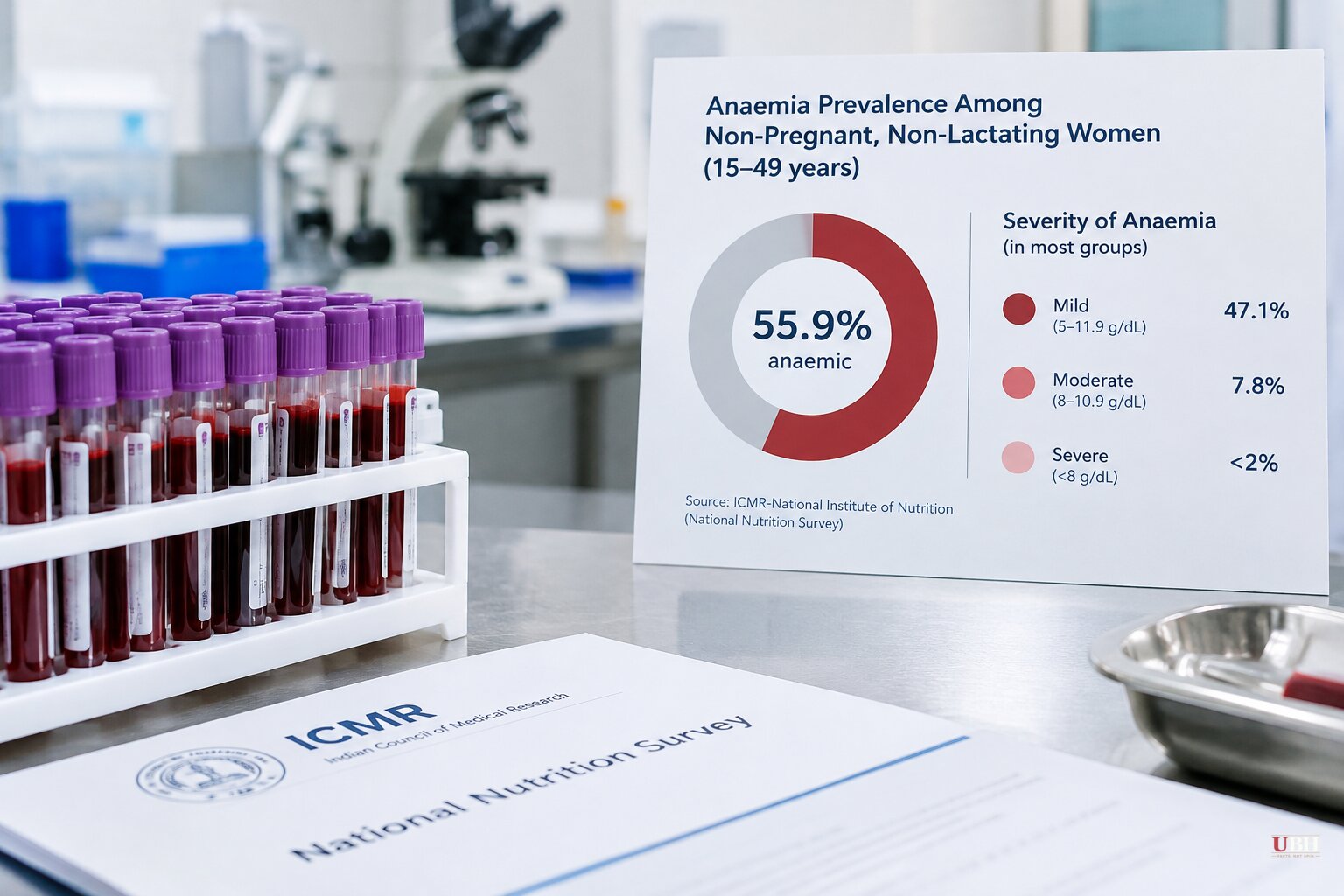
India's long-running argument over how many of its people are anaemic got a new data point on Monday, Nov. 23. The Indian Council of Medical Research's National Institute of Nutrition released the results of SAMPADA, a survey run over 2023-25.
The headline: 55.9% of non-pregnant, non-lactating women aged 15-49 are anaemic. NFHS-5, conducted in 2019-21, put that figure at 57%.
The one-point gap should not be read as progress. The two surveys covered different groups of women and used different testing methods, so the figures are not directly comparable.
How the survey was done
SAMPADA covered more than 2 lakh people in over 81,000 households across 183 districts in 35 states and union territories. Researchers analysed more than 1.7 lakh blood samples.
The key difference is the method. SAMPADA used venous blood samples and automated analysers, which the Health Ministry's release describes as the gold standard. Earlier national surveys relied on finger-prick tests.
That is why the survey was awaited. The NFHS-6 fact sheets released earlier this year left out anaemia estimates. The government had said a separate ICMR survey would supply them. Deccan Herald reports the Health Ministry dropped anaemia testing from NFHS-6 in 2023 over concerns that finger-prick sampling could overstate prevalence.
The numbers
Among women of reproductive age, roughly 26% have mild anaemia, 26.9% moderate and 2.9% severe. Other groups:
- Adolescent girls aged 10-19: 46.3%
- Adolescent boys aged 10-19: 22.8%
- Children aged 12-59 months: 41.8%
- Children aged 5-9: 31.3%
- Pregnant women: 43.6%
- Lactating women: 58.1%
- Men aged 20-59: 22%
Severe anaemia accounted for less than 2% of most population groups. The release says about half of anaemic women, adolescent girls and children have the mild form, and about three-fourths of anaemic men and adolescent boys do.
Big gaps between states
Among women aged 15-49, West Bengal recorded the highest state prevalence at 72.4%. Assam followed at 71.9%, Chhattisgarh at 71.5%, Punjab at 70.5% and Tripura at 70%. Gujarat came in at 66.2%.
The Andaman and Nicobar Islands topped everything at 81.2%.
It is not just iron
The survey tested a sub-sample for iron, folate, vitamin B12 and inflammation markers. Iron deficiency accounts for about half of anaemia cases in women, adolescent girls and children, according to the report.
Among women of reproductive age, only 26.7% have both iron deficiency and anaemia, even though 55.9% are anaemic. The release points to other causes, including infections, haemoglobinopathies and inflammation.
Vitamin B12 deficiency is widespread. It affects 65.4% of adolescent girls and 66.1% of adolescent boys, 57.4% of women of reproductive age, 60.4% of men aged 20-59 and 63.1% of pregnant women.
That matters for policy. India's main weapon, the Anaemia Mukt Bharat programme, rests on iron and folic acid supplementation, screening and treatment. If half the problem is something else, more iron tablets will not fix it.
Two readings of the same result
Rajiv Bahl, secretary of the Department of Health Research and director general of ICMR, called the lower numbers encouraging: "It is encouraging that prevalence of anaemia is lower in SAMPADA compared to previous national surveys." He said the survey gives an evidence base to strengthen Anaemia Mukt Bharat.
The counterpoint comes from the data's own limits. Because methods and groups differ, the new estimates cannot be treated as an overall improvement, as Deccan Herald points out. A policy analysis of the survey makes the same point: when the method changes, the number can change even if people's health has not. It adds that India has separate snapshots, not a clean trend line.
Comparisons break down for children too. SAMPADA counts those aged 12-59 months, while Anaemia Mukt Bharat targets 6-59 months, so the youngest children are outside the survey's figure.
The prevalence is still huge by any measure. More than half of women of reproductive age and nearly half of adolescent girls are anaemic after decades of government programmes.
Next steps
The open question is how much of the one-point drop is real. Answering it requires the next national survey to use venous blood sampling, as SAMPADA did. Until then, the gap between 57% and 55.9% tells officials very little about whether the programmes are working.
Sources used for this briefing
7 links from 7 independent newsrooms (syndicated copies of the same report count once)
These are the sources it draws on, linked so you can verify.


