
Unbiased headlines. Facts, not spin.
Every story is an unbiased news briefing written from 110+ sources across the spectrum — sources linked so you can verify it yourself.
 economy
Major Story (7/10)
July 7, 2026 at 05:29 AM
economy
Major Story (7/10)
July 7, 2026 at 05:29 AM
FCC Votes July 22 to Drop ISP Fee Itemization Requirement from Broadband Labels
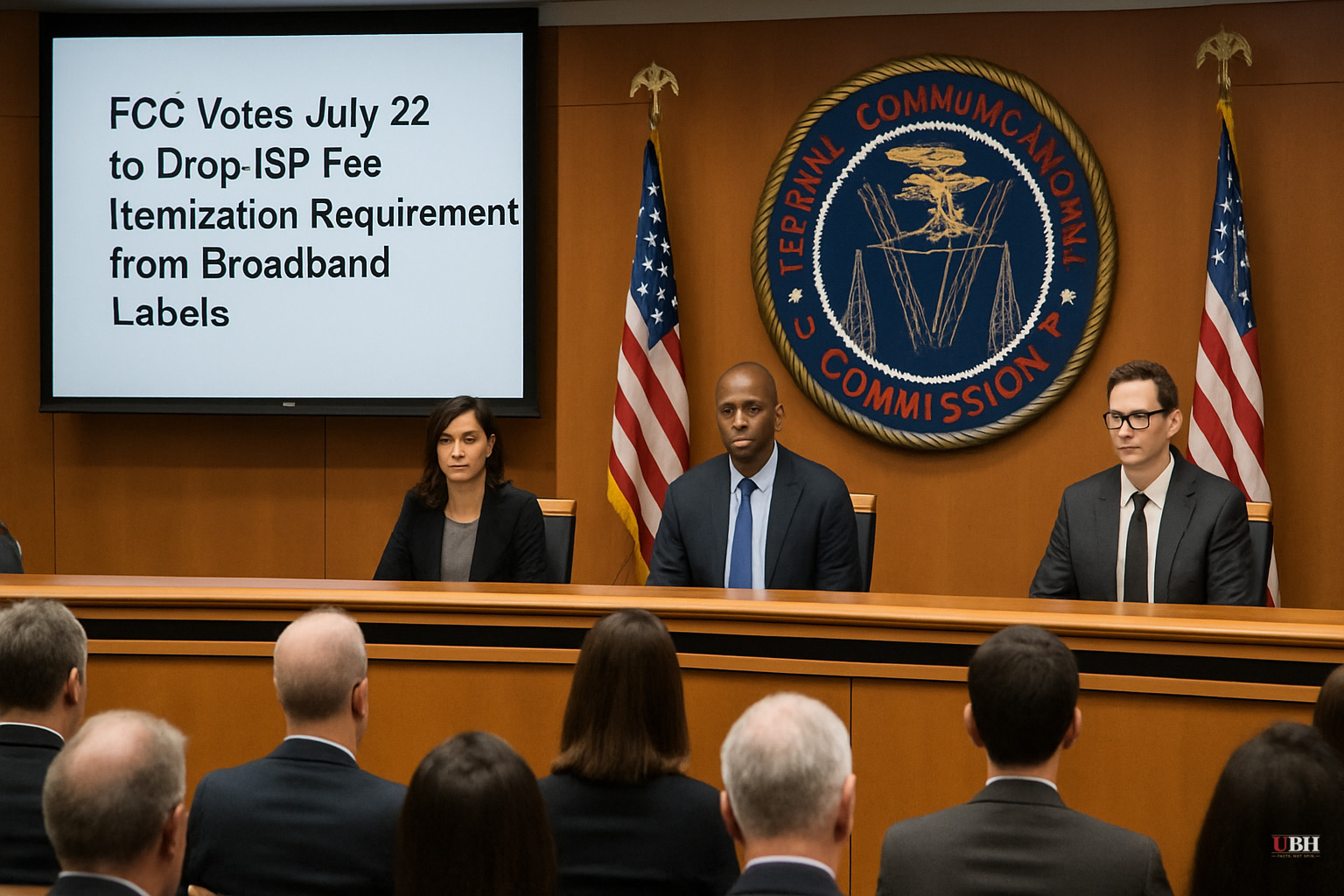
What the FCC Is About to Do
The Federal Communications Commission is scheduled to vote on July 22 to scale back disclosure requirements that have been in place since the Biden-era update to broadband labeling rules. If the order passes — and it almost certainly will, given the commission's Republican majority — internet service providers will no longer be required to itemize each fee they pass along to consumers.
Instead, according to the FCC's draft order reported by Ars Technica, ISPs can lump all passthrough fees into a single "up to" figure. That aggregate number can cover both government-mandated fees and fees from third parties like utility pole owners, categories that are fundamentally different in origin but will look identical on a label.
How the Current Labels Work, and Why They Were Created
Broadband "nutrition labels" became mandatory in April 2024. Modeled on FDA food labels, they require ISPs to display the real price of a plan, including fees, speeds, and contract terms, in a standardized format before a customer commits.
The label rules stem from a bipartisan directive. Congress instructed the FCC to create them in the Infrastructure Investment and Jobs Act of 2021, and the FCC adopted the framework unanimously in 2022, according to a letter from Sen. Mark Warner and seven Democratic colleagues sent to FCC Chairman Brendan Carr. That bipartisan origin matters: this was not a controversial party-line mandate when it passed.
A 2024 survey of more than 2,500 broadband consumers found that 85% found the labels useful for comparison shopping, according to CNET.
What the July 22 Order Would Change
The rollback goes beyond fee bundling. According to Ars Technica, the FCC's draft order would also:
- Allow ISPs to link to a label rather than display it prominently on ordering pages and account portals
- Eliminate the requirement that labels be available in machine-readable spreadsheet format
- Relax the phone disclosure rule so sales reps can summarize label information "conversationally" instead of reading it verbatim
FCC Chairman Brendan Carr has defended the changes as a modernization effort. He argued that the 2022 rules adopted under former Chairwoman Jessica Rosenworcel "departed quite dramatically" from what Congress actually required, adding "costly requirements that are unrelated to consumers' purchasing decisions," according to Broadband Breakfast. Carr also pointed out that consumers themselves have complained that finding label information can feel like a "Sisyphean task" or "a game of Where's Waldo."
If labels are buried or unusable in practice, they deliver less value than their paper promise.
The Case Against This Rollback
The counterargument is direct. Commissioner Anna Gomez, the lone Democrat on the commission, called the proposal "one of the most anti-consumer items I have seen," according to CNET. Her specific objection: the passthrough fees being bundled are fees that ISPs choose to charge, not fees they are required to pass on. Providers add them voluntarily to widen the gap between advertised price and actual bill. Hiding them in aggregate lets ISPs pocket the difference while maintaining plausible deniability about what consumers are actually paying.
Raza Panjwani, senior policy counsel at New America's Open Technology Institute, told CNET he sees a deliberate two-step at work: "You make it less useful. Then you say, 'Oh, look, it's not that useful. We should get rid of it.'" Weakening a tool and then pointing to its weakness as justification for eliminating it is a regulatory pattern the FCC has not provided a detailed explanation of why each specific rollback is necessary.
Sen. Warner's letter, co-signed by Senators Adam Schiff, Ben Ray Luján, Brian Schatz, Ron Wyden, Edward Markey, and Kirsten Gillibrand, argues the FCC's proposal "recreates exactly the kind of billing opaqueness that Congress sought to end."
Who Pushed for This
Comcast and other ISPs complained publicly about the fee itemization requirement. Ars Technica reported they lobbied against the Biden-era update specifically because of the complexity of disclosing the fees they had chosen to charge. The FCC's October 2025 Notice of Proposed Rulemaking kicked off the public comment process, and the draft order released last week is the result.
ISPs are not required to advertise below-cost prices. They could simply advertise the real total price and charge exactly that. The entire passthrough fee structure exists because they choose not to.
What Happens Next
The July 22 FCC vote is the final step before the order takes effect 30 days after publication in the Federal Register. No investigation or legal challenge has been announced as of July 7, 2026, though Senate Democrats have formally demanded Carr reverse course. Whether any ISP-facing enforcement mechanism survives intact or whether the label framework becomes a checkbox exercise rather than a genuine consumer tool remains to be seen after the vote.
Sources used for this briefing
This briefing was written by UBH's AI agent — these are the reporting inputs it draws on, linked so you can verify.


