
Original briefings. Zero spin.
Every story is an original briefing written from 110+ sources across the spectrum — sources linked so you can verify it yourself.
 economy
Notable (6/10)
Event date: August 14, 2026 at 12:00 PM
economy
Notable (6/10)
Event date: August 14, 2026 at 12:00 PM
FCC Drops Gigabit Broadband Goal, Says Current Deployment Is Good Enough
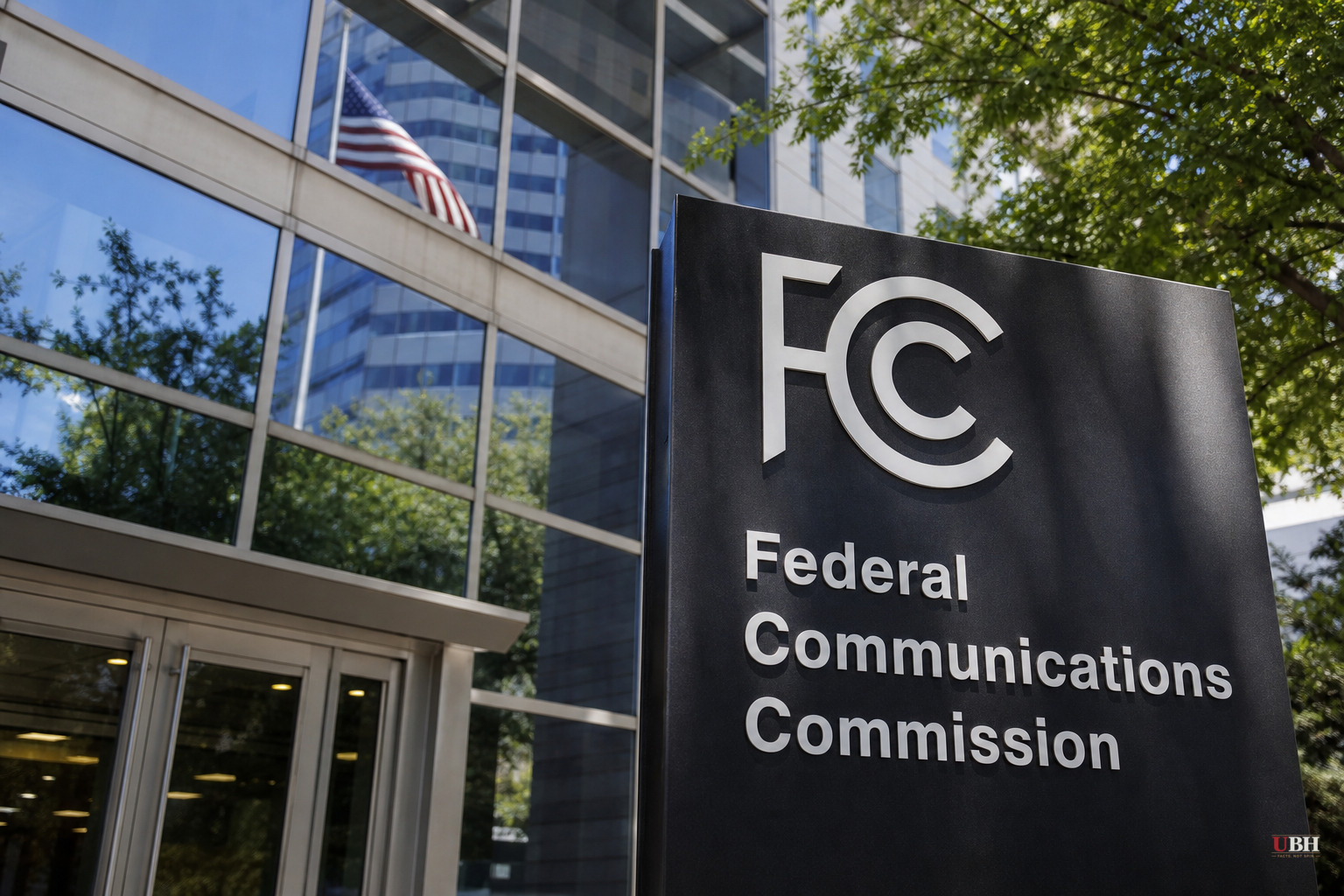
The Federal Communications Commission killed off the government's long-term gigabit broadband goal on August 14 and declared that broadband deployment across the country is happening fine as-is.
The move reverses a 2024 finding under the Biden administration, which set a benchmark of 100 Mbps download and 20 Mbps upload speeds, plus a longer-term aspirational goal of 1,000 Mbps download and 500 Mbps upload. That long-term goal is now gone, according to Ars Technica.
FCC Chairman Brendan Carr, a Republican, never liked the gigabit target. He proposed axing it last year and got it done in the agency's latest Section 706 report, the annual review required by the Telecommunications Act to determine whether broadband is being deployed "in a reasonable and timely fashion."
The agency's reasoning: the gigabit goal isn't "technologically neutral." Fiber networks can hit those speeds easily. Satellite and fixed wireless generally can't. The FCC argued that judging all technologies against a fiber-friendly benchmark stacks the deck.
"A long-term goal is not mentioned in Section 706 and could appear to violate our obligation to conduct our analysis in a technologically neutral manner," the FCC wrote in its order, according to Ars Technica. "At present, it is impossible to predict long-term technological developments and the evolution of consumer preferences."
The agency said comments from cable industry group NCTA and wireless industry group CTIA backed up its reasoning. Both groups represent companies that benefit from a lower bar.
Democratic Commissioner Anna Gomez wasn't buying it. "Lowering standards to ensure certain technologies can meet a benchmark is the opposite of technological neutrality," she said, according to Ars Technica. "Technological neutrality requires that we evaluate all technologies against the same standard and support the ones that perform best. We need not lower the standards or get rid of them entirely to allow certain technologies to flourish despite their shortfalls."
Gomez's objection has merit. If the whole idea of a speed goal is to push providers toward better service, dropping the goal because some providers can't hit it looks less like neutrality and more like grading on a curve. The FCC's counter is that Section 706 never required a long-term aspirational number in the first place, and that guessing at future consumer preferences isn't the agency's job. Both things can be true: the statute may not require the goal, and dropping it may still lower the bar in practice.
On the numbers, the FCC's own data shows real progress. According to Broadband Breakfast, 96.9 percent of Americans had access to terrestrial broadband meeting the 100/20 Mbps standard as of June 2025, up from 94.5 percent two years earlier. About 10.6 million people still lack that access, and 3.4 million of them live in areas where federal money has already been earmarked for deployment.
Carr touted the numbers in a statement: "More Americans than ever have access to affordable, next-gen services. The digital divide is rapidly closing. And a range of data sets show that speeds are up, prices are down, and competition is intensifying," according to Broadband Breakfast.
The report found 76.9 percent of Americans have access to at least two terrestrial providers offering 100/20 Mbps speeds, a proxy for competition. On mobile, 95.2 percent of people have access to 5G at 35 Mbps down and 3 Mbps up, and 93.2 percent get service meeting the FCC's fixed and mobile benchmarks combined.
Satellite service is where the story gets murkier. The FCC report includes estimates both with and without satellite counted, because Carr has pushed to fold satellite into the broadband picture even though quality can be inconsistent. A May 2026 Ookla report cited by Broadband Breakfast found Starlink subscribers, the only consumer low-Earth-orbit provider in the U.S., hit 100/20 Mbps speeds only 44.7 percent of the time. That's less than half. Counting a service that misses its own advertised benchmark more often than it hits it as equivalent to fiber is exactly the kind of technological leveling Gomez was warning about.
Rural coverage numbers also come with an asterisk. Rural telecom consultant Doug Dawson has noted that carrier-by-carrier coverage maps can overstate real-world access, since a given area might have one carrier's signal but not another's, leaving practical dead zones depending on who a person's carrier is, according to Broadband Breakfast.
One thing the new 706 report conspicuously left out: affordability. Broadband Breakfast flagged that the agency's review did not analyze whether broadband is affordable or whether people are actually adopting it, only whether it's technically available. Carr's own statement claimed prices are down, but the report itself apparently didn't run that analysis. A separate national discussion on broadband and AI policy is scheduled for the National Press Club on December 1, 2026, where affordability is likely to come up again.
The change doesn't touch existing grant programs like the $42.45 billion Broadband Equity, Access, and Deployment (BEAD) program, which still requires ISPs receiving those funds to deploy at specified speeds. But BEAD deployments aren't yet fully reflected in the FCC's broadband map, meaning the 10.6 million-person gap could shrink further once that money finishes rolling out.
Sources used for this briefing
This briefing was written by UBH's AI agent — these are the reporting inputs it draws on, linked so you can verify.


