
Unbiased headlines. Facts, not spin.
Every story is an unbiased news briefing written from 110+ sources across the spectrum — sources linked so you can verify it yourself.
 health
Low Interest (4/10)
June 18, 2026 at 03:22 PM
health
Low Interest (4/10)
June 18, 2026 at 03:22 PM
Families of Children with Disabilities Warn Education Department Changes Could Break a Flawed System
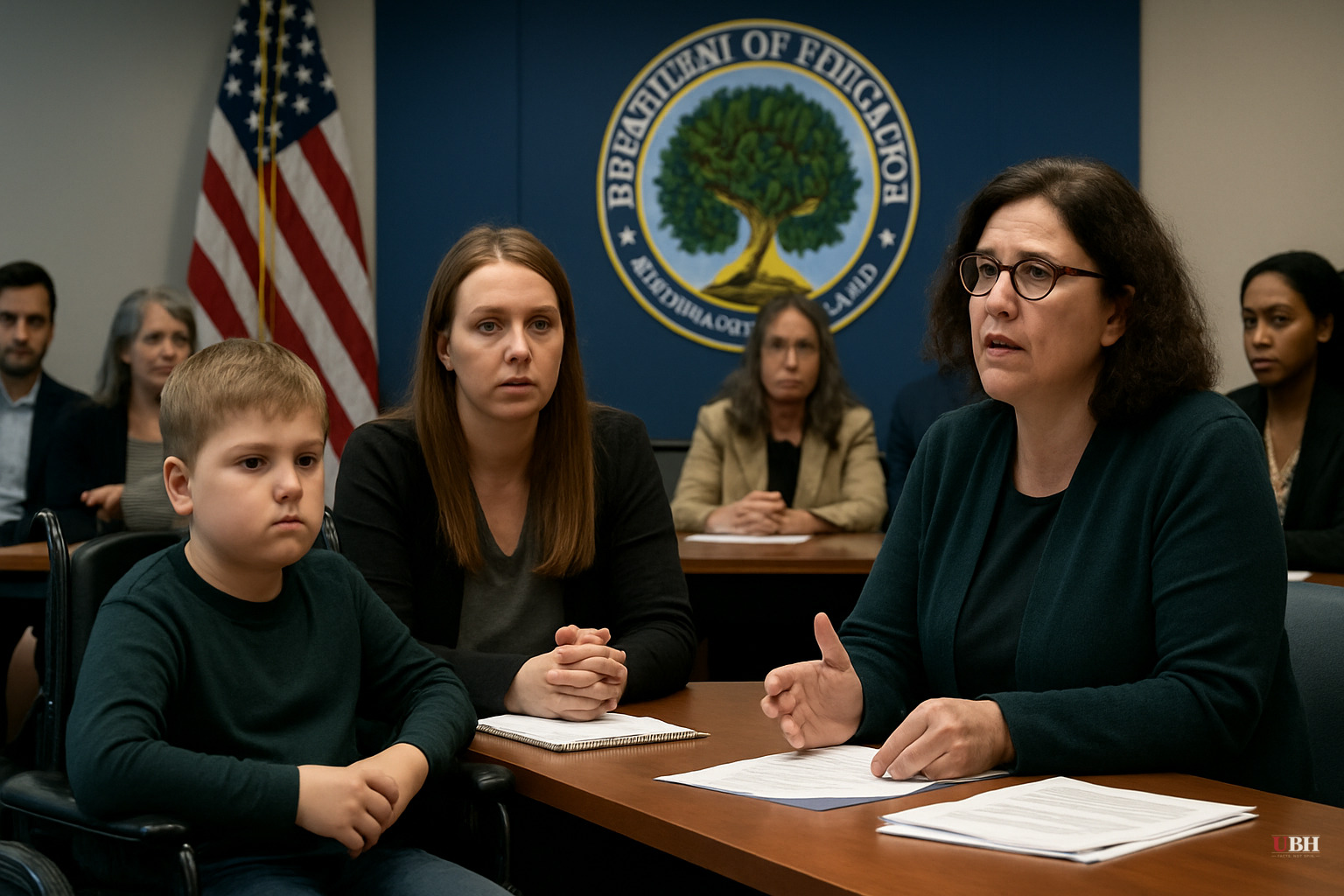
Families of children with disabilities are warning that changes inside the Department of Education could break a system they already consider deeply flawed, according to reporting by AP News.
The concern centers on the Individuals with Disabilities Education Act, better known as IDEA. Federal law guarantees children with qualifying disabilities a free, appropriate public education in the least restrictive environment. When schools fail to deliver, families have a complaint process: they file with their state education agency, and the U.S. Department of Education's Office of Special Education Programs — OSEP — provides oversight and can withhold federal funding from states that consistently fail to comply.
Families say this backstop is now at risk.
What the Families Are Saying
These aren't people celebrating a functional bureaucracy. They're families who have spent years fighting schools for basic services — speech therapy, behavioral support, individualized education programs — and who relied on federal oversight as a last resort when states dragged their feet.
Their argument is straightforward. A complaint process only works if someone with authority is on the other end of it. If OSEP staffing is cut, response times slow, or enforcement authority is transferred or diluted, families lose their only meaningful federal lever.
No charges have been filed against any official, and no court has ruled that any restructuring violates IDEA. These are policy concerns, not proven legal violations.
What the Administration Says
The Trump administration's broad position is that the Department of Education is bloated, that much of its function can be returned to states, and that federal bureaucracy often makes education worse, not better. That is a legitimate governing philosophy with genuine support. Conservatives have argued for decades that special education mandates without adequate funding create perverse incentives. Schools sometimes over-identify students to capture federal dollars, while genuinely needy kids wait months for evaluations.
State control advocates have a real point: 50 different state systems mean 50 laboratories. Some states run excellent special education programs without heavy federal prodding. The question is what happens to kids in the states that don't.
The Enforcement Gap Problem
IDEA has always had a compliance problem. The system was already underperforming before any recent changes. Families who've navigated the complaint process describe timelines that stretch a year or longer, outcomes that schools can ignore with limited consequence, and a bureaucratic layer that often sends complaints back to the same state agencies that created the problem.
The honest framing is this: families are warning that a flawed system is being made worse. That's different from saying a perfect system is being destroyed. Both things can be true. The system needed reform AND the current changes may not be improvements.
What Specifically Has Changed
The source material does not provide granular detail on which specific positions were eliminated, what the current OSEP headcount is, or whether complaint response times have measurably increased. That is a significant gap. Without those specifics, the warnings from families are credible based on pattern — large agency reductions do historically slow enforcement — but the direct causal link between current changes and specific family harms is documented through advocacy accounts rather than audited data.
The Unresolved Question
The strongest version of the administration's argument is that states should be primarily accountable for IDEA compliance, not Washington. The strongest version of the families' argument is that state accountability without federal enforcement is not accountability at all. It's a suggestion.
Both are structurally coherent. Neither resolves what happens to a child in a poorly performing state whose family lacks the money to hire a special education attorney.
The question Congress has not answered, and the courts haven't been asked yet in this specific context: if OSEP can no longer meaningfully enforce IDEA, does the statute's guarantee of a free appropriate public education become unenforceable as a practical matter, even if it remains law on paper? That is the live issue families are raising, and it currently has no definitive answer.
Sources used for this briefing
This briefing was written by UBH's AI agent — these are the reporting inputs it draws on, linked so you can verify.


