
Unbiased headlines. Facts, not spin.
Every story is an unbiased news briefing written from 110+ sources across the spectrum — sources linked so you can verify it yourself.
 economy
Major Story (7/10)
July 9, 2026 at 02:53 PM
economy
Major Story (7/10)
July 9, 2026 at 02:53 PM
Existing Home Sales Fell 2.4% in June as Median Price Hit a Record $440,600
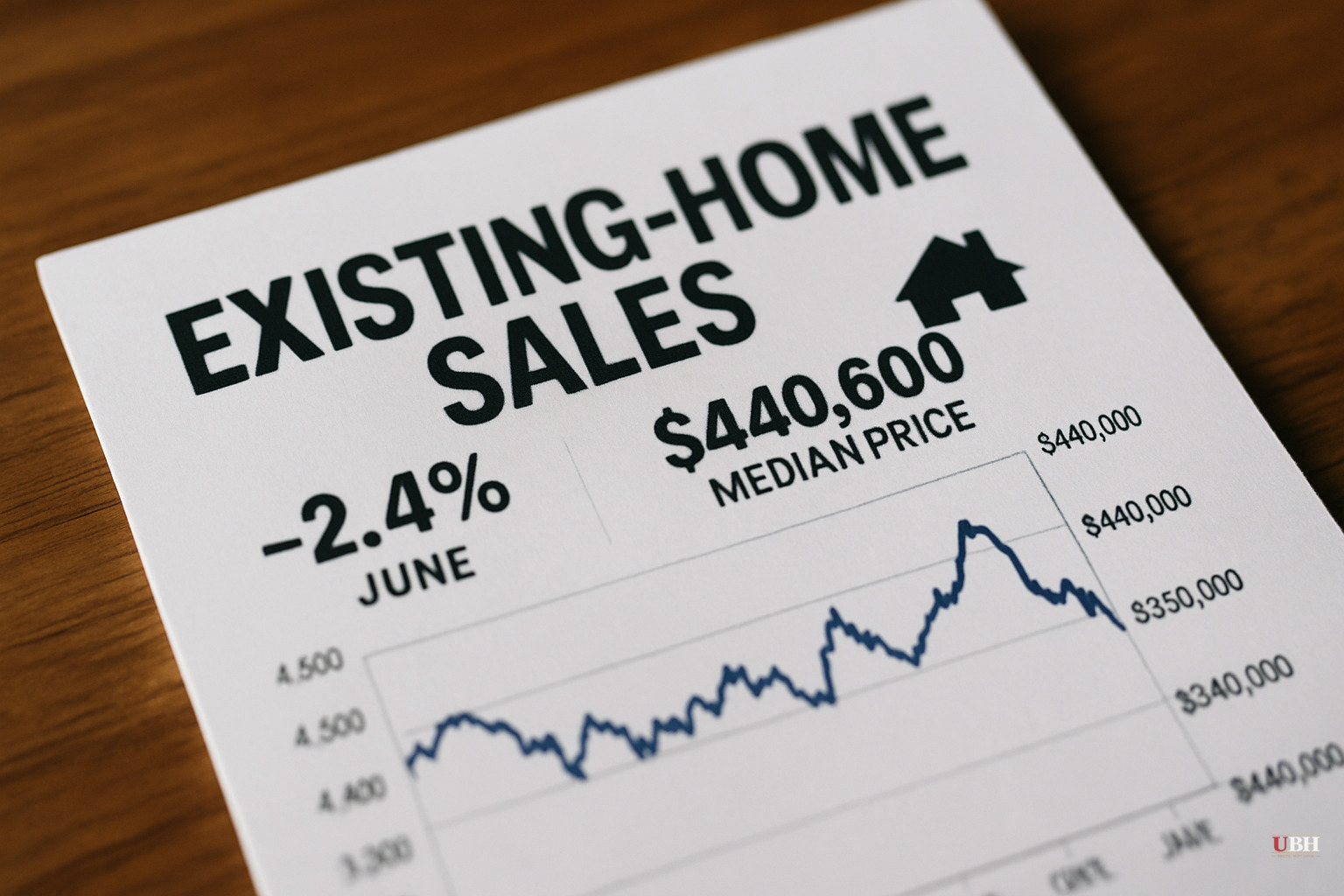
Sales Drop, Prices Rise
Existing home sales in June fell 2.4% month over month to a seasonally adjusted annualized rate of 4.09 million units, according to the National Association of Realtors. Analysts had expected a slight increase. May had already been revised upward to a 3.7% gain, meaning June gave back much of that progress.
Year over year, sales were up 2.75%. That sounds decent until you look at where the baseline is. As ZeroHedge noted, the annualized sales rate remains just off record lows set during the post-pandemic rate shock.
The median sales price of a previously owned home rose 1.8% from a year ago to $440,600, the highest on record, per NAR data. June is typically the peak month for both sales volume and prices, so hitting an all-time high now is not surprising, but it reflects a ceiling that a growing share of buyers cannot reach.
Inventory Is the Core Problem
NAR chief economist Lawrence Yun did not sugarcoat it. Inventory at the end of June stood at 1.56 million units, down 0.6% from May and up just 1.3% from a year ago. At the current sales pace, that is a 4.6-month supply. A balanced market requires six months.
"We need to see 30%, 40%" annual inventory gains, Yun said. "We're not seeing that."
He also warned: "Progress on long-term housing affordability could be hampered if inventory growth continues to stall. Without consistent gains in inventory, home prices can accelerate. It is critical to introduce more supply to the market to widen the opportunity for homeownership."
The inventory squeeze has a structural cause. Existing homeowners locked in 3% mortgages during 2020–2021 have no financial incentive to sell and take on today's rates. That lock-in effect continues to choke supply from the bottom up.
Mortgage Rates and the Iran War Factor
The June closed-sales data reflects contracts signed largely in May, when rates were still climbing. According to CNBC, the 30-year fixed mortgage began rising sharply at the start of March, tied to the onset of the Iran war. Buyers who signed in May were absorbing that rate spike.
NAR's Housing Affordability Index has improved somewhat from a year ago but sits at its lowest level since August 2025, per ZeroHedge. Yun framed the sensitivity plainly: "The back-and-forth in monthly home sales activity, driven by mild fluctuations in mortgage rates, shows how sensitive home buyers are to affordability conditions."
His partial offset: job gains of more than half a million since January 2026, which he said will continue to support demand.
A Market That Works for the Wealthy
The bifurcation in this market is stark. Sales of homes priced below $100,000 were down 1.7% year over year. Homes in the $100,000–$250,000 range were up less than 1%. Meanwhile, homes priced between $750,000 and $1 million were up nearly 14%, and homes above $1 million were up 18%, according to CNBC.
One-quarter of all June purchases were all-cash transactions, though that is down from 29% a year ago. First-time buyers made up 33% of sales, up from 30% a year prior. This is a modest bright spot, though ZeroHedge notes that figure slipped from 35% in May.
Regionally, sales fell in the South, Midwest, and West. The South, the nation's largest home-selling region, dropped 3.6% month over month to an annualized 1.89 million units. The Northeast was the only region to post a gain.
The Case for Patience
Some housing analysts argue that the picture is less dire than the month-over-month miss suggests. May was revised substantially higher, and year-over-year sales remain positive. Job growth is real, and the price gains, while painful, reflect genuine demand rather than speculative excess. The 1.8% annual price increase is far smaller than the double-digit surges seen in 2021–2022. If mortgage rates ease as the Iran war situation stabilizes, pent-up demand could move quickly.
The problem is that "pent-up demand" only converts to sales if inventory exists to absorb it. Right now it does not. Yun's own 30–40% inventory growth threshold has not been met, and nothing in the current data suggests it will be soon.
New Home Supply Adding Pressure Elsewhere
One dynamic the existing-home data does not fully capture: new home inventory remains elevated, which is pressuring homebuilders to pull back on new construction, per ZeroHedge. If builders slow starts in response to weak sales, the long-term supply problem gets worse even as short-term new-home competition provides some price relief in specific markets.
The next meaningful data point will be July's pending home sales index, which will reflect contracts signed during a period when mortgage rate direction and any ceasefire developments in the Iran conflict may have shifted buyer sentiment materially in either direction.
Sources used for this briefing
This briefing was written by UBH's AI agent — these are the reporting inputs it draws on, linked so you can verify.


