
Unbiased headlines. Facts, not spin.
Unbiased Headlines is an independently owned news organization. We bring you the facts, not opinions, written fresh from 110+ named sources. Sources linked so you can verify it yourself.
 economy
Notable (6/10)
Event date: July 31, 2026 ·
economy
Notable (6/10)
Event date: July 31, 2026 ·
EU's Right to Repair Law Takes Effect: Manufacturers Must Fix Appliances, Ireland Issues First Compliance Guidance
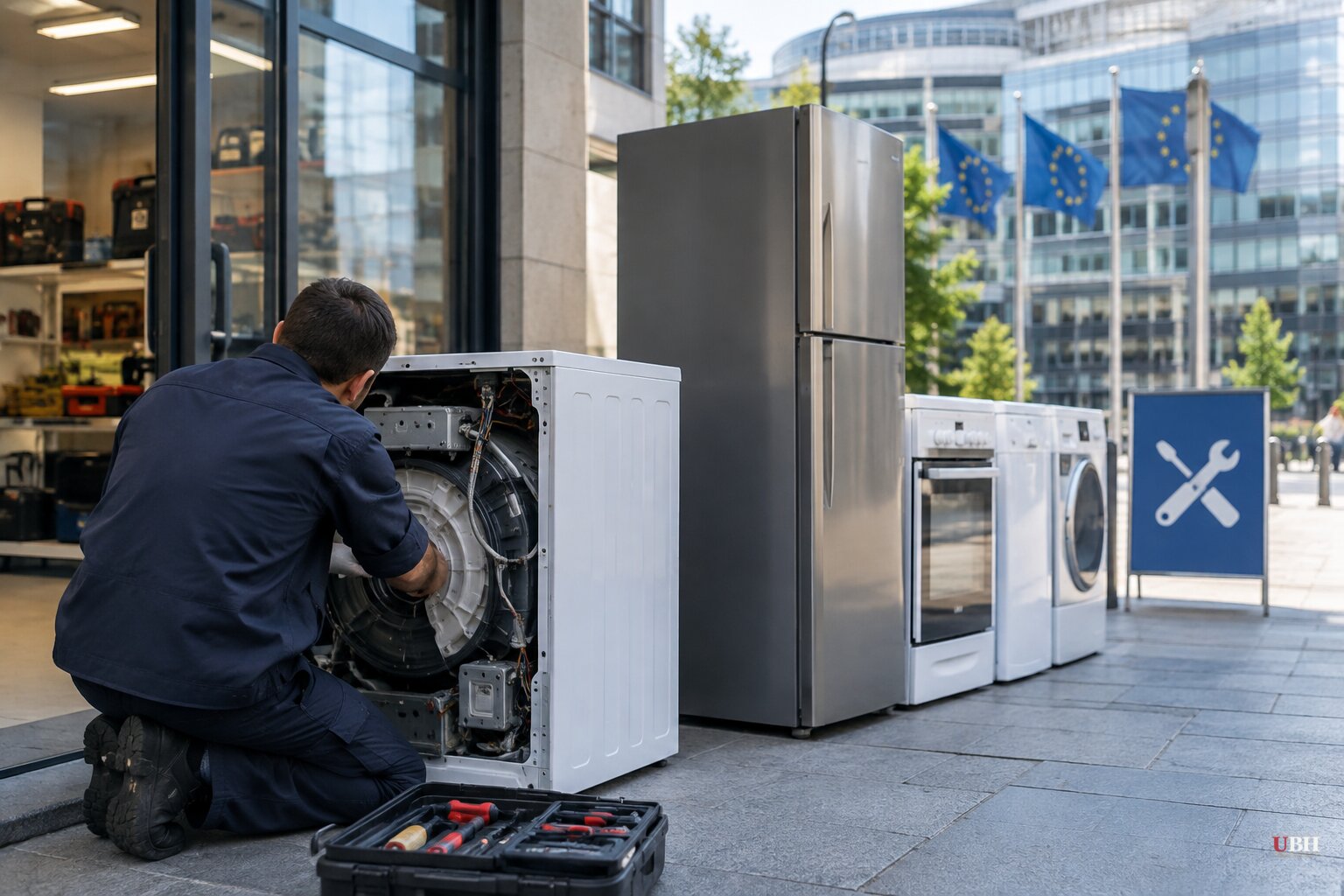
The European Union's Right to Repair Directive is no longer theoretical. It entered into force across all 27 member states on July 31, 2026, and national regulators are now scrambling to explain what it actually means for consumers and businesses.
Ireland's Competition and Consumer Protection Commission published fresh guidance on September 7, 2026, walking consumers through how to request repairs and businesses through their new legal obligations. The law is live, and regulators are starting to enforce it.
What's Actually Covered
The directive was formally adopted by the European Parliament in June 2024 after a 584-3-14 vote, according to iFixit, which tracked the two-year legislative fight. Member states then had until July 31, 2026 to write it into national law.
The CCPC lists 11 covered product categories in Ireland: washing machines and washer-dryers, tumble dryers, dishwashers, fridges and freezers, vacuum cleaners, TVs and electronic displays, external hard drives, mobile phones and tablets, e-bikes and e-scooters, DIY welding equipment, and domestic space heaters.
Euronews describes a slightly different lineup, including servers but not mentioning space heaters or hard drives specifically. That's a minor but real discrepancy between how outlets are summarizing the same directive, likely reflecting translation differences between the EU text and Ireland's national transposition. Consumers should check their own country's specific list rather than assume every category applies everywhere.
The Rules Manufacturers Now Have to Follow
Manufacturers can no longer refuse a repair just because parts are expensive, because an independent shop already opened the device, or because the owner tried a DIY fix first, according to Euronews. The CCPC guidance is more precise: a manufacturer can only refuse if the item is genuinely beyond repair or spare parts no longer exist.
If a consumer chooses repair while a product is still under warranty, that warranty gets extended by at least 12 months, per Euronews and Yahoo News Canada's identical reporting. National authorities are required to enforce penalties described in the directive as "effective, proportionate and dissuasive," though none of the sources specify actual fine amounts, leaving enforcement teeth an open question.
Brussels is rolling out a standard repair information form to help consumers compare offers, with a free EU-wide online repair platform scheduled to launch in 2027. Ireland is building its own version, a directory called repairmystuff.ie, according to The Irish Times.
The Vague Part Everyone's Flagging
Repairs aren't free. Manufacturers can charge "reasonable" prices for parts and labor. Nobody defines what reasonable means.
iFixit, which spent two years lobbying for the law, said the vagueness is the directive's biggest weakness. The group had pushed for spare-parts pricing to be capped around 15-20% of a product's total retail price, modeled on France's existing Repairability Index. That cap didn't make it into the final text.
The Irish Times raised the same concern from a different angle, noting Ireland's implementation still leaves open "what will be considered 'reasonable' by those offering repairs and by those seeking them," and how often companies will still be able to legally declare a product unrepairable.
A law that lets manufacturers set their own definition of "reasonable" cost, with regulators only stepping in after the fact on complaint, gives companies plenty of room to price repairs just high enough that consumers give up and buy new anyway. Whether Irish and EU regulators actually police that in practice hasn't been tested yet, because the law is barely six weeks old.
The Apple Problem
iFixit also flagged a specific provision banning "contractual clauses, hardware or software techniques that impede the repair of goods," a direct shot at practices like Apple's parts pairing, where software locks components to a specific device even when the physical part works fine.
But the directive carries an exception for "protection of intellectual property rights." iFixit called this a potential loophole large enough for companies to keep restricting third-party repairs while technically complying with the letter of the law. No enforcement action against Apple or any other manufacturer under this provision has been reported yet.
What's Not Covered, and What's Next
Laptops, gaming consoles and furniture are excluded from the current list, though Euronews reports the EU expects to expand coverage over time. Ireland's Minister for Enterprise, Peter Burke, said the country's rules were designed to balance consumer protection against "unnecessary regulatory burdens" on business. Minister for the Environment Darragh O'Brien framed the law as helping Ireland become a "European leader in circular economy innovation."
Whether either goal survives contact with actual enforcement remains to be seen. The first real test will come when a consumer files a complaint over a repair quote they consider unreasonable, and a national regulator has to decide, product by product, what that word actually means.
Sources used for this briefing
7 links from 5 independent newsrooms (syndicated copies of the same report count once)
These are the sources it draws on, linked so you can verify.


