
Unbiased headlines. Facts, not spin.
Unbiased Headlines is an independently owned news organization. We bring you the facts, not opinions, written fresh from 110+ named sources. Sources linked so you can verify it yourself.
 economy
Major Story (7/10)
Trump Waives Red-Dye Diesel Rules Through Dec. 31 and Promises $8 Billion in Farm Fuel Aid as Prices Stay High
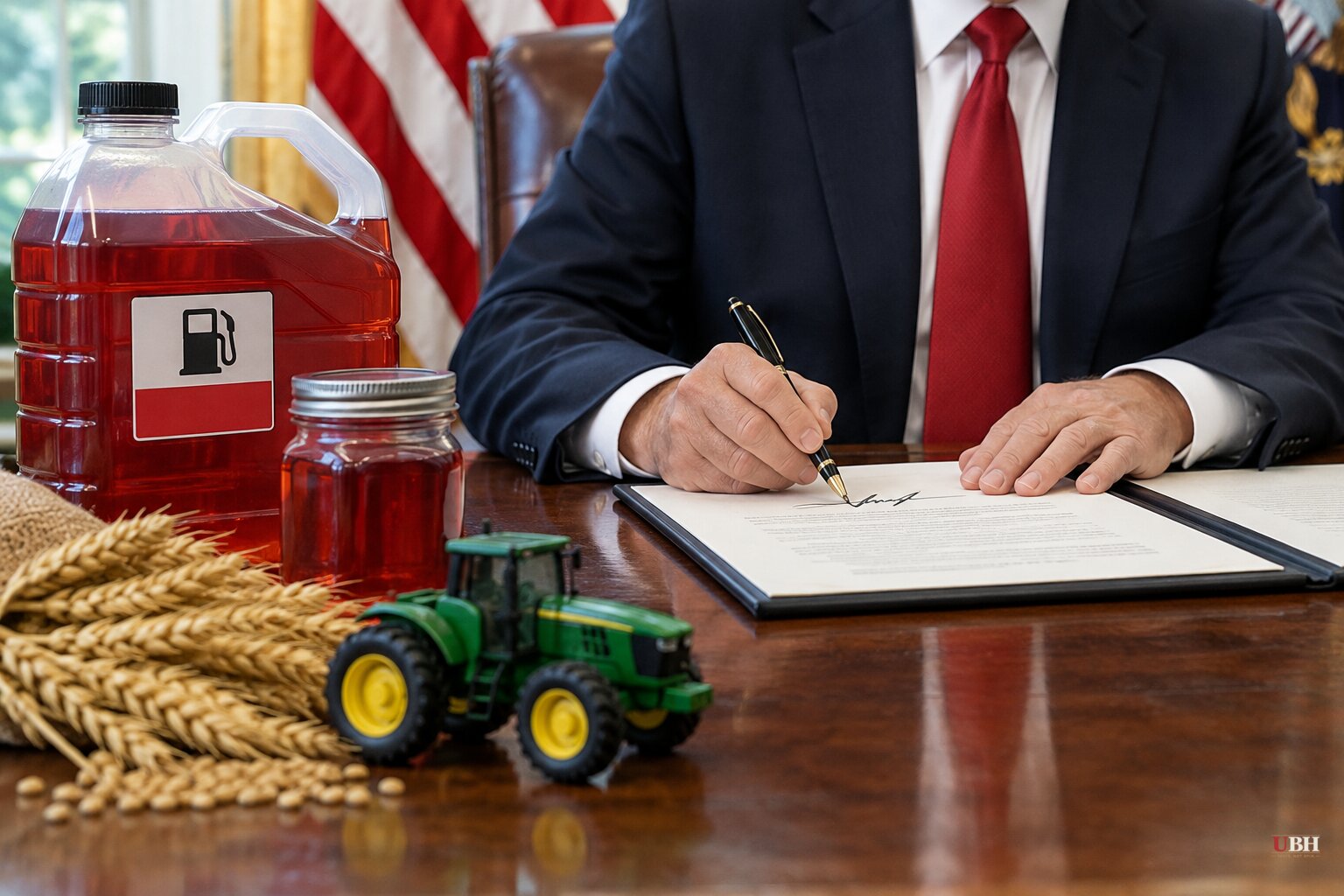
Diesel is expensive, and Washington is trying to do something about it before the November midterms.
Twenty days after President Donald Trump signed an executive order waiving federal restrictions on red-dyed diesel, the national price is still the main complaint among the people who burn the most of it.
What the order does
Trump signed the order on Oct. 5. It lets red-dyed diesel, normally sold without the federal highway fuel tax and limited to farm and off-road equipment, be used on public roads through Dec. 31.
The waiver took effect that night. It lowers costs for truckers by 24.4 cents per gallon, since the dyed fuel carries no federal motor fuel tax. The White House fact sheet estimates the savings at about $100 per truck refill.
The order directs Treasury Secretary Scott Bessent to defer certain diesel fuel tax payment obligations and provide penalty relief as the law allows. It also tasks Agriculture Secretary Brooke Rollins and Transportation Secretary Sean Duffy with carrying out the policy.
Seven states had already waived their own red-dye restrictions in recent weeks: Texas, Louisiana, Alabama, North Carolina, Tennessee, Nebraska and Missouri. The federal order makes the suspension national.
The restriction itself dates to the 1993 budget law signed by President Bill Clinton. It raised the federal diesel excise tax by 4.3 cents per gallon and set a penalty of $1,000 or $10 per gallon for using or selling dyed fuel on highways. The IRS required red dye for all tax-exempt diesel after Sept. 30, 1994.
The fuel itself is not the problem. Synergy Petroleum says dyed and clear diesel perform about the same when both meet the same specifications. The main difference is that the dye can stain tanks, hoses and skin.
$8 billion for the harvest
At a rally near Wichita, Kansas, Trump announced a second piece. The Department of Agriculture will launch a "Harvest Fuel Relief" program that provides farmers $8 billion to offset diesel costs this harvest season.
Trump credited Sen. Roger Marshall (R-Kan.), who is running against Democrat Adam Hamilton. "Roger got it to happen. Good job, Roger," Trump said.
He also reminded the crowd of earlier farm payments. "I just gave the farmers $12 billion, and in my first term, I gave them $28 billion," he said, adding that the money "came out of the tariff money from China." He called it "a gift from China." Rollins posted that USDA "will ALWAYS have their backs."
How high is high?
The two sides describe the price differently.
NPR's reporting from Oregon says diesel remains near record highs despite Trump's recent actions. Breitbart News argues the opposite: prices are high but not record-setting once inflation is counted.
AAA put the national average at $6.3151 per gallon in the reading Breitbart cited, down from $6.4391 a week earlier. Breitbart compared that to the July 14, 2008 peak of $4.764, which it says equals roughly $7.26 in August 2026 dollars using the Bureau of Labor Statistics' CPI for urban consumers.
Both descriptions can hold at once. A price can sit near the top of its history and still fall short of the inflation-adjusted peak. Neither framing changes what a farmer pays at the tank.
What it looks like in Harney County
In Harney County, Oregon, near Hines, rancher Katie Baltzor runs black angus cattle with her husband, Keith. Cattle outnumber people there by a wide margin.
"Fuel costs, parts costs, everything has gone up," Baltzor said. Calf prices have risen too, she said, "but calf prices still have not kept up with inflation." Her summary: "If everything else goes up and cattle prices don't, you're just spinning your wheels a bit."
Diesel is stacked on top of drought. Low snowpack and little rain have cut irrigation water across Oregon and fed this year's wildfires.
Record-size fires this summer burned the mountain grazing areas where Baltzor normally ranges her herd. She and hired riders went into heavy smoke to pull cattle out of the fires' path.
The cows came home the third week of July instead of the second week of September. Some neighbors had to start feeding hay early. Baltzor did not, because she had raked and bunched standing pasture.
The ranch was moving about 150 head down Highway 205 on horseback when she described the work still ahead: pregnancy-checking the cows, vaccinating and deworming.
What's next
The red-dye waiver expires Dec. 31. The Harvest Fuel Relief program was announced from a campaign-style stage, and the details of how the $8 billion reaches farmers and ranchers are the next thing to watch from USDA.
In the meantime, diesel buyers will judge the order the way Baltzor judges everything else: by whether the numbers on the invoice move before the waiver runs out and voters head to the polls in November.
Sources used for this briefing
7 links from 3 independent newsrooms (syndicated copies of the same report count once)
These are the sources it draws on, linked so you can verify.


