
Unbiased headlines. Facts, not spin.
Unbiased Headlines is an independently owned news organization. We bring you the facts, not opinions, written fresh from 110+ named sources. Sources linked so you can verify it yourself.
 economy
Notable (6/10)
Event date: October 17, 2026 ·
LVMH Asia Sales Fell 5% as Bernstein Sees No China Rebound and Goldman Forecasts 7% Luxury Growth in 2027
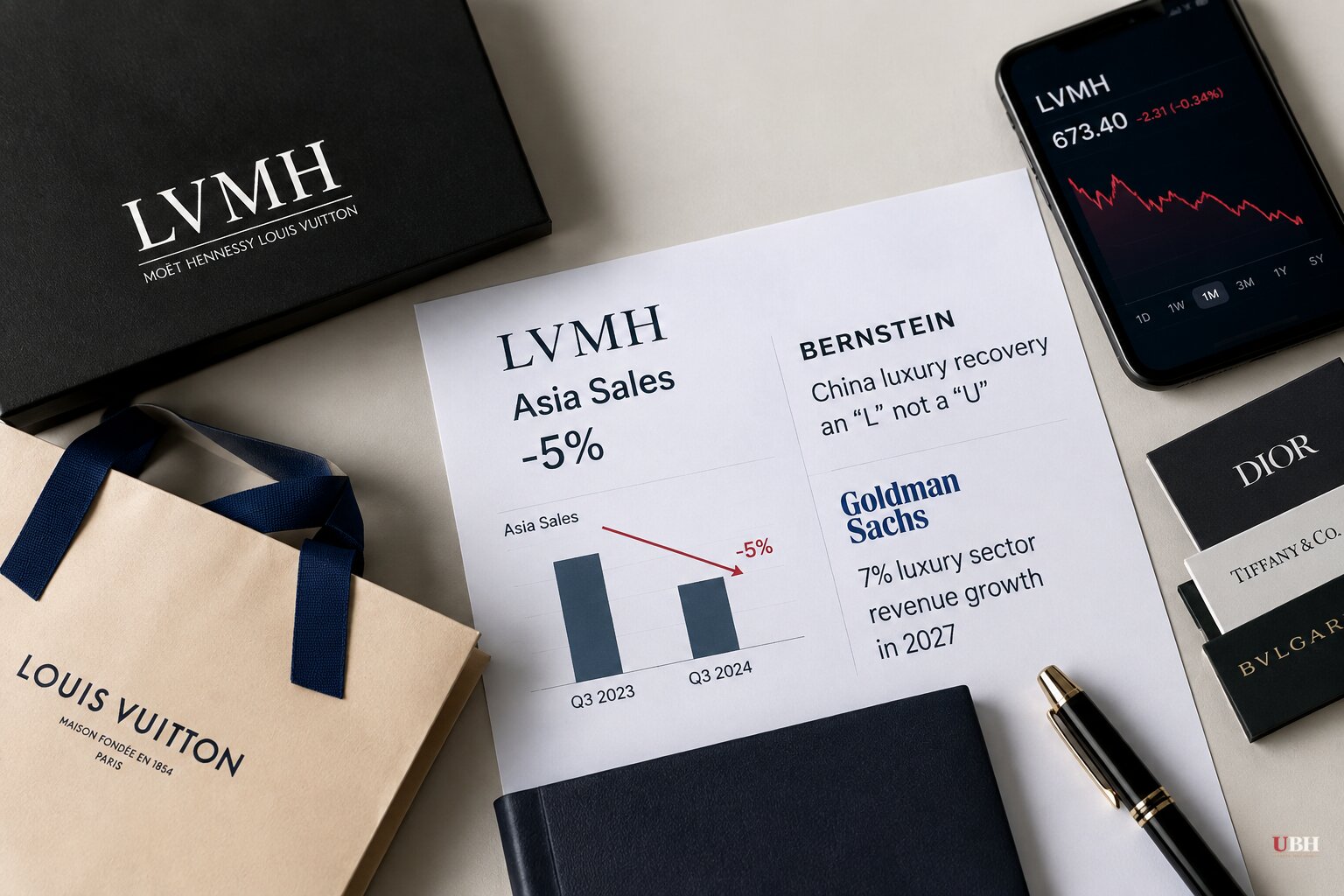
Since LVMH's Oct. 12 third-quarter update showed sales in Asia falling 5%, two major forecasts have landed on opposite sides of the question it raised: does luxury need China back to grow?
Bernstein says yes. Goldman Sachs says the sector is recovering anyway.
What LVMH reported
LVMH, the world's largest luxury group, posted organic sales growth of 1% to €18.5 billion ($20.7 billion) for the quarter. Analysts had expected 1.3%, according to a Visible Alpha consensus.
The fashion and leather goods division, which produces nearly half of group revenue and is dominated by Louis Vuitton, fell 5% organically. The consensus was a 1.8% decline.
Watches and jewelry, home to Bulgari and Tiffany, grew 6%, down from 9% in the first half. That category had held up better than handbags and fashion.
Asia, dominated by China, was the only region that declined. U.S. sales rose 5%. LVMH's U.S.-listed shares fell more than 3% after the update was published.
Chief Financial Officer Cecile Cabanis told analysts that "in the third quarter specifically, Asia was penalised by a sharp macro-led deterioration in Chinese consumer sentiment, with a tangible impact on discretionary expenses." Asked about China's tax crackdown on wealthy individuals, she said Chinese consumers' "feel good" factor had taken a hit.
New offshore-trust tax rules in China are adding to the financial pressure on affluent shoppers, and Hermès and Kering also reported weaker China momentum.
The Molly Tea fight
Louis Vuitton has also filed a string of trademark and copyright suits in China, including one against the tea chain Molly Tea over a logo resembling a floral motif tied to the brand. The dispute drew a consumer backlash in China.
The timing overlaps with the sales drop. Cabanis pointed to macro sentiment, though, and LVMH has not tied the Asia decline to the lawsuits.
Bernstein: an L, not a U
In an Oct. 17 report, Bernstein analyst Luca Solca wrote: "The U-shaped recovery we were expecting looks much more like an L." He added that "it would be judicious to revise down expectations for broader industry growth over the next few years."
The math behind that is simple. Luxury grew close to 8% a year for roughly 30 years through 2019. Solca said that "according to some sources" 50% to two-thirds of that growth came from Chinese consumers.
Chinese buyers still account for around 15% to the high-30% range of consumption at some companies Bernstein covers. Solca said it is "probably prudent to assume that growth without a revival in Chinese demand would be roughly half of that rate, closer to 4% or 5% than to 7% or 8%."
Bernstein blames falling property prices, elevated youth unemployment and slower wealth creation through real estate and financial services. It also flagged households drawing down savings without a matching pickup in spending.
Exports are one of the few bright spots in China's economy, which Bernstein says reduces pressure on Beijing to shift toward consumption-led growth. The firm expects only incremental, possibly temporary stimulus unless conditions worsen.
Chinese shoppers are trading down rather than quitting luxury, Bernstein said. Its advice to brands is to offer more accessible products and sharpen their value pitch.
Goldman: a recovery is already underway
Goldman Sachs sees it differently. In an Oct. 22 report, Erwan Rambourg, head of Europe Luxury and Lifestyle in Goldman Sachs Research, forecast 7% revenue growth in 2027 for a basket of large listed luxury makers. That is up from an expected 6% in 2026.
Goldman calls that "a solid recovery" and a rebuttal of bears' argument "that the sector may have gone ex-growth for an extended period." It names the U.S. as a surprising bright spot, where buying habits have not yet fully reflected the number of wealthy consumers.
The LVMH numbers fit that split. U.S. sales rose 5% while Asia fell 5%. Caixin reported that LVMH's U.S., Europe and Japan sales grew in the quarter.
The scale of the slump
Europe's leading luxury groups have lost around €330 billion in market value since the start of the year, with LVMH's shares down roughly 40%. Chinese consumers account for roughly a fifth of global luxury purchases.
Brands are also dealing with fallout from the Iran war and signs of slowing U.S. consumer spending, which could erode the American strength Goldman is counting on.
The open question is Beijing. Bernstein expects only incremental stimulus unless conditions worsen. Goldman's 7% figure for 2027 does not require a Chinese rebound, which is the exact assumption Bernstein disputes.
Sources used for this briefing
6 links from 6 independent newsrooms (syndicated copies of the same report count once)
These are the sources it draws on, linked so you can verify.


