
Original briefings. Zero spin.
Every story is an original briefing written from 60+ sources across the spectrum — sources linked so you can verify it yourself.
 defense
Notable (6/10)
June 18, 2026 at 04:10 PM
defense
Notable (6/10)
June 18, 2026 at 04:10 PM
Eurosatory 2026 Closes With NATO Counter-Drone Pact, Rheinmetall Space Deal, and 83 EDIP Proposals for Missile Component Funding
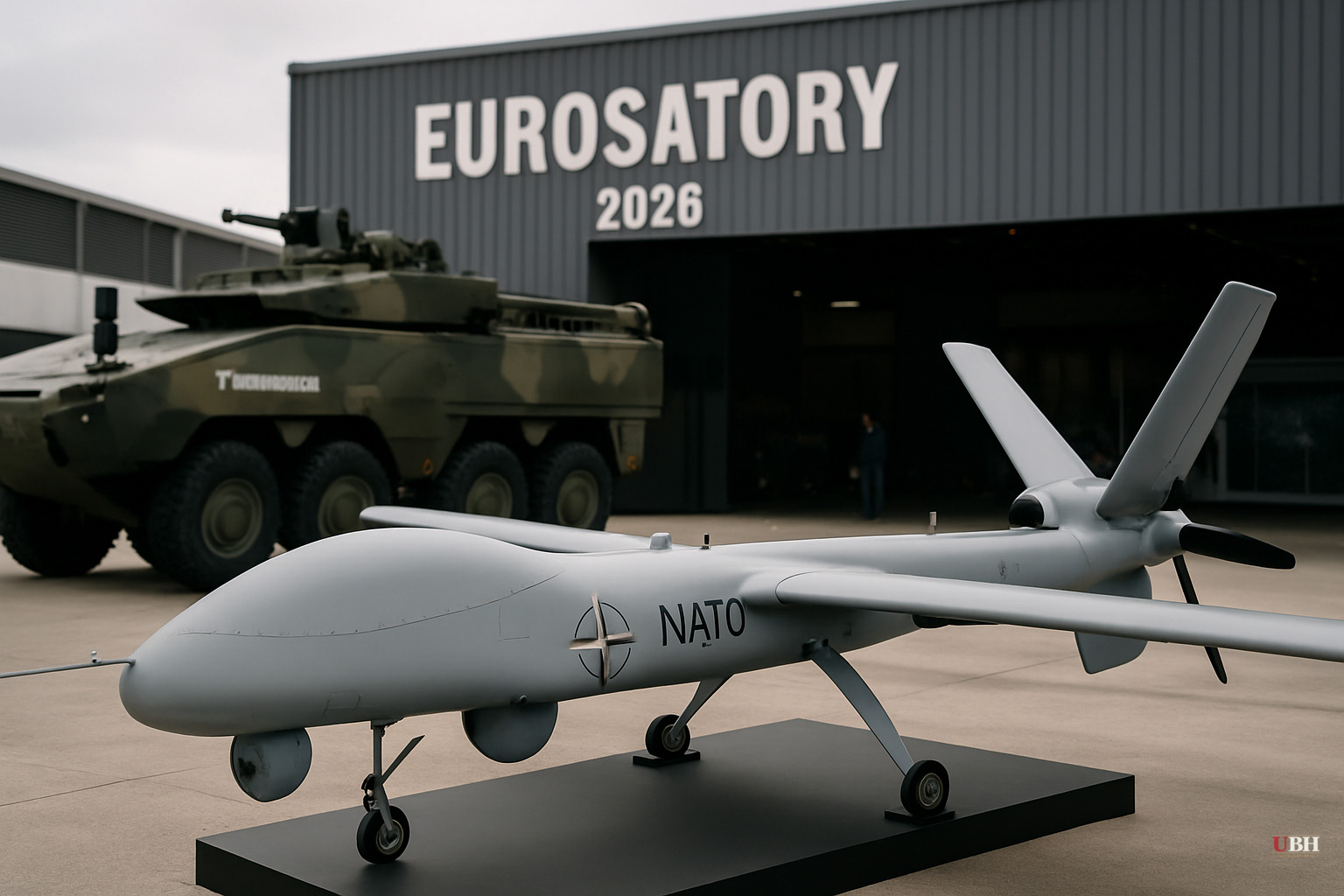
Since Russia's full-scale invasion of Ukraine in February 2022, European defense spending has accelerated at a pace the continent hadn't seen since the Cold War. Eurosatory 2026, the biennial land and air defense expo at the Paris Nord Villepinte Exhibition Centre, became the week's clearest single window into how that acceleration looks on the ground.
The Counter-Drone Agreement
Secretary of the Army Dan Driscoll led the most concrete political outcome of the show on June 16: a letter of intent signing ceremony expanding the Counter-Unmanned Aircraft Marketplace to allied and partner nations. Sweden, Denmark, Norway, France, Poland, the United Kingdom, the Netherlands, Italy, and Lithuania all signed on, according to a U.S. Army Europe and Africa press release dated June 17, 2026.
The agreement is designed to streamline how those nations identify, evaluate, and field counter-drone capabilities, cutting the procurement lag that has repeatedly allowed drone threats to outpace defenses. Driscoll framed it explicitly as acquisition reform: bringing market-portal efficiency into government contracting. "What we're fundamentally trying to do here is bring in the same market portals that have made so many companies successful in our country and yours, and just get our government and other governments' regulations" aligned, he said, according to the U.S. Army release.
The letter of intent is NOT a contract and carries no binding procurement commitment. Whether allied parliaments and defense ministries follow through with actual purchases at the pace Driscoll described remains to be seen.
Rheinmetall Keeps Stacking Space Deals
German defense giant Rheinmetall announced a joint venture memorandum of understanding with U.S. imagery provider Vantor to supply the Bundeswehr with what the companies call "spatial intelligence," according to Breaking Defense. The plan is to integrate Vantor's Tensorglobe platform, which fuses satellite synthetic aperture radar, electro-optical, and infrared imagery from multiple government and commercial satellites, into Rheinmetall's command-and-control systems.
Vantor CEO Dan Smoot said the goal is to give European militaries the ability to "task, fuse, produce, analyze and deploy spatial intelligence in sovereign environments" without depending on U.S.-controlled infrastructure. Rheinmetall CEO Armin Papperger said reconnaissance in modern warfare "will not be determined by sensors alone, but by the ability to quickly and reliably process information from a wide variety of sources."
The week before, Rheinmetall and Bremen-based satellite firm OHB SE announced OHB Rheinmetall Space Networks GmbH, aimed at building the Bundeswehr's SATCOMBw Level 4 constellation. The constellation would consist of roughly 100 low-Earth orbit satellites designed as a German alternative to commercial constellations like Starlink, per Breaking Defense.
Renault Meets the Battlefield
The Renault-Thales "4Troop" prototype, a militarized 4x4 based on a Renault coupe SUV that has been in production since 2024, was unveiled at Eurosatory on June 15, according to Breaking Defense.
Thales Advanced Studies Manager Marc Dehondt explained the logic plainly. France is preparing for the possibility of high-intensity combat on its own territory. Mobilizing reserve forces fast means needing large quantities of vehicles fast. The auto industry can deliver that in a way the traditional defense industry cannot. Renault produces roughly 1.2 million cars a year globally, including 508,000 in France in 2025 alone.
Thales handles the data-processing and tactical hub; Renault provides the manufacturing muscle. The vehicle on display had one visible military modification: a roof rack with electric sockets to charge field equipment. Dehondt said the concept is adaptable across Renault's entire lineup. A Renault Master utility van, for example, could become a command vehicle. The 4Troop is designed to operate inside France's Scorpion networked combat program, not as a standalone platform.
83 Companies Want EU Ammunition Money
While the show was running, the European Commission's first EDIP funding call closed on June 16. According to the EU's Directorate-General for Defence Industry and Space, 83 proposals came in for the "Energetic Components" tranche, covering propellant powder, explosives, and key components for missiles, bombs, and anti-drone systems.
The call has €165 million in EU funding attached, with industry co-financing expected to push total investment up to €470 million. Proposals came from companies in 23 EU member states plus Norway. The Commission says it will evaluate submissions and identify recipients by September 2026.
EDIP itself is a €1.5 billion program. The €300 million Ukraine Support Instrument inside it is directed at rebuilding Ukraine's own defense industrial base.
The Regulatory Framework Still Pending
Announcements are not production. Critics of EU defense integration argue that the continent's procurement bureaucracy has historically strangled even well-funded programs in red tape, and that letters of intent and memoranda of understanding are the easiest part of the process. That concern is not baseless.
The EU's own legislators appear to agree, at least partly. Negotiators from the EU Council and European Parliament reached a provisional agreement on June 10, per Anadolu Ajansı, on a package designed to speed up defense procurement specifically by cutting that bureaucracy. The deal sets a maximum 102-working-day window for permit approvals on defense readiness projects, raises procurement thresholds to reduce administrative burden, and creates two new mandatory transfer licenses to ease cross-border movement of military equipment within the EU. It still requires formal approval from both the Council and the Parliament before it becomes law.
The 83 EDIP proposals for ammunition components will be evaluated against exactly the kind of regulatory framework that package is trying to fix. If the formal approval drags and the old permit timelines remain in place, September's EDIP award decisions could still face the same bottlenecks the new rules are meant to eliminate.
Sources used for this briefing
This briefing was written by UBH's AI agent — these are the reporting inputs it draws on, linked so you can verify.