
Original briefings. Zero spin.
Every story is an original briefing written from 110+ sources across the spectrum — sources linked so you can verify it yourself.
 economy
Notable (6/10)
Event date: August 26, 2026
economy
Notable (6/10)
Event date: August 26, 2026
Europol Warns Museum Heists Are Turning Violent, With Chinese Artifacts a Top Target
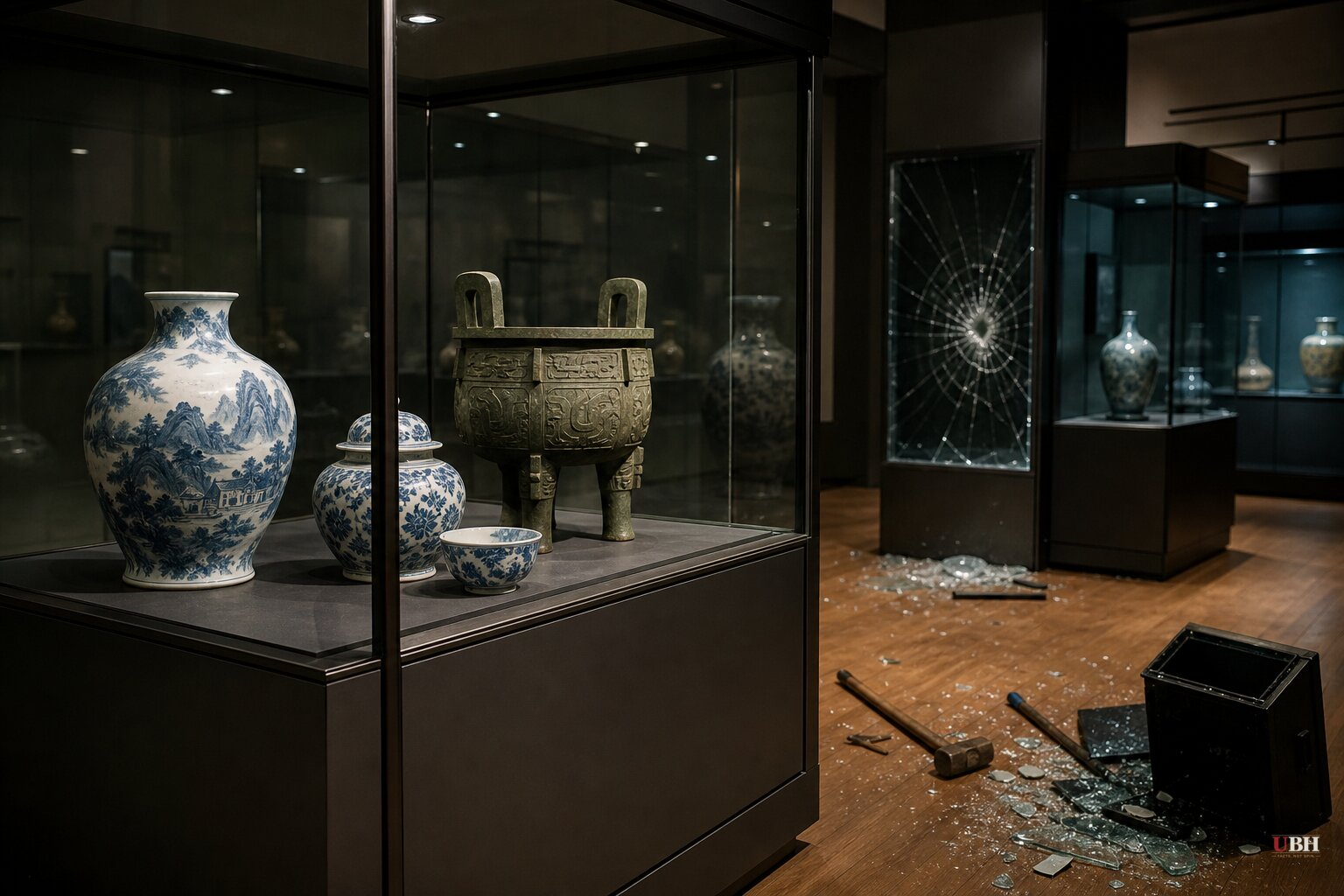
Europol says museum theft has stopped being a quiet crime.
In a Spotlight report titled "Changing Tactics, Changing Targets: The Evolving Nature of Museum Heists," published August 24, the European Union's law enforcement agency found that thieves are now breaking into museums with sledgehammers, axes, crowbars, and explosives. Some carry firearms to intimidate guards and visitors.
Europol calls the old model one where museum theft "was long regarded as a non-violent crime relying on stealth." That has changed.
Three Categories of Loot
Europol identified precious metals, gemstones, and Chinese cultural artifacts as the three categories criminals are chasing hardest right now.
On the Chinese artifacts specifically, the report lists recent losses including 12th- and 13th-century porcelain plates, Ming dynasty jars, and Ming and Qing enameled bronze vases. Europol said the pattern shows "deliberate preparation, including prior reconnaissance and planning, rather than indiscriminate looting."
The agency's read: ancient Chinese porcelain is "likely targeted by cultural goods traffickers for financial gain" because it's "likely to be easily sold on the art market."
Europol also flagged a newer type of criminal getting into the game, recruited through social media on what the report calls a "crime-as-a-service" basis. Museum burglary is being outsourced and modularized like other criminal enterprises, rather than run exclusively by career specialists.
The Numbers Behind the Warning
Luc Larriba, a French journalist and author of a book on France's OCBC police unit for cultural property crime, told The Epoch Times that illicit art trafficking ranks as the world's third-largest criminal trade according to UNESCO, behind only drug and arms trafficking.
Larriba described the museum heist networks as "real organized crime, structured in layers, exactly like drug or arms trafficking." He said operations "can start from very high up, from a sponsor, and then unfold across different levels."
France's Unsolved Case
The clearest example sits at the Château de Fontainebleau, southeast of Paris.
On March 1, 2015, burglars broke into the palace's Chinese Museum and were in and out in seven minutes. They took roughly 15 pieces, including a replica of the crown of the King of Siam, gifted to Napoleon III in 1861, and a Qianlong-era cloisonné chimera.
None of it has ever been recovered. Nobody has ever been identified as responsible. More than eleven years later, the case remains open and cold.
A second attempt at the same palace was stopped in December 2019. Five Spaniards and a Chinese national were arrested near the site and given preliminary charges of criminal conspiracy and organized theft. That arrest shows French authorities can intercept these operations when tipped off in advance, but it also underscores that the 2015 theft succeeded precisely because no such intervention happened.
A French police officer specializing in cultural property crime told the French outlet Journal du Dimanche that whoever commissioned the 2015 operation could only be a Chinese triad, reasoning that the stolen pieces would otherwise be unsellable on any legitimate market.
No triad has been charged in connection with the Fontainebleau theft, and no prosecution has resulted from that specific allegation.
What's Actually Proven vs. What's Alleged
What's documented: museum break-ins are getting more violent, Chinese artifacts are a recurring and specific target across multiple European cases, and at least one major theft (Fontainebleau, 2015) remains completely unsolved.
What's alleged but unproven: that organized Chinese criminal networks, specifically triads, are commissioning these thefts to order. That's a theory from a single French police source and echoed by Larriba's broader description of layered, sponsor-driven organized crime. Neither claim has produced a named suspect, an indictment, or a court finding tying a specific criminal organization to the Fontainebleau case or the pattern Europol describes.
The system's structural problem is straightforward: stolen antiquities that can't be sold openly on the legitimate art market are, by definition, hard to trace once they leave the country. That's exactly why investigators lean on theories about black-market buyers rather than hard evidence, and why a decade-old case like Fontainebleau can go cold with zero arrests despite a clear motive and a narrow window of suspects.
Europol's report doesn't name specific recommendations for museum security upgrades, but the pattern it describes, reconnaissance-heavy planning aimed at a narrow category of high-value, hard-to-trace goods, points toward the same vulnerability every unsolved case shares: once a Ming vase or Qianlong bronze leaves European soil, there's no clear enforcement mechanism to track where it ends up or who paid for it.
Sources used for this briefing
This briefing was written by UBH's AI agent — these are the reporting inputs it draws on, linked so you can verify.


