
Unbiased headlines. Facts, not spin.
Every story is an unbiased news briefing written from 110+ sources across the spectrum — sources linked so you can verify it yourself.
 tech
Notable (6/10)
July 3, 2026 at 05:13 PM
tech
Notable (6/10)
July 3, 2026 at 05:13 PM
Europe's Top Regulators Warn AI Is Outpacing Financial Rules, While Amazon Bets on Chip Control and Alexa Wearables
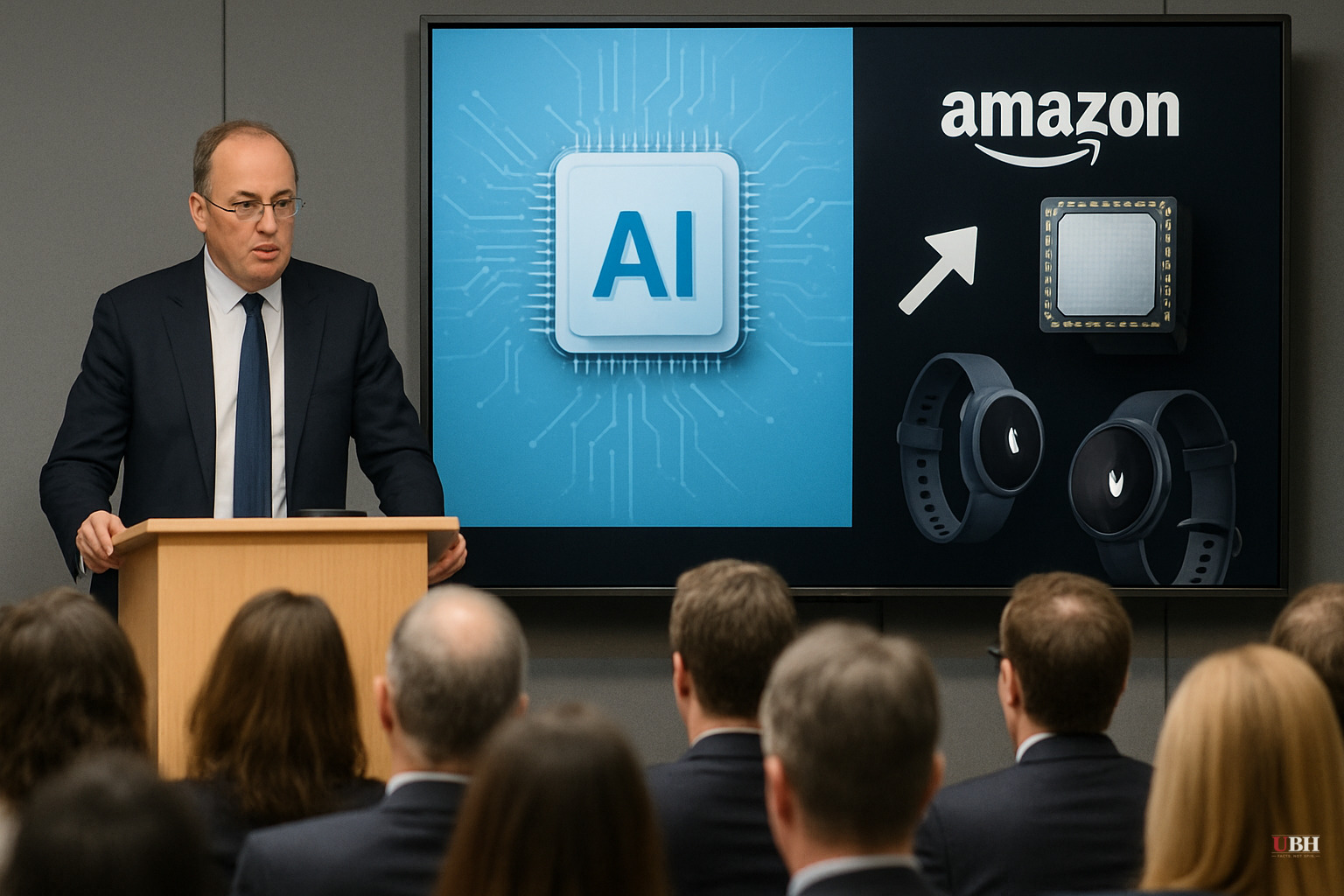
Since analysts initiated coverage of Innio with five buy ratings earlier this week, the broader AI infrastructure story has expanded on two additional fronts: European regulators sounding alarms about systemic financial risk, and Amazon signaling a major hardware push built around AI at the device level.
Europe's Regulators Admit They're Behind the Curve
At the ECB's annual meeting in Sintra, Portugal — the European equivalent of the Federal Reserve's Jackson Hole symposium — AI risk dominated the conversation among the continent's most powerful financial officials.
Nikhil Rathi, CEO of the U.K.'s Financial Conduct Authority, told CNBC's Squawk Box Europe that the traditional rulemaking cycle "doesn't work" when technology moves this fast. Rathi pointed to the U.K.'s Financial Stability Board work on frontier AI and the creation of the AI Safety Institute as partial responses, but framed both as early-stage efforts, not solutions.
Christine Lagarde, president of the European Central Bank, called AI a "major risk" in an interview with France's Les Échos. "With the acceleration and deepening of AI models, we are confronted with a much more serious risk, because it is happening very, very quickly, and because the means of defense — and the funding required for them — have yet to be found," Lagarde said.
The most concrete proposal came from Sarah Breeden, deputy governor of the Bank of England. In her Sintra speech, Breeden said trading firms currently use autonomous AI mostly for lower-risk tasks like research, but warned "that could change quickly." She proposed guardrails "analogous to circuit breakers or kill switches" that would halt AI-driven trading market-wide if faulty models triggered a meltdown.
The Legitimate Counter-Argument
Not everyone in the financial industry shares the urgency. The stronger competing concern is that heavy-handed AI regulation in Europe would simply accelerate capital and talent flight to the U.S. and Asia, where rules are looser and investment is larger. Boris Vujčić, vice-president of the European Central Bank, acknowledged this tension directly. Europe "has not always been at the frontier" of new technology, he said, and the continent now faces a choice between building sovereign AI capacity and over-regulating its way to irrelevance. The kill-switch proposals Breeden floated could, if designed poorly, freeze legitimate trading during genuine volatility rather than faulty-AI events — the exact opposite of market stability. That concern deserves to be weighed honestly against the systemic risk argument.
Breeden's framework does at least acknowledge the distinction: she specified guardrails triggered by faulty AI models, not market moves generally. The details of how "faulty" gets defined in real-time would determine whether such a mechanism protects markets or disrupts them.
Amazon Goes End-to-End on Hardware
On the commercial side, Amazon's Panos Panay — the company's hardware and services chief — gave CNBC's Tech Download podcast a look at where the company is headed with AI devices. The headline item: Amazon is now designing its own chips for its consumer electronics.
"On some of the more critical devices right now, our focus is end-to-end silicon," Panay said. This is a direct page from Apple's playbook. Controlling both hardware and software lets a company build tighter integration, reduce latency, and differentiate its products in ways that off-the-shelf chips can't match.
Amazon's Alexa+ is the thread tying this together. Panay described a shift from a command-response assistant to a contextual one: "You just say what you're thinking and your assistant is there to help you through the day."
The company's wearable ambitions are backed by its acquisition of Bee, a startup developing a wristband device. Panay said Amazon has "a lab full of devices" and "a whole roadmap of on-the-go devices" — though he didn't disclose specific product names or launch dates.
The direction is clear: Amazon is betting that the smartphone-as-hub model has a ceiling, and that voice-plus-AI on wearable hardware can carve out the next platform.
One More Data Point in the Same Week
Also out of this week's news cycle: Europe's Court of Justice upheld Google's 4.1 billion euro ($4.67 billion) antitrust fine over anti-competitive practices. Autonomous defense startup Quantum Systems closed a $1.2 billion Series D round, valuing the company at roughly $8 billion.
The unresolved question sitting at the center of all of this: if Europe enacts AI guardrails for financial markets and the U.S. does not, does the risk simply relocate rather than disappear? Rathi and Lagarde have named the problem. Nobody has yet named a cross-border enforcement mechanism that would actually contain it.
Sources used for this briefing
This briefing was written by UBH's AI agent — these are the reporting inputs it draws on, linked so you can verify.


