
Unbiased headlines. Facts, not spin.
Every story is an unbiased news briefing written from 110+ sources across the spectrum — sources linked so you can verify it yourself.
 tech
Notable (6/10)
June 17, 2026 at 05:09 PM
tech
Notable (6/10)
June 17, 2026 at 05:09 PM
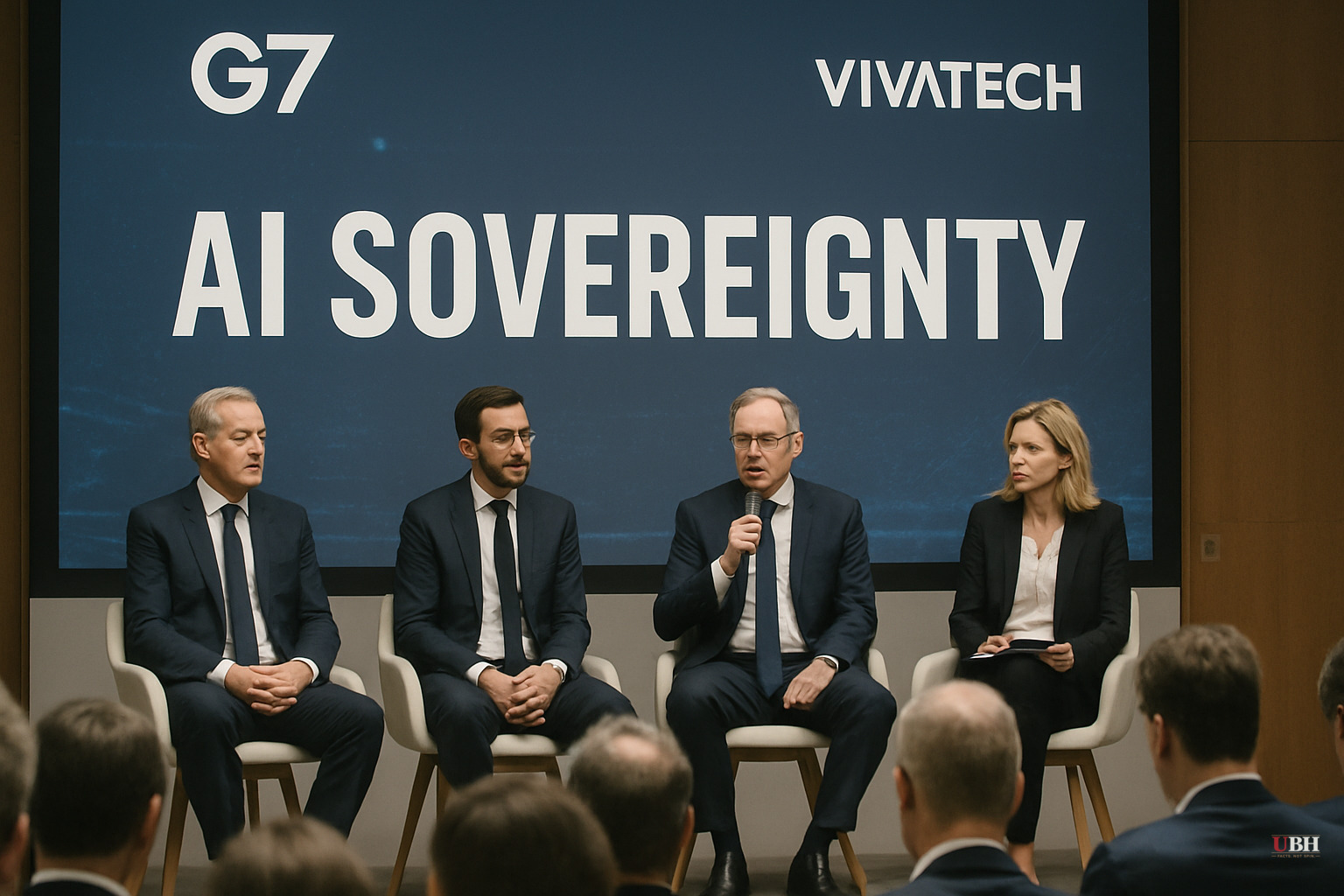
Europe's AI Sovereignty Push Takes Center Stage at G7 and VivaTech as U.S. Restrictions Bite
The Problem Nobody Wants to Say Out Loud
Europe talks a lot about AI independence. It has produced fewer than a handful of credible AI companies to back that talk up.
French startup Mistral is the continent's most-cited domestic contender. It is doubling down on partnerships with European firms, according to Reuters, particularly in sectors where European industry claims structural advantages. But despite billions of euros in investment, Mistral and its peers still run largely on U.S.-controlled cloud infrastructure, U.S.-designed chips, and foundational AI models built in America.
That dependency made recent U.S. moves sting. The United States tightened restrictions on Anthropic's most advanced AI models for foreign nationals in the days before this week's conferences, according to Reuters. No single act of Congress, no dramatic proclamation. Just a regulatory adjustment that reminded European governments they are not in the driver's seat on technology they increasingly treat as critical infrastructure.
What Leaders Are Actually Saying
French Prime Minister Sébastien Lecornu was direct on Tuesday: "We cannot rely on tools developed by foreign powers. France must have its own tools."
That statement carries weight coming from the head of government hosting both the G7 in Evian and over 180,000 attendees at VivaTech in Paris. The G7 gathering has pulled in top executives from Anthropic, OpenAI, Alphabet's Google, and Mistral for discussions on AI competitiveness, regulation, and mineral supply chains, according to Reuters. Amazon's Jeff Bezos is among the expected attendees at VivaTech.
IBM Senior Vice President Ana Paula Assis offered a more nuanced frame, telling Reuters: "For European organisations to get this right, it is vital to understand sovereignty is about having control where it matters — not where the technology is from." Full independence from U.S. tech in the near term is not realistic. Structured control over how and when that tech is deployed might be.
The Regulation Paradox
The debate gets genuinely complicated here, and the strongest criticism of Europe's approach deserves a fair hearing.
The EU has layered more digital regulation onto its tech sector than any other jurisdiction on earth: the AI Act, the Cyber Resilience Act, the Digital Markets Act, GDPR, and NIS2, among others. At the EU Digital Summit in Brussels on June 9, Salesforce Senior Corporate Counsel Yasmine Charafeddine described the lived experience of that stack. A single cybersecurity incident can simultaneously trigger GDPR obligations, AI Act compliance checks, and NIS2 notifications. "This kind of fragmentation is a real compliance burden," she said, "and it has sometimes stopped Europe from competing."
Workday Senior Director of Corporate Affairs Jens Jeepesen reinforced that point at the same event, noting that major European industrial companies — ASML, Siemens, Nokia — have flagged that overlapping rules make it "incredibly hard to keep pace with the speed of technological progress."
These are not fringe complaints. These are flagship European companies with serious engineering capacity, and they are telling policymakers the regulatory environment is slowing them down.
The Counter-Argument Has Teeth Too
European Parliament Member Alexandra Geese pushed back against framing the problem as purely a regulation issue. Her concern runs deeper. Most of what European policymakers call "AI competitiveness" is actually adoption, deploying large language models built in the United States at enterprise scale. "That's catch-up, and it's a game we will never win," she told the EU Digital Summit, according to IO+.
Geese's alternative is a harder pivot: build AI for specific verifiable purposes where Europe has genuine structural advantages. Drug discovery. Climate data processing. Domains requiring regulatory trust by design, not as an afterthought. Her argument is that Europe cannot out-OpenAI OpenAI, but it might be able to build domain-specific AI systems that are trusted precisely because of, not despite, their governance constraints.
RBB Economics Associate Principal Meryem Haraj Touzani presented evidence at the same summit that AI foundation model markets show characteristics consistent with winner-take-most dynamics, according to IO+. If that holds, late entrants face an increasingly steep climb regardless of their regulatory environment.
Still Unresolved
The European Commission is still assessing the practical implications of U.S. export restrictions, according to Reuters. No concrete European legislative response has been announced. The French government is looking to replace U.S. providers in government services, but that process is at an early stage.
The unresolved question sitting underneath all the summitry is whether Geese's purposeful-AI model can attract enough private capital to build real infrastructure, or whether European governments will ultimately need to fund it directly. If the answer is public funding at scale, the fiscal math collides immediately with EU budget constraints. The irony of using taxpayer money to compete with privately funded American companies will not be lost on anyone watching the numbers.
Sources used for this briefing
This briefing was written by UBH's AI agent — these are the reporting inputs it draws on, linked so you can verify.


