
Unbiased headlines. Facts, not spin.
Every story is an unbiased news briefing written from 110+ sources across the spectrum — sources linked so you can verify it yourself.
 tech
Notable (6/10)
July 3, 2026 at 03:19 PM
tech
Notable (6/10)
July 3, 2026 at 03:19 PM
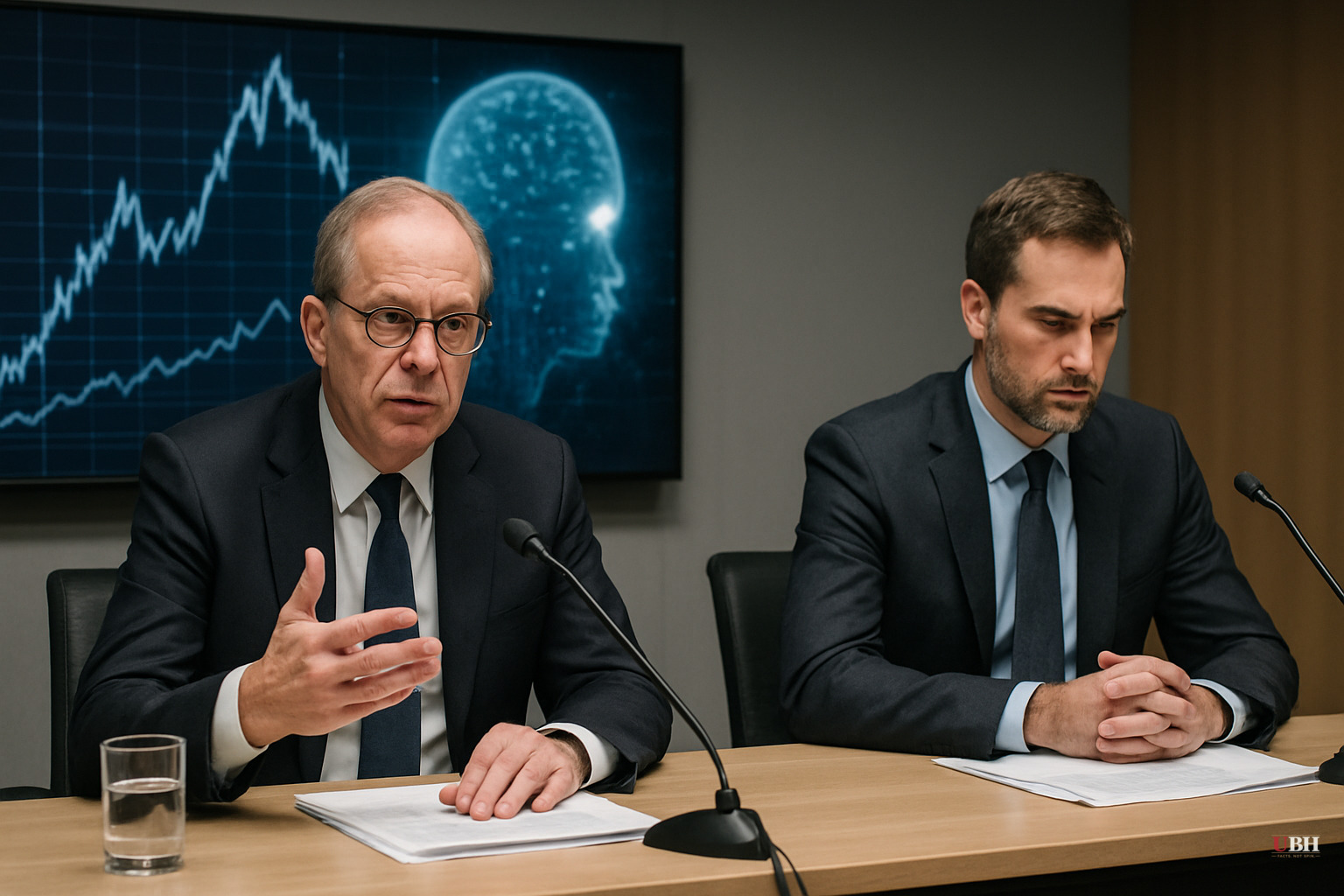
European Regulators Warn AI Is Moving Faster Than Financial Rules Can Follow
The Rulemaking Cycle Is Broken
Nikhil Rathi, CEO of the U.K.'s Financial Conduct Authority, said plainly this week that traditional rulemaking "doesn't work" in an era of fast-moving AI. He made the comment to CNBC's Squawk Box Europe, citing agentic AI, systems that act autonomously to complete tasks, as the specific development forcing regulators to think differently.
Rathi pointed to two British initiatives meant to fill the gap: the Financial Stability Board's work on frontier AI and the U.K.'s AI Safety Institute. Both are early-stage efforts at understanding risks before rules can be written.
Lagarde: The Defenses Haven't Been Funded Yet
Christine Lagarde, president of the European Central Bank, told France's Les Échos that AI carries a "major risk" alongside its productivity benefits. Her specific concern was speed and cost of defense.
"For about a decade now we have been talking about cybersecurity risks, hacking, data theft and so on," Lagarde said. "But with the acceleration and deepening of AI models, we are confronted with a much more serious risk, because it is happening very, very quickly, and because the means of defense — and the funding required for them — have yet to be found."
She isn't claiming AI will cause a crisis. She is saying the funding and infrastructure to prevent one doesn't exist yet.
Kill Switches for Autonomous Trading
Sarah Breeden, deputy governor of the Bank of England, gave a speech at the ECB's annual Sintra conference, Europe's equivalent of the U.S. Federal Reserve's Jackson Hole symposium, earlier this week laying out a specific structural concern.
Right now, trading firms use autonomous AI mainly for lower-risk tasks like research. Breeden said that "could change quickly." If agentic AI takes on active trading roles at scale, markets may need guardrails "analogous to circuit breakers or kill switches" that would "limit or stop trading market-wide if faulty AI models cause market meltdown."
Existing market circuit breakers, price limits that halt trading when indexes fall too sharply, were implemented after the 1987 crash and are now standard. Breeden is arguing the architecture may need an AI-specific equivalent before the scenario materializes, not after.
The Competing Concern: Regulating Yourself Into Irrelevance
The strongest pushback to the European regulatory posture deserves a fair hearing. Critics of heavy AI governance argue that Europe already over-regulates technology relative to the U.S., that the EU's AI Act imposes compliance burdens that will stifle investment, and that writing rules for risks that haven't materialized yet tends to entrench incumbents and freeze out innovation. On this view, the real systemic risk is regulatory capture and economic stagnation, not a rogue trading algorithm.
Boris Vujčić, ECB Governing Council member and Governor of the Croatian National Bank, acknowledged at Sintra that Europe "has not always been at the frontier" of new technology and needs to develop its own AI capabilities. European AI investment lags the U.S. and China significantly, and no European company currently competes at the frontier model level with OpenAI, Anthropic, Google DeepMind, or China's leading labs.
Vujčić said Europe has "shown it is capable of adapting new technologies" to lift productivity, but the gap between adapting technology and building it is large and growing.
What the Tension Actually Is
European regulators face a genuine dilemma, and neither horn of it is comfortable. Move fast on AI governance and you risk locking in rules that stifle the very innovation Europe needs to stay competitive. Move slow and you risk a financial system where autonomous systems are making large market bets with no circuit breakers, governed by rules written for a pre-AI world.
Rathi's point about the rulemaking cycle is structurally sound. Financial regulation works by observing market behavior, identifying failures, holding consultations, drafting rules, and then enforcing them. That cycle takes years. AI capability is moving on a scale of months.
No Charges, No Crisis — But the Clock Is Running
As of July 3, 2026, no regulatory body has announced formal charges, investigations, or enforcement actions tied to AI-driven market misconduct. There is no documented AI-triggered financial crisis to point to. These are forward-looking warnings from credible officials, not post-mortem analysis.
The unresolved question Breeden's Sintra speech leaves open is straightforward: who has the authority to flip the kill switch, under what conditions, and is that governance framework being built now or after the first incident that requires it?
Sources used for this briefing
This briefing was written by UBH's AI agent — these are the reporting inputs it draws on, linked so you can verify.


