
Unbiased headlines. Facts, not spin.
Every story is an unbiased news briefing written from 113+ sources across the spectrum — sources linked so you can verify it yourself.
 finance
Major Story (8/10)
October 5, 2026 at 12:02 PM
finance
Major Story (8/10)
October 5, 2026 at 12:02 PM
European Bond Contagion Spreads to Italy, Belgium and Greece as ECB Weighs Its Emergency Toolkit
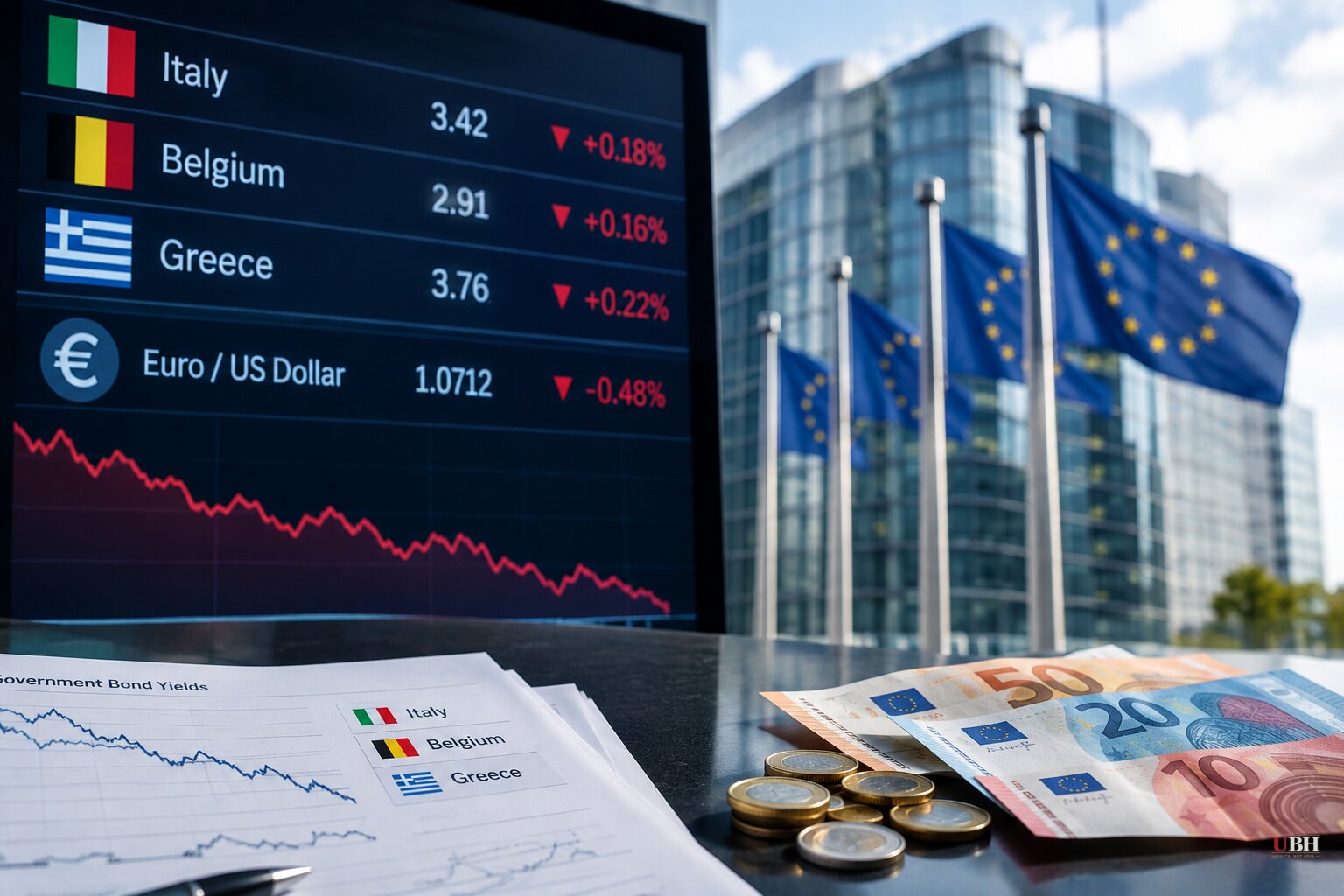
Contagion Is No Longer Just a France Problem
Since the euro sank to a 17-month low Monday against the dollar on France's deficit troubles, the damage has spread beyond Paris. On Thursday, October 1, bonds from Italy, Belgium and Greece tumbled alongside French debt, posting some of their biggest spread moves in years, according to Bloomberg and a report from Europe Says.
Germany was the exception. Investors piled into Bunds as the traditional safe haven, a flight to quality that also gave a lift to recently-battered U.S. Treasuries.
Jeff Mueller, co-head of fixed income at Morgan Stanley Investment Management, put it bluntly: "We are starting to see first signs of contagion. If the erratic price action observed on October 1 continues for some time, this may draw some attention from policymakers."
The Numbers Behind the Panic
The spread between French and German 10-year yields, the market's go-to gauge of investor fear, ended last week at 140 basis points after jumping 34 basis points in a single week. That was its biggest weekly move in 17 years, according to LSEG data cited by Reuters (via KFGO). The gap reached its widest level since 2012, the height of the original eurozone debt crisis, per the Guardian.
France's own numbers explain why. Prime Minister Sébastien Lecornu's government unveiled a €54 billion savings package last month aiming to cut the deficit from 5.5% of GDP this year to 5% next year. Lecornu has warned that without action, the shortfall could balloon to 6.5%. Opposition parties, including Marine Le Pen's National Rally, have made clear the plan faces a fight in a hung parliament ahead of April 2027 elections.
Spain added fuel over the weekend. Prime Minister Pedro Sánchez called a snap election after rightwing parties blocked emergency housing legislation, rattling Madrid's Ibex 35 even as the rest of Europe's equity markets mostly held steady, the Guardian reported.
This isn't an isolated European story. U.S. Treasury yields hit their own multi-decade highs last week, with the 10-year touching 5.26% and the 30-year above 5.6%, levels not seen since 2002, according to Morningstar. Eurozone inflation jumped to 3.8% year-over-year in September, a three-year high, per FXStreet, driven in part by oil prices that have stayed above $100 a barrel despite Middle East crude exports reportedly returning to pre-war levels.
What the ECB Might Actually Do
Traders are now pricing in fewer rate hikes from the European Central Bank, not more. Swaps data show markets expect three ECB hikes by the end of next year, down from four earlier in the week, according to Europe Says. The odds of an October hike have fallen to roughly 20%, FXStreet reported, even as inflation runs hot, because policymakers are wary of tightening into a disorderly bond market.
One option on the table: pausing quantitative tightening, the ECB program that stops reinvesting proceeds from maturing bonds. Jamie Searle, a rates strategist at Citigroup, said that move would effectively shrink the supply of bonds that price-sensitive investors need to absorb.
The bigger instrument is the Transmission Protection Instrument, an unlimited bond-buying tool the ECB created in 2022 specifically to "counter unwarranted, disorderly market dynamics." It has never been used. If Italy, Belgium or Greece keep bleeding alongside France, the TPI becomes the ECB's most direct lever to backstop the bloc, effectively asking German and Dutch taxpayers to help underwrite French political dysfunction.
Not Everyone Is Convinced This Is 2011 Again
The strongest pushback against the contagion narrative comes from Ninghui Liu, head of investment strategy and research for APAC at State Street Investment Management. Liu argues the market has only been reacting for about a week and that France's fiscal troubles remain, for now, a country-specific story rather than a bloc-wide crisis. "Germany definitely will step in, because they are the ones who want to make sure that the EU can still hold," Liu said.
That's a fair read of the current data. Spreads, while sharply wider, are still well below their 2012 peaks, and Friday's session saw long-dated bonds across the bloc recover somewhat, according to both Europe Says and a Briefs report citing the same week's trading.
But the underlying problem Liu's framing doesn't erase is structural. Jefferies' global head of equities strategy, Christopher Wood, argues G7 government bonds broadly, not just France's, have been in a structural bear market since March 2020, ending a 39-year bull run. His case: emerging-market local-currency debt has outperformed G7 bonds by 59% since then, and Jefferies' own sovereign-debt portfolio weighted toward China, India, Singapore and Brazil has beaten the G7 index by 73.5% over the same stretch.
That's a notable signal independent of any single country's budget fight. Western governments, the U.S. included, have spent and borrowed for years on the assumption that cheap money would always be there. The bond market across the developed world is now pricing in the opposite. France's election mess may be the trigger, but the rot, if Wood's thesis holds, runs through Washington, Rome and Tokyo too.
The next test comes Wednesday, when the Federal Reserve releases minutes from its September meeting, a reading investors will scan for any language on how much further the bond turmoil might push the Fed to hold rates, according to FXStreet.
Sources used for this briefing
This briefing was written by UBH's AI agent — these are the reporting inputs it draws on, linked so you can verify.


