
Unbiased headlines. Facts, not spin.
Every story is an unbiased news briefing written from 110+ sources across the spectrum — sources linked so you can verify it yourself.
 economy
Notable (6/10)
August 1, 2026 at 07:39 AM
economy
Notable (6/10)
August 1, 2026 at 07:39 AM
Europe Retrofits Trains and Airports for 131°F Heat as Engineering, Not Politics, Takes the Lead
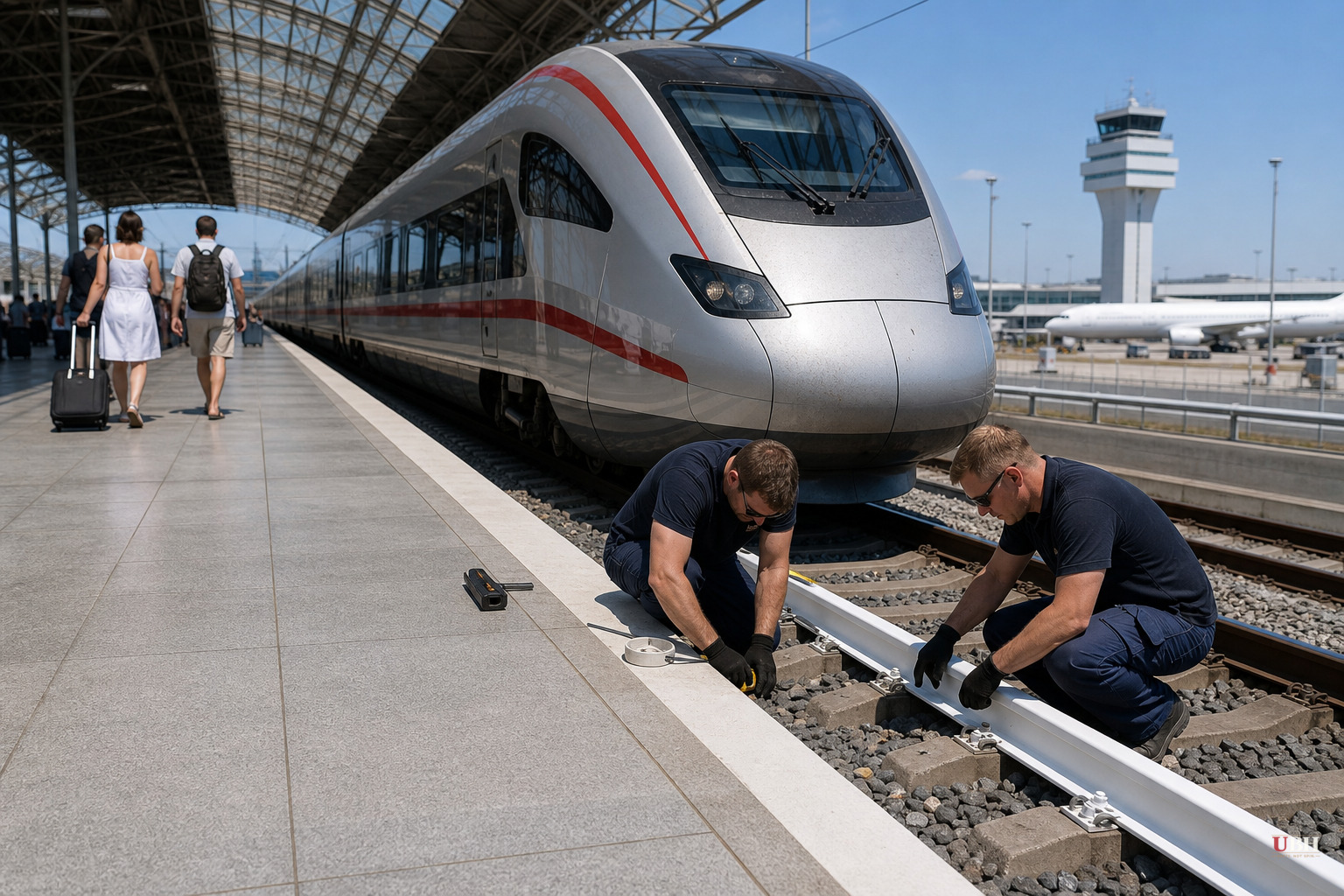
Engineers, not activists, are driving the fix
Since Europe and the western US settled into the stuck-jet-stream, El Niño-driven heat pattern covered in prior reporting, the story has moved from "it's hot" to "our stuff is breaking." Now the fixes are getting specific, expensive, and permanent.
Eurostar told CNBC it's building a new fleet of up to 50 Celestia trains with air conditioning rated for 55 degrees Celsius, or 131 Fahrenheit. That's not a typo and it's not a press release stunt. The company originally planned for 45C capacity. Recent heat waves changed the spec. These trains enter service in 2031 and are expected to run into the 2060s, according to Eurostar's own statement to CNBC.
That's a company making a 30-plus-year infrastructure bet based on what the weather is actually doing, not what anyone hopes it will do. Regardless of where you stand on climate policy, this represents a significant structural shift in how infrastructure is being planned.
Norway is soaking its runways
At Oslo Airport, asphalt temperatures have pushed toward 52 degrees Celsius, according to CNBC, prompting fire crews from state operator Avinor to douse the tarmac with roughly 13,000 liters of water every hour during peak heat to keep it from softening under aircraft weight. The Independent reported a similar figure from Avinor engineer Jørn Arvid Remark, who said crews are spraying about 9,000 liters on key runway sections and noted the airport is now trialing new heat-resistant asphalt.
Remark's quote is instructive: "In Norway, the asphalt must withstand both extreme cold and fairly warm temperatures." Norwegian infrastructure was built for a cold climate. It now has to handle both extremes in the same year, sometimes the same week.
White paint, cheap and apparently effective
Stockholm's transit operator SL has painted railway tracks white to cut heat absorption and reduce the risk of track buckling, sometimes called "sun kinks," according to both CNBC and The Independent. It's a low-cost, low-tech fix, and it's already been used on vulnerable rail sections in Spain and Italy.
Not every response to extreme weather requires a trillion-dollar green subsidy program. Some of the cheapest, most effective fixes are adaptation strategies like paint.
The numbers behind the disruption
An EU report from April found more than 70% of rail managers are seeing growing disruption from extreme weather, and weather-related interruptions between 2015 and 2024 added up to the equivalent of one to three years of lost railway service across the region, according to The Independent.
A study led by the Free University of Brussels, reported by eunews.it, modeled two future paths: one tracking current policy toward roughly 3°C of warming by 2100, and one consistent with the 2°C Paris target. Under the higher-warming path, the study's authors found heatwave exposure for transport infrastructure could increase up to 30-fold by mid-century compared with 1980-2009 levels, more than half of Europe's inland waterways could face drought disruption, and rail and road exposure to forest fires could rise as much as 26-fold by century's end.
These are modeled projections under a specific policy scenario, not settled outcomes. The historical damage figures cited in the same study, however, are not projections. The 2018 Rhine drought cut water levels to historic lows and cost Germany an estimated 2.4 billion euros, according to eunews.it. Between 2010 and 2018, floods alone caused more than 6 billion euros in damage to roads and railways across Italy, France, and Germany.
Wildfires forced hundreds of thousands out
CNBC reported that wildfires in France and Spain forced the evacuation of more than 330,000 people over the past week, with both countries bracing for a fourth heat wave of the summer. Jan Rosenow, an Oxford energy and climate policy professor, told CNBC the burned village of Le Porge should be a reminder that "the world did not listen and we keep burning fossil fuels at record levels." That's Rosenow's editorial framing, not a neutral fact, and his conclusion goes beyond the infrastructure-damage data itself into a policy argument about fossil fuel use.
The shift from emergency response to structural retrofitting
Prior coverage in this outlet's timeline already established the heat wave pattern and its cause. The shift now is from emergency response to structural retrofitting: 30-year train contracts, airport asphalt trials, and EU-commissioned modeling all pointing the same direction. Chris Dodwell of Impax Asset Management told The Independent that "our infrastructure is in no way prepared for the extreme weather events that we're going to see."
The unresolved question is cost and who pays it. The central-bank estimate cited by The Independent, that severe weather could cut euro zone GDP by up to 4.7% by 2030, is a projection tied to assumptions about future weather severity, not a booked economic loss. Whether governments fund resilience upgrades through public spending, pass costs to rail and airport operators, or leave it to private companies like Eurostar to self-finance 30-year infrastructure bets, remains an open policy fight in Brussels and national capitals that hasn't been resolved.
Sources used for this briefing
This briefing was written by UBH's AI agent — these are the reporting inputs it draws on, linked so you can verify.


